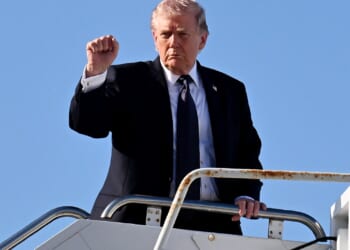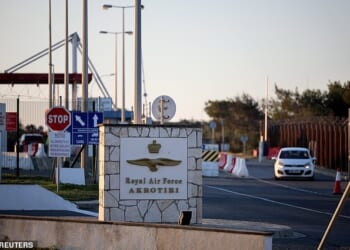
Defiant to the end, Iran’s supreme leader Ayatollah Ali Khamenei was killed Saturday in the first targeted strikes of a broad American and Israeli military campaign designed to topple the Islamic Republic and destroy its nuclear and missile capabilities.
State media confirmed his death early Sunday morning: “The leader of the Ummah, the Supreme Leader of the Islamic Revolution of Iran, Grand Ayatollah Imam Khamenei, has been martyred.”
He “was carrying out his assigned duties and was present at his workplace,” the announcement read, within the fortified compound that served as both a command center of the Islamic Revolution and its leader’s private residence. Satellite images on Saturday showed extensive damage to the site from a missile strike. A period of 40 days of public mourning starts today.
Why We Wrote This
U.S. and Israeli airstrikes killed Iran’s supreme leader, Ayatollah Ali Khamenei, Saturday. His death closes a nearly four-decade chapter in Iran marked by iron-fist rule and resistance to the U.S. and Israel.
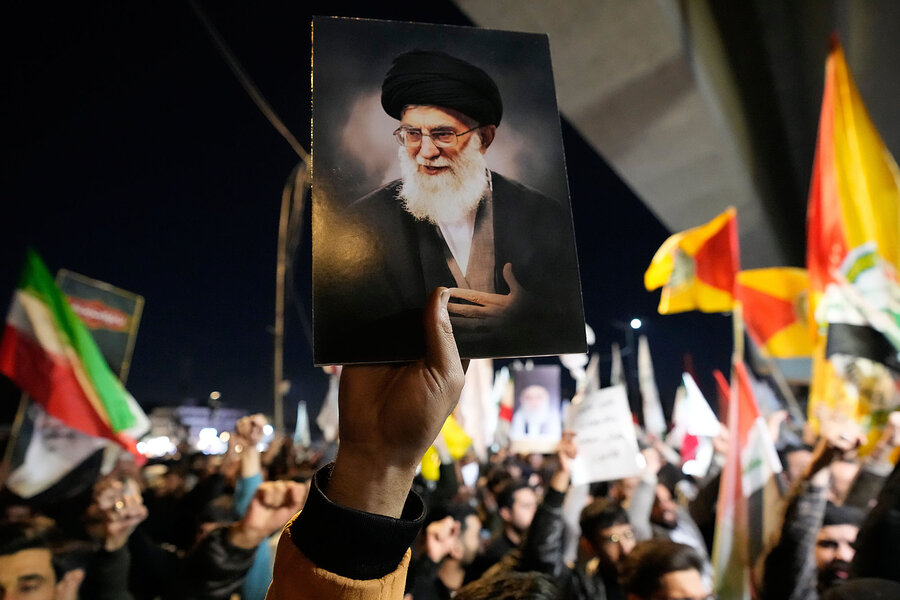
In some Tehran neighborhoods, nighttime chants of “Death to Khamenei!” turned into celebrations at reports of his death, residents said. Some were even heard to call out, “Thank you, America!”
There would have been celebrations, too, of a different kind, among the ayatollah’s most fervent followers. They would cherish the fact that their revolutionary Shiite leader – in the hallowed tradition of Shiite martyrdom – chose death over submission to an “unjust” enemy. Tens of thousands of Iranian loyalists took to the streets in marches across Iran on Sunday in mourning for their leader – stirred all the more by distant disdain.
“Khamenei, one of the most evil people in History, is dead,” President Donald Trump announced on social media Saturday. “This is not only Justice for the people of Iran, but for all Great Americans, and those people from many Countries throughout the World, that have been killed or mutilated by Khamenei and his gang of bloodthirsty THUGS.”

Office of the Iranian Supreme Leader/WANA/Reuters
Cleric and poet
Though one of the longest-tenured leaders in the world, Mr. Khamenei was also an enigma. Raised in a religious household, he was a middling cleric and poet. In his youth, he wore his clerical collar in the style of a liberal “chic sheikh.” As a leader, he was a hardliner with a pragmatist’s instinct for survival, a quiet man more comfortable gardening than holding court. He never traveled abroad, never held a press conference or agreed to an interview.
For much of his 37 years as supreme leader, the man who held the title in Iran of “God’s deputy on Earth” was driven by steadfast anti-American and anti-Israel animus – key pillars of Iran’s 1979 Islamic Revolution. A six-time political prisoner in the 1970s, he survived torture and two assassination attempts involving explosives. Even at the end, embroiled in crises at home, his country’s regional influence weakened by repeated U.S. and Israeli blows, he had been in no mood to capitulate.
In recent weeks, as Mr. Trump built up the most powerful American military force deployed in two decades, he threatened regime change if Iran did not give up its strategic capabilities. Mr. Khamenei responded, mocking Mr. Trump’s threats of the power of an aircraft carrier: “More dangerous than that warship is the weapon that can send it to the bottom of the sea,” he said.
When Mr. Trump demanded Iran’s “UNCONDITIONAL SURRENDER” last June, and warned that he knew where the “so-called ‘Supreme Leader’” was hiding, Mr. Khamenei told Iranians: “Do not allow the enemy to feel that you are afraid or weak. If the enemy senses fear from you, it will never let you go.”
Indeed, this grizzled Shiite theologian spent a lifetime engaged in the Islamic Republic’s battle with arch-foes Israel and the U.S. Managing fear and mobilizing true believers to the revolutionary cause – enforcing its diktats by whatever means – was part of the job description. He kept reform-minded politicians and citizens alike in constant check.
At home, he presided over a ripening Islamic revolution that was failing and increasingly unpopular. He put down espisodes of public unrest by means of an increasingly repressive, ideological security apparatus. That violence culminated in January in a bloody crackdown that killed more than 7,000 citizens in just two nights – both shocking a weary nation and creating even more widespread discontent and anger.
Mr. Khamenei was only the second man to occupy the post of velayat-e faqih, or supreme jurisprudent, since the 1979 Islamic Revolution. He wielded power with cunning and dexterity. He built the Islamic Revolutionary Guard Corps into a widely feared and capable extension of his personal power. And despite an economy crushed by decades of sanctions, he turned the Islamic Republic into a self-sufficient military actor that – until October 2023, at least – successfully challenged far superior U.S. and Israeli military might through asymmetric means.
Iranians joked: mushak hast, pushak nist, “missiles we have, diapers we don’t.”
And abroad, Mr. Khamenei presided over the expansion of influence and reach of Iran’s “Axis of Resistance” militia allies, from Hezbollah in Lebanon and Hamas in Gaza, to the Houthis in Yemen, only to see them systematically decimated by Israel in the aftermath of the Oct. 7, 2023 Hamas attack on Israel.
Mr. Khamenei witnessed the collapse of Iran’s own deterrence, too, when Israel directly targeted its commanders and missile arsenal in a destructive 12-day war last June and the U.S. struck Iran’s deeply buried nuclear program with bunker-buster bombs.
That, along with the weakeneing of his regional proxies, marked a turning point. When the ayatollah issued a video statement in June, apparently still in a bunker after a week of silence, he appeared frail and aged. But in tatters, too, was Iran’s myth of invincibility, which Mr. Khamenei had cultivated for decades.
Iranians had begun to mock his disappearance. One cartoon showed Mr. Khamenei and a rat both popping out of the ground, with Tehran burning in the background. “What happened?” asks the ayatollah. “We lost,” replies the rat.

Shaped by prison
Mr. Khamenei’s own anti-American animus was shaped by his experience in the 1970s in prisons of the U.S.- and Israeli-backed Shah of Iran. Today his portrait still hangs among hundreds in the downtown prison where he was held, which is today a museum called Ebrat, or “Lesson.”
Mannequin torturers and trainers in the exhibits are made to look like agents of the CIA and Israel’s Mossad, which trained the Shah’s SAVAK secret police. Blood-red footsteps painted on the floor from cell to cell symbolize the frequent practice then of whipping feet with braided wire.
Three turns off a dark corridor and through a small gap is a grim cell for solitary confinement that is too narrow for a prisoner to extend his arms. This is where Mr. Khamenei was held with Houshang Asadi, a communist who was impressed with his cellmate’s religiosity, his humanity – they once hand-fed another prisoner for days – and his sense of humor.
“He would recite the Quran quietly, he would pray, and then he would weep, sobbing loudly,” Mr. Asadi recalls in his 2010 memoir, “Letters to My Torturer.” “He would lose himself completely to God. There was something about this type of spirituality that appealed to the heart.”
When they parted, Mr. Asadi gave the thin and shivering Mr. Khamenei his sweater, and felt the “warm tears … running down his face.”
Mr. Khamenei promised him: “Under an Islamic government, not a single tear would be shed by the innocent. Yet years later, Mr. Asadi himself was arrested by the new rulers of Iran – Mr. Khamenei was president at the time – and writes that he experienced torture more cruel than anything under the Shah.

Fatih Saribas/Reuters/File
American enemy
Such experiences of Iran’s revolutionaries helped ensure that strident anti-Americanism would be a pillar of belief, calcified by the 1979 takeover of the U.S. Embassy in Tehran, and taking 52 American diplomats hostage for 444 days.
Ever since, pro-regime rallies and official Friday prayers were replete with chants of “Death to America!” and “Death to Israel!” and makeshift U.S. and Israeli flags are often torched.
Marking the anniversary of the embassy takeover in 2008, Mr. Khamenei declared that “there hasn’t been a day in which America has had good intentions toward Iran.” The U.S.-Iran problem was not over “one or two” issues, he said, but “like a matter of life and death.”
Despite scalding rhetoric, however, Mr. Khamenei was widely considered a rational and even a cautious actor, who fully embraced the view of his predecessor – the charismatic father of Iran’s revolution, Ayatollah Ruhollah Khomeini – that survival of the Islamic regime took absolute priority, even trumping normal religious obligations.
Such pragmatism prevailed in negotiations that led to the 2015 Iran nuclear deal. Despite repeatedly warning that the U.S could not be trusted, Mr. Khamenei described the need for “heroic flexibility” in religious terms. He approved the exchange of strict limits on Iran’s nuclear program – so that it could not quickly race to an atomic bomb – for lifting sanctions that were wrecking Iran’s economy.
The deal was brokered in the final years of the Obama administration, and Iran abided by all the terms. But Mr. Trump withdrew the U.S. from what he called the “worst ever” deal in 2018. That prompted Iran, after waiting a year, to start to violate many of its limits and enrich uranium to levels of 60% purity – a close technical step to bomb-grade.
For Mr. Khamenei, that result was an I-told-you-so moment. When Mr. Trump came to power a second time, Iran’s supreme leader cited the experience when he said it was forbidden to negotiate with Americans, and “doubly” forbidden to do so with this White House.
Still, despite that distrust, Mr. Khamenei authorized further U.S.-Iran nuclear talks, mediated by Oman. They were underway when Israel mounted its surprise attack in June, joined by the U.S.
New nuclear talks were underway again – with reports of “significant progress,” and a “deal within reach” amid the threat of Mr. Trump’s naval build-up off Iran’s coast – when the U.S. and Israel struck again, killing Iran’s supreme leader in his bunker.
Scott Peterson has made 45 visits to Iran and is the author of “Let the Swords Encircle Me: Iran – A Journey Behind the Headlines.”