For generations, Lynda Ben-Menashe’s family, like that of many other Australian Jews, found a warm and welcoming refuge in the southern continent, half a world removed from the turmoil and horrors they witnessed in Europe and elsewhere.
In the case of Ms. Ben-Menashe, president of the National Council of Jewish Women of Australia, she is fifth-generation Australian on her mother’s side, from a family who fled the pogroms of Eastern Europe.
“It was my experience as an Australian Jew to grow up in a country where Jews were deeply integrated into the fabric of building society here,” she says.
Why We Wrote This
The Bondi Beach massacre has shattered the sense of security held by Australian Jews, generations of whom found a warm haven far from the horrors of Europe. Some now hope Australians see that antisemitism is not just a Jewish problem.
Among her own family have been judges, university officials, and social justice activists, part of a larger community of 120,000 that is well-represented in Australian business, medicine, arts, and philanthropy.
Yet the community’s sense of security, now shattered by the deadly Bondi Beach Hanukkah attack on Sunday, had already shifted dramatically since October 2023.
Just two days after Hamas’ deadly Oct. 7 rampage in southern Israel, a pro-Palestinian protest was held at the iconic Sydney Opera House. Those gathered chanted anti-Israel slogans along with obscenities against the Jewish people.
The country’s Jewish community felt betrayed when no arrests were made or consequences felt. It seemed, community members say, like a wake-up call that something fundamental had changed.
“It was a turning point, and this is a turning point again,” Ms. Ben-Menashe says. “Australians thought we Jews were exaggerating … and, now, I reckon they get that we were not.”

Indeed, as the Israel-Hamas war raged in Gaza, an unprecedented wave of antisemitic attacks followed in Australia: the torching of synagogues, attacks against Jewish-owned businesses and schools, and a mass doxxing of Jewish artists. Anti-Israel graffiti, including “Glory to Hamas,” began to appear.
Leaders of the community, which includes one of the largest populations of Holocaust survivors and their descendants in the world, beseeched the government to take stronger action.
A tragedy foretold
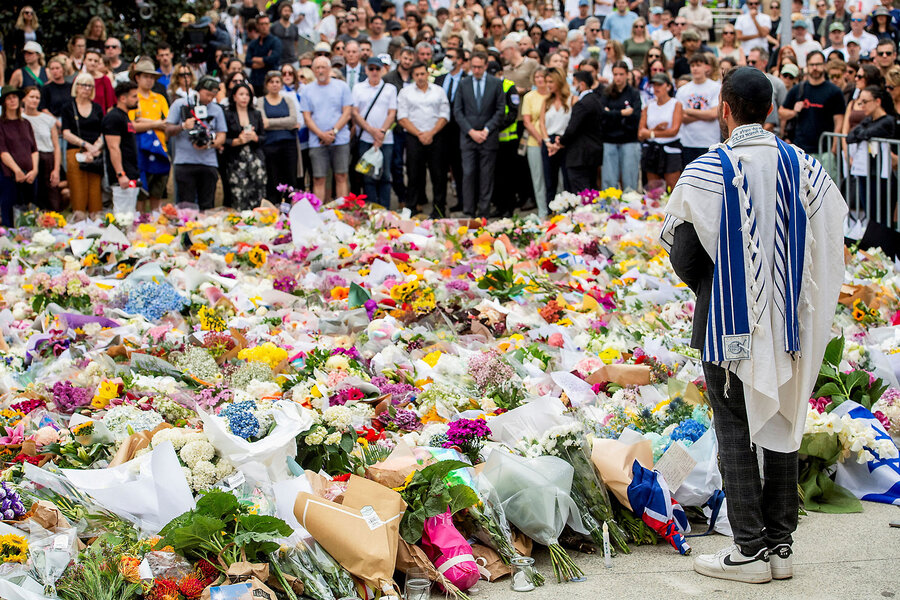
Today, following the killing of 15 people by two gunmen on Sunday, the deadliest antisemitic attack in Australia’s history, the community’s mood is one of anger and betrayal, of a tragedy foretold. The Hanukkah celebration overlooking Sydney’s iconic Bondi Beach was secured by just two police officers.
Even as murder charges are brought against the surviving gunman – the younger of a father-and-son duo who officials say were radicalized by the Islamic State – and Australia announces more restrictive gun laws, Jews are wrestling with what is next for them as a community.
“People feel like they have not been heard, that no one has taken the time to listen [to our concerns], and instead we have been silenced, shut down,” says Sharon Berger, events and partnership manager at The Jewish Independent, an Australian Jewish newspaper. “There is a lot of anger.”
“Instead of listening to our pain, people came to the conclusion it’s okay to vilify Jews,” says Ms. Berger, who lives near Bondi Beach, and swims there most mornings. The tearing down of posters of Israelis taken hostage by Hamas in public places – something that happened in other parts of the world as well – was another example, she says, of “mainstreaming of the idea that ‘We don’t have space for you and your story.’”
She and others in the Jewish community describe a slippery slope in which the delegitimizing of Israelis paves the way for delegitimizing Jews. From there, a mass shooting of Jews goes from unimaginable, she argues, to “not unfathomable.”

Among the 15 killed last weekend was a Holocaust survivor and a 10-year-old girl, Matilda Poltavchenko, whose Ukrainian Jewish family fled to Australia looking for refuge from the war there.
“We came from Ukraine, and brought my oldest son here, and were so happy he’s not fighting and safe here,” Valentyna Poltavchenko, Matilda’s mother, said through tears at a news conference. “I could not imagine I would lose my daughter here. It’s just a nightmare.”
“Take this terrible tragedy and use it”
Jillian Segal, a special envoy to combat antisemitism appointed by the government in July 2024, says she saw a “progression” of antisemitism and violent rhetoric in pro-Palestinian marches and protests, such as “Globalize the Intifada,” ahead of the Bondi Beach attack.
In an interview with Sky News, Ms. Segal said government calls for unity in response to the massacre were inadequate, saying Australia should “take this terrible tragedy and use it.”
“Let us deal with the underlying cause,” she said. “It’s not just about saying ‘Let’s come together.’ We have to rid our country of this ancient hatred. It’s become a scourge. … We need to deal with it in schools, in immigration, in the arts.”
She also implored Australians to “please embrace the Jewish community. They need you, they are part of the community.”
Though antisemitism has always existed in Australia, it was considered to be on a much lower flame before Hamas’ Oct. 7, 2023, attack. The country also has a legacy of racism, especially toward Aboriginal people and South Pacific Islanders.
In recent decades especially, Australians have prided themselves on living in a multicultural country where people of different backgrounds are respected and fairness is highlighted as a virtue. That context, Jewish community members say, makes their increasingly undermined sense of security feel even more acute.
They cite antisemitism on the far right, visible at a recent neo-Nazi rally, and within some elements of the progressive left.
Soon after Oct. 7, Jenny Leong, an Australian lawmaker from the left-wing Greens party, said “the tentacles” of the “Jewish lobby and the Zionist lobby” were “infiltrating into every single aspect of … ethnic community groups.”

Michael Currie/SOPA Images/Sipa USA/AP/File
For Nechama Shemtov, a Chabad community leader based in Washington, D.C., who grew up in Bondi Beach, Sunday’s attack was personal. She has family members and friends who were there, including one relative who was badly wounded.
Australian Jews have deep ties to Israel, she notes. “We are loyal Australians, and we deeply love that country, and at the same time, we also have an ancestral homeland we are connected to. Both can hold space in our hearts,” she says.
“Glimmer of hope”
“We have to speak out against those who have done us harm. We have to deal with that. But at the same time, we have to appreciate those who stand up and help us,” she says, referring to Ahmed al-Ahmed, the Syrian-born Australian father who tackled and disarmed one of the shooters. “It gives me a glimmer of hope.”
More than $1 million have been raised for Mr. Ahmed, who is in hospital recovering from gunshot wounds. Australian Prime Minister Anthony Albanese, who visited him Tuesday, said Mr. Ahmed “shines out as an example of the strength of humanity” and “represents the best of our country.”
Ms. Shemtov describes the minimal police presence and what she alleges was a slow reaction to the Sydney shooting as “a failure of epic proportions.” The government rejects criticism of its response.
“Do not be afraid,” which she says is the most repeated expression in the Bible, is the message Australian Jews should nevertheless keep front of mind as they move forward from the attack.
She notes, too, that as the Jewish community continues to hold candle-lighting events for Hanukkah, the holiday’s story is a reminder that even after hardship, “the lights will always shine strong.”
“We can be rattled in the moment, but ultimately not be afraid,” she says. “We will not just overcome, but thrive.”
Ms. Ben-Menashe says she hopes the shooting leads to a genuine shift in the country’s understanding that antisemitism is not just a Jewish problem: “Mainstream Australia has woken up and understands that if you can get shot at Bondi Beach, this hate that has been enabled and not punished is a threat to all Australians as well.”