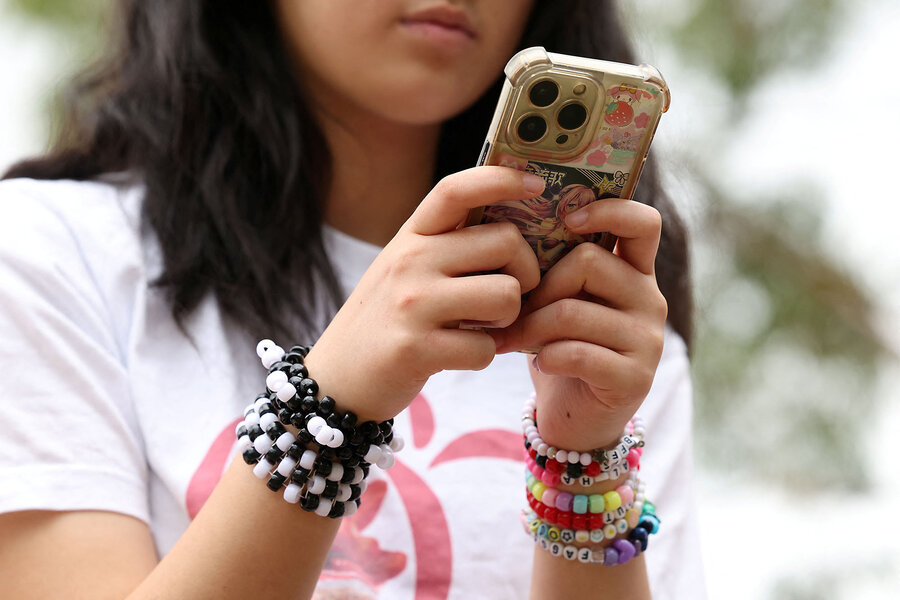
On Wednesday, Australia is banning social media for children and young teens. That means no TikTok, Instagram, Reddit, or Snapchat for anyone under 16. It’s the first law of its type in the world. Other countries are looking to follow Australia’s example.
The landmark legislation stems from a book. Jonathan Haidt’s “The Anxious Generation” blames smartphones for a spike in teen mental health issues. The New York psychologist’s 2024 treatise, which has sold 2 million copies, persuaded an influential Australian politician to take action. Now, the Southern continent will fine social media companies that allow access to under-age users.
Mr. Haidt calls the legislation “a game-changer.” Malaysia recently announced it will follow suit. Denmark is looking to restrict social platforms until age 15. Last month, the European parliament voted in favor of a nonbinding resolution for a minimum age for social media. Its president, Ursula von der Leyen, said she will monitor Australia’s experiment.
Why We Wrote This
The country’s landmark legislation is part of a worldwide cultural shift that now sees smartphones as akin to driving and alcohol – for older teens and adults only. While supporters hope other countries follow Australia’s lead, critics say legislative bans will be ineffective, create unintended consequences, and infringe on civil liberties.
Yet, amid the groundswell, there are differing opinions about how best to address social media use for adolescents. Some believe it should be a parental issue, not a governmental one. They worry that legislative bans will be ineffective, create unintended consequences, and infringe on civil liberties. Others question whether Mr. Haidt is fostering a moral panic.
“We are very supportive of this new law that is coming into effect this week – providing parents with the air coverage we need to say ‘no,’” says Amy Friedlander of the Australian group Wait Mate, which advocates delayed smartphone use for teens.

Regardless, there’s little doubt that a global movement of concerned parents is generating conversations not just in parliaments, but also at school meetings, dinner tables, and BBQs. Viewed collectively, some see a cultural shift. One comparable, perhaps, to earlier moves to restrict teen access to tobacco, alcohol, and gambling.
“There’s definitely now more support of higher age restrictions for social media usage, with research showing that the majority of people in most regions now believe that social media should be more heavily regulated,” says Andrew Hutchinson, an Australian who is head of content at tech industry news site Social Media Today.
The law, known as the Online Safety Amendment, dictates that platforms “take reasonable steps” to enforce the age limit. What, exactly, that entails isn’t defined. But companies could face fines up to A$49 million (U.S. $32 million). Some platforms will rely on AI-backed facial recognition to determine users’ ages. Others may require that users provide identity documents, including passports, birth certificates, or bank accounts. Meta has deactivated hundreds of thousands of accounts on Instagram and Facebook. (Turns out some kids do actually use Facebook. Who knew?) Some social media platforms, such as YouTube, will still be accessible for those under 16 but without the ability to log into an account.
Social Media Today’s Mr. Hutchinson says that his two teenagers are confident that their cohort will figure out workarounds – perhaps virtual private networks connected to another country – to remain on social media. Some platforms including 4Chan, Discord, Bluesky, and the online gaming medium Roblox, are exempt from the ban. For now, at least. The Australian government’s efforts to stay abreast of the migrations could be like playing a game of whack-a-marsupial. Indeed, many antipodean teens are joining Yope, a new photo-sharing app geared toward Gen Z.
“If they’re hopping on other platforms and they get into trouble because it’s still social media and they’re not telling anyone they’re using it, then what happens? They have no one to go to and these are more unregulated platforms,” says Dr. Joanne Orlando, author of “Generation Connected.”

Courtesy of Joanne Orlando
The legislation is also being challenged in court by two 15-year-olds. The lawsuit is being backed by Digital Freedom Project, an internet rights group. They worry that the legislation could be a back-door form of government censorship.
“Of course there are social harms on social media,” says John Ruddick, president of Digital Freedom Project and also a Libertarian member of the New South Wales Parliament. “But we say that this should not be outsourced to bureaucrats. This should be a paramount parental responsibility.”
“I wanted a different future”
By contrast, the Australian advocacy group Wait Mate doesn’t see it as either a parenting or government issue. It needs a “whole-society” approach to turn things around quickly, says Ms. Friedlander via email.
The group promotes an online pledge to delay smartphones as a form of collective action. It’s much harder to withhold smartphones from individual children if all their peers have one.
“Seeing kids head-down at the bus stop, the minute they walk out the school gates, crossing the road, waiting in line – never looking up, it totally depressed me,” says Ms. Friedlander, who lives in Sydney and has three daughters. “The inability of teens around me to be present or connect was worrying. I wanted a different future for my own kids.”
Wait Mate was inspired by a similar pledge in the U.S. called Wait Until 8th.

“Parents were waiting for something like this: a simple and collective way to push back against a cultural current that felt too strong to face alone,” says Brooke Shannon, the Austin, Texas-based founder of Wait Until 8th. Writing via email, she calls Australia’s social media restrictions “a bold and encouraging step.”
Like its American counterpart, Wait Mate has seen a surge of interest since Mr. Haidt’s book went viral. The pledge now has 14,000 signatures.
In the U.S., 35 states have now either fully prohibited or restricted cellphone use in schools. That’s a monumental shift. Just two years ago, Florida became the first state to issue a ban. Educators in other nations are taking similar steps.
Cycling rather than scrolling
When Australian teacher Jimmy Kakanis read “The Anxious Generation,” he turned the school’s leadership team on to Mr. Haidt’s ideas. First, the high school in the town of Murwillumbah banned phone use for students. Then Mr. Kakanis started fixing up old bicycles for the playground. Mr. Haidt’s book advocates encouraging kids to spend more time congregating face-to-face rather than screen-to-screen. Preferably outdoors.
It’s also important, Mr. Haidt explains, for overscheduled kids to have times of boredom. And to allow children more freedom to take risks – within limits – so that they become more resilient and responsible. Often, they’ll fill that vacuum by discovering hitherto unexplored talents and interests. Like taking up cycling instead of scrolling. Mr. Kakanis’s students spontaneously built dirt bumps for airborne jumps. He started connecting with boys who’d been recalcitrant in classroom settings.

Evan Agostini/Invision/AP
“It’s been awesome to see those guys just going with it … fixing bikes, grease on their hands, figuring it out,” says the teacher. “I’m hands off. I’m just letting them do their thing.”
Mr. Kakanis can attest to the deleterious effects of smartphone over-dependency. One 13-year-old admitted to spending as many as 22 hours online on a Saturday. She was constantly getting into fights via her phone. That would then carry over into school.
In Lexington, Massachusetts, a parent in a social-media delay group called “Lex Kids Be Kids,” asked her school system to share its Youth Risk Behavior Survey. It includes questions about mental health and social media habits.
“I was able to get [the town schools] to conduct cross tabs on the results to show the effect of increased time of social media use on mental health and other factors (i.e., physical activity and sleep) in order to show the negative impacts social media is having on our own Lexington youth,” says Wendi Hoffer, a parent of three, via email.
“The Anxious Generation” offered the structure and backing for how “Lex Kids Be Kids” could move forward, Ms. Hoffer says.
Mr. Haidt’s book isn’t without its critics. Some psychologists say that it’s a mistake to claim a direct causal relationship between the adoption rates of cellphones and mental health issues. Those academics believe there are manifold reasons for anxiety and depression beyond just social media. Plus, they say, the scary anecdotal stories that the book recounts are outliers rather than the norm. The most vulnerable young people online are also the most vulnerable young people offline.
Will Aussie teens head back to the mall?
According to one Australian digital media expert, teen voices were largely missing during government debates about the ban.
“Young people really feel that their experiences have been homogenized by adults in the national conversation,” says Kim Osman, a senior research associate at the Digital Media Research Centre at the Queensland University of Technology. “There hasn’t been an acknowledgement of how different their experiences are.”
Ms. Osman helped lead a team that interviewed 86 teens across Australia about the roles that social media plays in their lives. The nonrepresentational sample yielded a variety of responses. Many of the 12- to 15-year-old interviewees lamented that the benefits of social media – including pursuing interests such as cooking or learning to tie fishing knots – have sometimes been overlooked in the calls for blanket bans.
“They love being able to express themselves creatively,” says Ms. Osman. “For a lot of young people, that’s where their community is.”
Nonetheless, an overwhelming number of the respondents said they welcomed more rules. They recognized the potential risks and harms of the platforms.
That’s where parents can play a powerful role, says Amanda Third, research fellow in digital social and cultural research at Western Sydney University. She says parents need to be more tech literate. And moms and dads should model good technology practices themselves.
“Children translate their moral frameworks across online and offline spaces,” says Ms. Third, who is also a children and families expert adviser to YouTube. “It’s not that they go into some kind of weird moral vacuum when they go online.”
Ms. Third adds that technology does present challenges that may need to be regulated. But she wishes that Australia had taken an alternative approach. Rather than a blanket ban, she favors pressuring technology companies to design better solutions around child protection online.
Mr. Hutchinson of Social Media Today is also critical of Australia’s approach. It’s more of a public relations move than substantive policy, he says. He calls it a bid to align with parental concerns.
“I suspect that other nations will be watching on to see what happens,” says Mr. Hutchinson, writing via email from his home in Canberra, Australia. “They’ll eventually see, via this test case, that education, and a collaborative approach to oversight, is more effective than blanket restrictions.”