With his sturdy legs, long ears, warm dark eyes, chestnut coat, and black nose, Moose is kind of a big deal around the stables at Colonial Williamsburg. He’s a handsome fellow, and he knows it.
His handler, Taylor Nixon, unclips Moose from his stable and leads him out into a passageway to meet some visitors. But then, unaccountably, Ms. Nixon attempts to lead him back into his enclosure, without first taking him out into the pasture for a nice stroll.
Moose protests. He snorts. He stomps. He locks his knees and refuses to move. Unless, of course, Ms. Nixon has some healthy horse snacks. (Spoiler alert: She does.)
Why We Wrote This
Between the 1500s and the 1800s, breeders developed specialized livestock breeds for different purposes. During this time of specialization, a host of breeds dwindled. The Rare Breeds program at Colonial Williamsburg is aimed at preserving breeds that have fallen out of favor.
“He’s such a brat,” says Ms. Nixon, lead groom for Cleveland Bays in Colonial Williamsburg’s Rare Breeds program, which preserves older breeds that have fallen out of favor. “But he’s my brat.”

Melanie Stetson Freeman/Staff
With his powerful build and long stride, Moose is exactly the kind of horse that one would find on any sensible 18th-century farm or estate. From Massachusetts to Georgia and inland toward what was then the wild Appalachian frontier, Cleveland Bays were America’s first pickup trucks, good for riding, for plowing, or for pulling carriages.
Launched in 1986, the Rare Breeds program promotes the preservation of livestock that research shows would have been prevalent in Britain’s Colonies in 18th-century America, says Darin Durham, Colonial Williamsburg’s manager of animal husbandry.
Between the 1500s, when horses like Cleveland Bays were first documented, and the 1800s, breeders developed specialized breeds for different purposes – lean thoroughbreds for racing, burly draft horses for plowing or pulling heavy loads, quarter horses for cattle ranching. During this time of specialization, Cleveland Bays and a host of other livestock breeds dwindled. By 1961, there were only about a dozen purebred Cleveland Bays left, prompting Britain’s Queen Elizabeth II to launch a breeding program to save the historic horse.
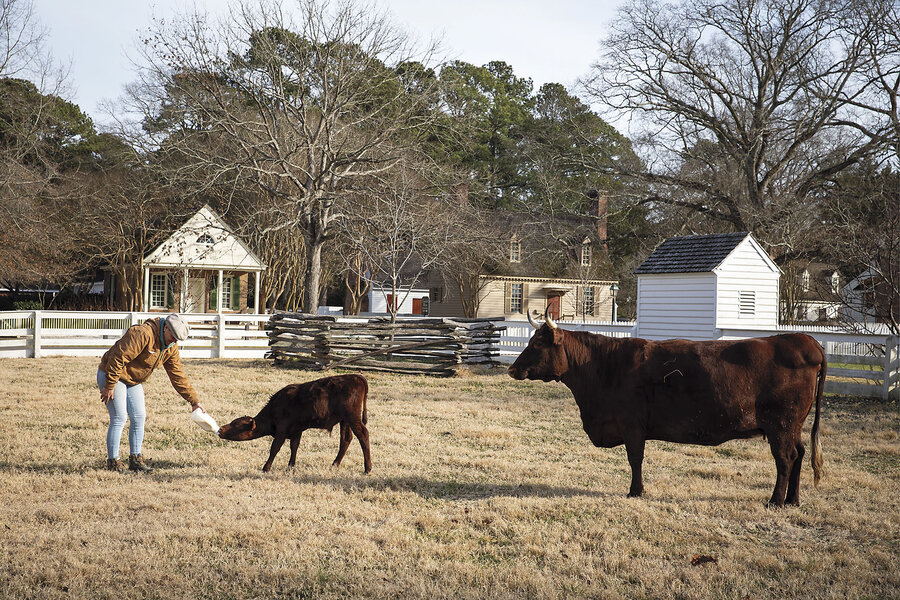
Today, the numbers of Cleveland Bays have stabilized – around 220 in North America and 1,000 worldwide – thanks to the efforts of organizations such as Colonial Williamsburg. In addition to 15 Cleveland Bays it has acquired or bred since the horse breeding program began in 2019, Colonial Williamsburg has 36 rare Leicester Longwool sheep, 16 American Milking Red Devon cattle and Durham Oxen, and dozens of rare chicken breeds such as Nankin Bantams and White-Faced Black Spanish chickens.
Like Cleveland Bays, Leicester Longwool sheep fell out of favor because of the specialization in other breeds. Leicester Longwools produce wool, but the wool is of only moderate quality, and the wool on their bellies and legs gets so matted that it must be thrown away after the spring shearing season. Modern sheep breeds often don’t have leg and belly wool, and are therefore more popular.
But don’t tell that to Ozzy. He’s a handsome Leicester Longwool who came to Colonial Williamsburg from the Australian island of Tasmania. He has been placed in a pen with a pregnant, shaggy-faced, and frankly nervous ewe named 21-91.
“He just has this calming effect on other sheep,” says Anna Rinehart, who watches over the Leicester Longwools.
Ozzy nuzzles 21-91.
“Just look at him. So calm.”

Melanie Stetson Freeman/Staff

Melanie Stetson Freeman/Staff

Melanie Stetson Freeman/Staff

Melanie Stetson Freeman/Staff

Melanie Stetson Freeman/Staff