
This article is taken from the March 2026 issue of The Critic. To get the full magazine why not subscribe? Get five issues for just £25.
British universities face unprecedented financial strain. According to a report from the Office for Students in November last year, 45 per cent of higher education providers would have losses in the 2025/26 year unless they took early offsetting action. The report found that universities were forecasting “a third consecutive year” of deteriorating financial performance. Whilst an inflation-matching increase in UK student fees has been agreed by the government and will soon take effect, revenue from overseas students — which boomed in the first two decades of the 21st century — has started to weaken.
The universities’ critics might say they were cosseted by too much government money in the late 20th century. If they are currently inconvenienced by the need to adjust to supply and demand, they are — like other organisations — in a market economy and must stop their losses. If not, they must be either closed or sold, and that is that.
But here is the rub. Not only does the new austerity imply a drastic change in the academic mindset, it also challenges unique institutional features of the British university sector.
In the past, virtually all British universities had the legal status of independent charities. Charities can of course generate revenues like profit-seeking businesses. However, much of their income has traditionally come in the form of grants and donations, or from endowments arising from gifts made possibly decades or centuries ago. Crucially, charities are not owned by anyone. They have stakeholders, but no shareholders.
A typical UK university is rich in assets, owning buildings and land worth far more than stated in its accounts. By pledging these assets as collateral for bank loans, it may for several years be able to combine recurring losses with its continued survival. But — to repeat — an inescapable fact of life is that losses cannot go on forever. Sooner or later, the banks will say, “No more, we cannot further increase our loans to you.” When a university is in these dire straits, or perhaps sometime earlier, it may have to consider sale to a third party, including possibly sale to a for-profit educational company.
A for-profit company has shareholders. We come to a conundrum. A university may have positive net assets with a market value; it may also, despite being loss-making overall, have highly profitable departments, also with market value. But — as it has no owners — the concept of its “sale” to a for-profit education company could be construed as logically incoherent.
At the least, the concept of a sale is anomalous, and needs to be challenged conceptually and perhaps legally. A figure — which might run into the tens of millions of pounds — could be the supposed “acquisition cost” which the company agrees to pay for the university. But to whom exactly are the tens of millions paid?
Obviously, they will be credited to a bank account. The money in the account may indeed be the only economic embodiment of the continuing charity. But who has control of that bank account, and for what functions and to which beneficiaries are the tens of millions to be directed?
Like the trustees of the original charity, well-intentioned outsiders might insist that the tens of millions can be easily restricted to use for charitable purposes. But would such purposes include covering the fees of students attending the university which has just been sold? If so, the money would end up in the hands of the for-profit company. The charity’s assets would then not have been “sold” in any meaningful sense, but misappropriated. Indeed, cynics might use the stronger word “theft”. No doubt the student fees in question could be dressed up as bursaries or scholarships or some other label, but that would not change the substance of the matter.

There is no need to exaggerate. To describe a possible process of misappropriation is not to suggest that it is inevitable in all cases. So far only two examples of the sale of a higher education institution to a profit-seeking company have been seen in the UK: the College of Law to Montagu Private Equity in 2012 and of Regent’s University to Galileo Global Education in 2021. The first was at a price of £200 million, with this sum being used to create and fund the Legal Education Foundation. The foundation is now an established and independent charity which undoubtedly does promote the greater availability of legal education.
But concern has been raised by the sale last year of City & Guilds’s training and qualifications arm to a Greek company, PeopleCert, for £166 million. Although not a university, City & Guilds — inclusive of that arm — was a British educational charity founded by the City of London livery companies in 1878. It received a Royal Charter in 1900. The £166 million will make possible (what is effectively) a new charity to finance further education, perhaps mostly in the UK.
Although neither eventuality has been enacted, the Guardian reported that a presentation to PeopleCert’s investors suggested savings at City & Guilds could be made by reducing staff numbers and moving some operations to Greece. The two senior executives who negotiated the sale to PeopleCert remained in place until very recently and have received substantial bonuses. The Charity Commission has opened a statutory inquiry into the City & Guilds transaction. Following these developments the two executives were put on leave on 16 January.
One of the UK’s leading authorities on charity law is Mary Synge, who has combined an academic career with the practice of law in a commercial environment. She is the author of a 2023 book The University-Charity: Challenging Perceptions in Higher Education. In her view, “it is time to speak up.”
Amongst other things, the book reviews the two university-related transactions in the context of the sector’s intensifying financial troubles. Whilst careful not to leap to judgement, Synge is anxious both that many more deals of this sort are in prospect and that the charitable principle may cease to apply in much of the university sector. The risk of asset misappropriation can be overstated, but it cannot be denied. She remarks that transactions may be structured so inappropriately as to leave observers “outraged”.

Last year the University of Buckingham received much unfavourable attention in the media. It was conceived in 1973, admitted its first students in 1976 and gained a Royal Charter and full degree-awarding university status in 1983. Uniquely, it has from the start avoided taking government money in order to better avoid intrusive official regulation and maintain intellectual freedom. Although it has had its ups and downs in its almost 50 years of existence, in the mid-2010s it was unquestionably a success. In particular, it ranked highly for the excellence of its student experience.
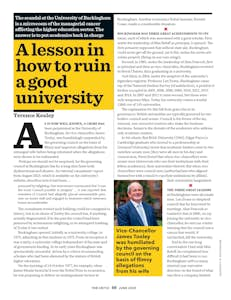
Since then almost everything has gone wrong. Sir Anthony Seldon, the vice-chancellor from 2015 to 2020, took misguided decisions to expand the university which resulted in vast losses. His predecessor, Terence Kealey, assessed Seldon’s period as “a catastrophe”, both financially and academically.
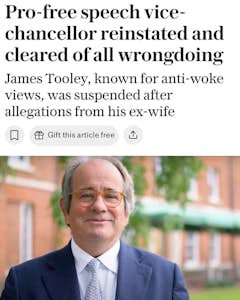
Seldon was followed by James Tooley who fell out with the council, composed largely of local businesspeople, which is the University’s ultimate governing body. Tooley was suspended by the Council because of allegations made by his estranged wife, which were later shown to be malicious, false and silly. Although Tooley was eventually reinstated, the episode not only disrupted the university’s administration, but was also a disaster for its reputation.
Last year in The Critic [“How to ruin a university”, June 2025] Kealey lambasted the role of non-academic councils in the governance of British universities. As council members are mostly unpaid, it is not easy to attract good quality candidates. Moreover, if they are recruited from the local business community, they tend to be ignorant of academic life. Sadly, they may join a university council with no higher motive than to spite people cleverer than themselves.
Kealey mentioned Sir Nigel Mobbs, the chairman of the University of Buckingham’s council between 1987 and 1998, who “would openly deride academics as ‘jumped-up school teachers’”. In his article Kealey presented a convincing argument that the highest authority in universities should be a senate comprised of academic staff, a model found — for instance — in England’s ancient and still world-class Oxbridge.
Anyhow, in the University of Buckingham’s case, the council remains in charge. For a body which has the fate of a university in its hands, it is remarkably opaque about its goals and intentions. All the same, it is reported to have appointed BDO, the accountancy and business advisory firm, to initiate a sale process.
The sale process might in theory involve an approach to another university with charitable status, resulting in a merger inside the charity sector. But the more plausible outcome is that BDO tries to find a bidder who, above all, wants to convert the University of Buckingham into a profit-making business.
How will key stakeholders react? Vital would be the perspective of past donors. It can be safely assumed that they gave money in the belief that the legal status of the University of Buckingham would continue unchanged indefinitely. In other words, they took it for granted that they were giving money to a charity.
In its early years, donations enabled the purchase of much of the buildings and property which constitute the campus. If the University of Buckingham were sold to a for-profit organisation, this would disrespect donors’ motives as well as devalue their philanthropy. Would some of them object so strongly to the change in status that they would seek legal review or even financial redress, with the aim being the recovery of donations plus interest?
Moreover, can it be overlooked that His Majesty’s Revenue and Customs is amongst the stakeholders? Over the years HMRC has paid enormous rebates to the University of Buckingham and its donors — as indeed to all universities and their donors — only on the basis that they are charities which qualify for this exceptional treatment. Might HMRC — with the government behind it — ask for its money back?
A related major issue for public policy cannot be escaped. Suppose it were accepted that the wishes and hopes of past donors can be overlooked in transactions which change universities’ status from charities to businesses. How would that affect the attitudes of potential donors in years yet to come?
Plainly, if these donors had always understood that their gifts were to charities and could not be appropriated (or even stolen) by the shareholders of private firms, the newly-revealed risk of such appropriation might deter their donations altogether. The dangers — the possible “outrage”, to recall Synge’s word — must be highlighted.
Further, this is not just a parochial matter solely of interest to the University of Buckingham and its well-wishers. Concerns would arise for all future donations to all British universities. The flow of such donations might be badly hit by the new uncertainties. Who would be so foolish as to hand over money to entities of ambiguous and changeable legal status where the ultimate beneficiaries would not be charities, but self-serving and perhaps greedy businesspeople?
The uncertainties about their continued independent existence and charitable position are greatest for the financially weakest universities, since these are those most likely to be “sold off” in (what may become) a marketplace in universities. The universities most in need of financial support would also be those hit hardest by the dwindling number of possible donors.
❃
None of the above is to be understood as denying the validity of the profit motive in higher and further education. The validity of that motive in vocational training, and even in such fields as language instruction, secretarial courses and engineering apprenticeship, is surely beyond question. Well-taught translators, secretaries and engineers have skills which are valuable both to themselves and society, but the inculcation of those skills takes up resources. How large should these resources be?
The success of the market economy stems from its insistence that resources are devoted to an activity only if it can attract revenue from freely motivated private sector customers. If some so-called “universities” provide degrees which have known value in the jobs market, if they can survive the discipline of market forces, and if they can deliver a good rate of return to investors, the right comment must be “best of luck”.
In fact, league tables are prepared for business schools, with rankings determined by the salaries achieved by alumni in their first year or three years after graduation as Masters of Business Administration. Unsurprisingly, the business schools with the highest-earning MBAs can also charge more for their instruction.
But can the inverted commas be avoided? Is a “university” in this sense still a university? The conservative political philosopher, Michael Oakeshott (1901–90), distinguished between vocational and university education. In a famous essay on “The Idea of a University”, he proposed that the acquisition of information and the pursuit of learning were different. Business schools, secretarial colleges and training boards are involved in the acquisition of information, and its instruction and dissemination. But they are not engaged in the pursuit of learning, the advance of knowledge and the growth of scholarship.
To many people — including the author of this article — the notion of a “for-profit university” is a misunderstanding, indeed almost a contradiction in terms. A properly-conceived university has as one of its reasons for existence the pursuit of learning, and this pursuit is appropriately conducted with indifference to the profit motive and in an institution whose focus is not “on the bottom line” in financial terms.

Two large issues are raised by the university of Buckingham’s current plight, as well as the financial trauma confronting the sector as a whole. In modern liberal democracies the correct allocation of resources to vocational education, and the associated activities of skill and information acquisition, can be left to the market. But what proportion of its resources — crudely, what per centage of gross domestic product — should a society commit to university education as Oakeshott characterised it?
Any answer to this question will necessitate a government stance of some sort. It cannot be left (as it was in the remote past, when many Oxbridge colleges were founded) to the church and occasional endowments from rich people. But — if the government is to spend taxpayer money on universities — can it be expected also to grant full management autonomy to them?
Are not universities naïve if they hope to be both independent from government and subsidised by the state? Before the huge expansion of British universities which followed the Robbins Report of 1963, they were not just charities, but also largely independent of government and unaffected by official regulation. Ironically, the University of Buckingham owed its existence mostly to a handful of academics who could remember the pre-Robbins era and resented the newly-imposed government interference. They wanted a university of the old type, unencumbered by either taxpayer money or meddling by civil servants.
Although forgotten now, one of the Robbins Report’s recommendations was for longer degree courses. It speaks volumes that the University of Buckingham pioneered the two-year degree. The heart of the financial problem in the UK’s higher education sector is that in the 21st century the government is over-extended with welfare and other spending commitments, and universities cannot expect to receive the same share of the nation’s resources as they did in the Robbins era.
The University of Buckingham has never taken government money, but its constitution is flawed. Members of its non-academic council are far too powerful. They would no doubt scorn Oakeshott’s conception of a university and seem not to understand what Buckingham’s founders were trying to create. Terence Kealey is right that non-academic councils, with unpaid members who have no vested interest in a university’s survival and its academic achievements, should not have final control over decisions which affect that university’s life or death.