Thousands of miles from the bombardment of Iran, Asia’s emerging economies are absorbing blows of another kind, as fuel shortages threaten to throttle a region that is a main driver of global growth.
Asian countries are heavily dependent on oil flowing from the Middle East through the Strait of Hormuz, a key chokepoint through which about 20 million barrels of oil flowed a day before it was effectively shut down by the Iran conflict.
More than 80% of the crude oil and liquefied natural gas passing through the strait was bound for Asia in 2024. Nearly 70% of that went to India, Japan, China, and South Korea, according to the U.S. Energy Information Administration.
Why We Wrote This
The vast majority of the oil passing through the Strait of Hormuz was Asia-bound. Now, countries there are forced to make do with what they have, highlighting the cost of fossil fuel dependence.
With supplies abruptly cut off, residents and businesses across the region are feeling the pinch – from restaurateurs in India to Filipino jeepney drivers – as governments scramble to mitigate the damage. Net oil-importing nations such as India, Bangladesh, Myanmar, Thailand, and the Philippines are being hit particularly hard, analysts say.
“The Asian economies’ GDP will definitely suffer,” says June Goh, a senior oil market analyst at Sparta Commodities in Singapore.
“We will see a fair bit of pain in our region for at least a few months,” she adds. “Prepare for some belt-tightening.”
Hunkering down
From Singapore and Indonesia to Taiwan, Asian petrochemical and refining businesses are invoking what is known as a force majeure clause to break contractual obligations in the face of oil shortages. If the flow of crude oil doesn’t resume, the entire supply chain could collapse, says Ms. Goh. And even if supplies are restored, it could take months for the industry to recover.

“Meanwhile, everyone has to hunker down and tide over the conflict,” she says.
Among Asia’s net importers, some countries are better positioned than others to buffer the oil shock.
Japan relies on crude oil imported from Gulf countries for more than 90% of its needs – but it has massive private and government oil reserves that could last for an estimated eight months. Japanese Prime Minister Takaichi Sanae announced some of those oil reserves – about 45 days worth – will begin flowing as early as Monday.
Japan set up its reserve system following the 1973 oil shock and has drawn upon it several times, but this release is expected to be the largest ever at about 80 million barrels, according to Nikkei Asia.
China is the world’s largest crude oil importer, and has bought some 90% of Iran’s oil exports. But it meets most of its energy needs – about 50% – with coal, relying on oil for only 17%. In recent years, China’s rapid expansion of renewable energy resources, such as solar, wind, and hydropower, have further lessened its vulnerability, experts say.
China’s “new energy industries are a nice hedge to an oil shock,” says Larry Hu, the chief China economist at Macquarie Group in Hong Kong.
China also has a large strategic petroleum reserve estimated to be able to last about four months, and has a goal to increase that during its new five-year economic plan.
But other Asian economies are much more vulnerable.
A scramble for cooking gas
In India, a sudden shortage of cooking gas is forcing restaurants and hotels to shutter, exposing the country’s heavy reliance on imports and sparking anxiety about wider disruptions.
Panic buying has spread to several cities, with long lines forming outside natural gas distributors. Some restaurants have gone so far as to cut menu items that need longer cooking times.

About 60% of India’s liquefied petroleum gas (LPG) is imported, and roughly 90% of those shipments pass through the Strait of Hormuz.
As supplies tightened, India’s oil ministry ordered refineries on March 8 to maximize LPG production for household consumption, raising domestic output by about 25%. Limited commercial supplies are being prioritized for essential sectors including health care and education, leaving many businesses scrambling.
“I have been contacting gas suppliers in the area for the last three days,” says Chanda Murthy, who had to close his restaurant in the southern city of Bengaluru after using up his last cylinder of gas. “There is nothing available.”
Mr. Murthy worries that if he can’t get the gas he needs to reopen, he will struggle to pay rent and the salaries of his eight staff members.
“I’m baffled that the government was so ill-prepared,” he says. “This is a crisis situation, and I don’t know how we will sustain it if it goes on any longer.”
Similar crises are playing out across India, say industry groups. In Mumbai, about 20% of hotels and eateries have shut down or scaled back operations.
“Restaurants simply cannot operate,” says Manpreet Singh of the National Restaurant Association of India, which represents about half a million restaurants nationwide.
Philippines feels the squeeze
Asian governments are adopting a variety of measures to mitigate the oil shock – some of them extreme. South Korea has introduced an oil price cap for domestic fuels for the first time in 30 years. Fuel rationing is underway in Bangladesh and Myanmar.
To reduce energy use, Vietnam and Thailand have imposed work-from-home policies, and Bangkok even urged bureaucrats to skip the elevator and take stairs. Pakistan has closed schools and required universities to go online. And the Philippines is going to a four-day workweek for government employees.
There, President Ferdinand Marcos Jr. sought authority from Congress to temporarily reduce excise taxes on petroleum products if global oil prices continue climbing.
“When the price of oil has breached $80 per barrel on average for a month, then the emergency powers can be exercised,” Mr. Marcos told reporters on Tuesday.
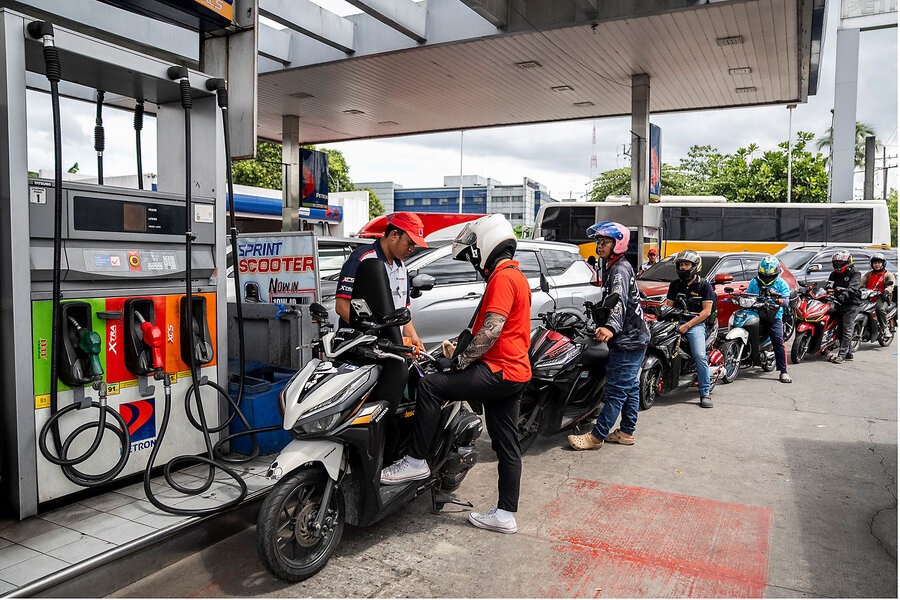
The Philippines imports about 95% of its petroleum requirements, leaving the country highly exposed to global supply disruptions and price swings. Mr. Marcos says the country has sufficient fuel for now, but transit operators are starting to feel the squeeze.
“The [fares] are still the same, but, of course, our earnings are smaller because diesel is expensive,” says Uriel Bataclan, who drives a jeepney – a kitschy type of minibus used for public transportation in the Philippines – in Cavite province, south of Manila. To cushion the impact on transport workers, the government has announced a fuel subsidy of 5,000 Philippine pesos (about $84) for public utility vehicle drivers, but Mr. Bataclan isn’t certain when that support will come.
The Iran war has also threatened fertilizer exports from the Middle East, raising concerns about a possible drop in productivity, says Arnel de Mesa, the assistant secretary of the Philippines Agriculture Department. His agency is exploring organic fertilizers, biofertilizers, and possible subsidies for farmers.
Bishop Gerardo Alminaza, president of Caritas Philippines, an influential social action group in the predominantly Catholic nation, says the crisis is exposing deeper structural risks tied to fossil fuel dependence, warning that the country remains “dangerously dependent on imported coal, oil, and gas.”
He hopes this is a wake-up call for policymakers to see renewable energy as “a national survival strategy.”