Amid the kayaks, local costumes, and Arctic mummies that a visitor might expect to find in the Greenland National Museum, there’s a curious addition: a Sears catalog.
The yellowing pages hold a strangely pivotal place in the history of Greenland. They tell of the moment when the United States first came to the world’s largest island, which stretches deep into the Arctic Circle.
Compelled to defend it against Nazi Germany during World War II, the U.S. did something more. It ushered in a wave of cultural change that dramatically altered Greenland’s future – symbolized by the Sears catalogs that were sent to almost every resident living there at the time.
Why We Wrote This
Greenlandic culture and identity, rooted in Inuit traditions, have seen a revival. As the world clamors for its rare earth minerals and energy potential, will its people be able to choose their own path?
More than 75 years later, the U.S. wants to return. President Donald Trump cites Greenland’s crucial role in defending the U.S. from long-range missile attacks and the threats of an increasingly open Arctic Ocean. Though he has toned down his demands, his interest remains. On Saturday, he posted on Truth Social that he plans to send a hospital ship to Greenland “to take care of the many people who are sick, and not being taken care of there.”
The claim perplexed many Greenlanders, who see their universal health care system as better than America’s. Greenland’s prime minister politely declined the offer.
Mr. Trump’s attempts to steer the future of the island has at times seemed to cast Greenland in the role of passive imperial pawn. The reality is much more dynamic.
Greenland’s 57,000 people are waking up. As they gain more autonomy from Danish rule, there has been a revival of Greenlandic culture and identity, and the territory has begun to chart a path unlike any national government in the world.
Nowhere else does an Indigenous community hold so much power and influence over national affairs, with 90% of Greenlanders identifying as Inuit. The result is a new model of governance, guided by Indigenous values.
Here, no one is allowed to own land, and society is built on a sense of communal well-being that goes deeper than any theoretical Western-ism, residents say.

“When you are part of a smaller community, there is a different way to be around one another,” says Malu Rosing of the International Work Group for Indigenous Affairs in Copenhagen, and a native Greenlander. “It’s a society where the stronger have to help the weaker.”
To Greenlanders, this is a different kind of freedom – one in which communal ties to one another, and to the land, are at the foundation of a caring and mutually dependent society.
For many here, Mr. Trump’s threats were a threat not just to a government or a military, but to a way of life.
Even as the American president softens his demands, a deeper question behind them remains: What will happen to Greenland from here?
The challenge facing Greenland is in many ways the same challenge that has beset Indigenous communities worldwide for centuries: Engage with the broader world and risk being overrun, or remain independent at the cost of isolation and lost opportunity.
No one thinks navigating that choice will be easy. Many believe it could take years, even decades. But the threat of a U.S. invasion and takeover has forced Greenlanders to think about what they want their future to be.
“There is a huge awakening in this moment,” says Liv Aurora Jensen, a graphic designer in Nuuk, the capital and home to about one-third of Greenlanders. “The people’s voice in Greenland is becoming more and more clear.”
This is obvious throughout Nuuk, where street corners are a riot of Greenland’s flag, a modernist, red-and-white interpretation of the famous Arctic sunset. Called Erfalasorput, or “our flag,” it hangs in shop windows, is displayed on cars, and sits atop nearly every flagpole.
But the evidence of Greenland’s cultural revival is also apparent in Ms. Jensen’s kitchen – and on her own skin.
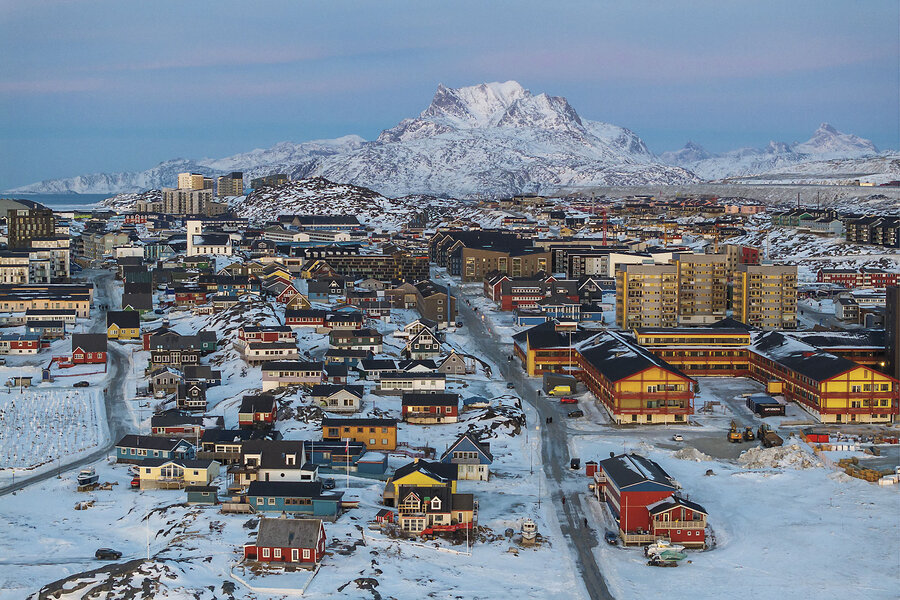
Outside the window is a classic scene of Greenlandic winter: brightly colored houses clinging to the weather-beaten rock, the fjord beyond fretted with the shocking blue of calved glacier ice.
Inside is a portrait of the new Greenland. Nearly everything is a product of the design company, Inuk Media, run by Ms. Jensen and her husband, filmmaker Peter Jensen.

Mark Sappenfield/The Christian Science Monitor
Contemporary plates, curtains, and cutting boards are etched with traditional Greenlandic symbols – and given a modern twist. Ms. Jensen’s designs have won awards from Slovenia to Japan to Germany.
As she sets the breakfast table, lines of blue dots around her forearm become visible. It’s a traditional Greenlandic tattoo, and only a decade ago, it was close to becoming a lost art when only two people on the island knew how to etch them into skin. Now, such tattoos are commonplace.
“We are seeing a very, very visual desire to show off our culture,” says historian Ujammiugaq Engell. Recalling a 2017 exhibition she did on Greenlandic tattooing, she adds: “I had never worked on anything that created such demand.”
These expressions of cultural independence are in politics, too. Since 2009, Greenland has been able to manage its internal affairs, while Denmark controls defense, foreign policy, and currency. But polls find Greenlanders want more. They don’t want to be a part of the U.S. – or Denmark, for that matter. Some 84% want to be independent, according to a January 2025 survey by Greenlandic and Danish media.
Yet there are telling asterisks. More than half say it will not happen for 10 to 20 years. And 45% say they do not want independence if it affects their standard of living.

Mark Sappenfield/The Christian Science Monitor
Currently, more than half of Greenland’s public revenues are grants from Denmark. Independence would mean finding ways to replace that. In the past, the task seemed nearly impossible, with Greenland’s economy almost wholly reliant on fishing. But a new moment of opportunity beckons.
The globe is clamoring for the minerals and energy Greenland has in abundance. How it chooses to develop that wealth – or not – could prove the biggest test of its ideals.
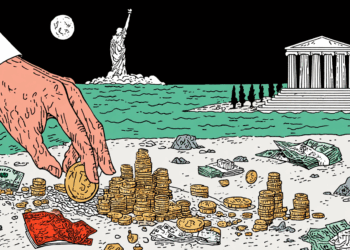
In recent years, Greenland has become the blank slate for powerful people’s economic dreams.
Not only does the world’s largest island hold some of the largest deposits of rare earth minerals – materials increasingly essential for modern technology – it also has massive hydropower potential. Business leaders see Greenland as a prospective source for huge amounts of cheap energy to run power-thirsty data centers.
In the U.S., a Reuters report suggests several tech billionaires have floated the idea of establishing a “freedom city” in Greenland – a libertarian utopia with limitless energy and minimal government oversight.
The report states that the “vision for Greenland … could include a hub for artificial intelligence, autonomous vehicles, space launches, micro nuclear reactors and high-speed rail.”
Naaja Nathanielsen’s own vision is dramatically different.
Greenland’s economic minister is open to investments. But she is unflinching that they must not harm Greenland’s values and ways of life. She and her people have no misgivings about forgoing lucrative development opportunities that have any whiff of exploitation of people or the environment.
“We’ve built in high expectations,” says Ms. Nathanielsen, who also serves as Greenland’s minister of justice. “One reason we don’t have a lot of mines is that we have higher standards.”

Mark Sappenfield/The Christian Science Monitor
“I cannot lower the standards,” she adds. “We will lose the backing of the local community.”
Economic growth cannot become destructive to the very communities it purports to benefit.
“We could develop 100 mines and hydropower, but that would require a lot of workforce coming in from the outside and put a great stress on our culture,” she adds. “We want tourism, but we don’t want to be overrun in our small communities.”
Christian Keldsen understands the desire to set such high standards. But the director of the Greenland Business Association in Nuuk says the government might need to be more flexible if it wants to hit its economic goals.
“If I want to attract investment, I need to be able to accommodate what investors want,” he says. “It’s not enough to say, ‘We’re open for investment.’”
He points to utility costs, which are the same across Greenland, from relatively urban Nuuk to the many isolated settlements spread across the island.
The goal of such price controls is to support Greenlanders living in remote settlements. But the government could do that in other ways – like subsidies, he says – that would allow utility prices to more fairly reflect market demands.
“It’s an ambition of the government to be an exporter of energy,” says Mr. Keldsen. “But to sell surplus energy, you need to sell it at a lower price.”
Some of these tensions have played out dramatically at the Kvanefjeld mine, which overlooks the fjords near the town of Narsaq at the southern tip of Greenland.
Australia-based Energy Transition Minerals has held the mining rights since 2007, but in 2021 Greenland banned uranium mining – a practice that has caused significant damage to Indigenous communities from Canada to Australia.
While Kvanefjeld was not a uranium project, there was enough uranium present to shut down operations. Energy Transition Minerals is now suing Greenland for more than $11 billion.
Mr. Keldsen declines to comment on the case, but speaking generally, he says there are opportunities for greater understanding between the government and the business community.
“We need to be bringing more data and a more contemporary mindset on this,” he says. “We’re looking for more trust.”
For her part, Ms. Nathanielsen is comfortable with keeping the standards high. The growing need for rare earth minerals and energy will eventually bring the right companies to Greenland’s doorstep, she says.
If they could add even three mines in the next 10 years, she adds, “That would make a real change for our economy.”

Leonhard Foeger/Reuters/File
Peter Jensen, Ms. Jensen’s husband, has some sympathy for the challenges businesses face in Greenland.
He came to Nuuk in 1985 as a 20-something hoping to become Greenland’s first great moviemaker. But his initial experience was moving from house to house every night, since the only apartments available were controlled by the government – and there was a 10-year wait.
When he eventually decided to form his own media company, he tried to get a bank loan but failed, despite having a million Danish krona in business commitments. A friend offered his fishing boat as collateral. The bank still said no.
Finally, Mr. Jensen had to go door to door to raise funds, eventually getting the owner of one of Nuuk’s biggest fishing operations to front the money in exchange for ownership of half the company. He was sleeping about two hours a night.
Over time, Mr. Jensen became the “grand old man” of Greenlandic film, producing documentaries, commercials, and collaborations with major companies like Disney.
Years later, he married Liv, who was by then his business partner, and they moved to Denmark. They thought they might never return.
“We were tired of being in Greenland,” he says. “It’s so hard to be an entrepreneur here,” he says. But after he left, he found he missed being home. “In those two years, I realized how much I loved this country.”
He looks out his kitchen window across the fjord and knows one thing. No one owns that land.
“We have this kind of feeling of freedom, how we are apart from the world,” he says. “You can just go out into nature and shoot your own food.”
Ms. Jensen chimes in that it is not unusual – or controversial – for even a government minister to call in and say he’s going hunting that day. “That’s what makes us very proud. It’s our land, it’s our soul,” she says.
Business is hard for her here, too. “If I have to produce something, it has to be abroad,” she says. Greenland does not have the industries she needs to make her household goods. But she thinks Greenland has its priorities right – and the world can learn something from that.
“It’s not all about money,” Mr. Jensen says. “There can be a new way of doing things, and Greenland can be a model.”

Part of Greenland’s path forward means finding a way through the past. And that means wrestling with Denmark’s complicated colonial legacy.
In some ways, Greenland was fortunate.
“One of the reasons Greenlandic colonial history is so different is we were colonized on a very different philosophical grounding than any other place,” says Ms. Engell, leader of the Nuutoqaq Local Museum in Nuuk.
The Christian missionary who first established a permanent Danish presence on Greenland in 1721, Hans Egede, came with an unusual respect for the native culture.
In other places, “the arrival of the church often meant the complete erasure of a culture,” says Ms. Engell. But Egede “fought quite hard to preserve a lot of the cultural heritage we have today.”
That meant Greenland kept hold of many of its traditional practices and, perhaps most important, its language. But some traditions, such as tattooing, largely disappeared.
More problematic was the relationship established between Danes and Greenlanders, which was unambiguously paternal. In later years, the Danish government turned Egede’s ideals into policy, passing laws that kept Greenlanders locked in time. Up until World War II, Greenlanders were required to sew their own clothes, and simple items like petroleum lanterns were deemed too modern.
That’s when the Sears catalogs came in.
With the Nazi takeover of Denmark, Greenland turned to the U.S. for defense. The powerful neighbor gladly accepted, but did not care about keeping Greenland “Greenlandic.” So, in came American feature films, radio, and Sears catalogs, cracking open a new world.
“It was the first time the Greenlandic people had a say,” says Ms. Engell. “While the rest of the world was burning, the Greenlandic people felt a sense of freedom, of evolving.”
When Danish control returned, the tables flipped. Denmark pushed modernization at a dizzying speed, but the reasserted sense of colonial control brought devastating consequences.
Danish authorities closed isolated settlements and forced residents into cities where they had no social standing or understanding of even how to use modern facilities like toilets.
“All the evolutions you had in the rest of the world – we went through all those different phases in 30 years,” says Ms. Engell. “As a byproduct of that, a lot of people lost their identity and purpose.”
Alcoholism soared, as did suicides.
From the 1960s to the 1970s, the Danish government implanted contraceptive devices in thousands of teenage Greenlandic girls, some as young as 12, without their or their parents’ consent – an official effort to keep the population of Greenland down.
“There is a dark, dark history between Greenland and Denmark,” says Frederik Fuuja Larsen, curator of the Greenland National Museum in Nuuk.

For Rakel Sanimuinaq, overcoming that darkness has been a decades-long struggle.
At age 4, she felt called to become a shaman – using ancient Inuit traditions and connections to ancestors to bring healing. But her mother said it was too dangerous. The Danes didn’t understand.
Mrs. Sanimuinaq heard stories about how kids had thrown rocks at her great-grandmother for following the traditional ways. At a boarding school in Denmark, she was told her beliefs were evil.
“I tried my very best to adapt,” she says. Still, she went through severe crises and attempted suicide more than once. “Applying Western methods to a spiritual crisis, it wasn’t working for me, at least.”
But in recent years, Mrs. Sanimuinaq has felt a dramatic shift. When a priest on live television put Christianity and traditional Inuit beliefs on equal footing, “it was a historic moment.”
Both sides need to come together to find restoration as equals, says Mrs. Sanimuinaq, who now has her own practice in Nuuk. “What I see is a balance slowly being restored.”
“We had to cope in silence,” she adds. “Now, the Danes are listening, and that is part of the healing. That is all we need: freedom to be who we are. The mirror of colonization is that we’re not good enough to be who we are.”

Mark Sappenfield/The Christian Science Monitor
Mr. Larsen of the National Museum has seen how insidious this sense of inferiority can be. In the past, when his museum was asked to work on research projects with others, it was rarely given any more than a brief credit line at the bottom. Greenlandic researchers tacitly accepted themselves as second-class.
But that has changed – and he has helped change it. In the past decade, Mr. Larsen began issuing an ultimatum: “If you want to work with us, we want an equal voice.” It worked.
Ironically, Mr. Trump’s interest in Greenland might be giving Greenland and Denmark the chance for a similar reset. There are signs that Denmark is now listening to Greenland in ways it had not before.
For years, Greenland has demanded an apology from Denmark for its contraception campaign. But it wasn’t until Mr. Trump returned to office – with his designs on Greenland – that Danish Prime Minister Mette Frederiksen issued a formal apology, describing it as “systemic discrimination.” Women affected by the policy can also apply for $46,000 each in reparations.
In that way, Greenland’s revival is not only an attempt to reclaim Indigenous traditions, but an attempt to find new ways to engage with Denmark – and the world.
To Mala Johnsen, that can only be a good thing.
The former auto mechanic plays the part of Greenland’s antihero to a T. Seated casually in a chair of the café of Nuuk’s decidedly Nordic-style cultural center, Mr. Johnsen is a revolutionary in fleece. His manifesto is the clothing he wears.
His brand, Bolt Lamar, is arguably Greenland’s hottest clothing line. He and co-owner Arny Mogensen say they were tired of sunsets and polar bears and kayaks – all the familiar icons of Greenlandic art. “Everyone used Greenlandic stuff to the point of being souvenirs,” Mr. Johnsen says. “We wanted to do something completely the opposite.”
So they created a line of streetwear that would not look out of place in South Central Los Angeles. At first, no one knew it was Greenlandic. And they worked hard to keep it that way. They used foreign models on photo shoots “to make us feel bigger than we were.” They kept a low profile.
Along the way, however, Bolt Lamar did become quintessentially Greenlandic. Fishermen wear their clothes as workwear. Teens wear them clubbing. Now, many people in town know where it comes from.
For both partners, Bolt Lamar became a way to widen Greenlanders’ world.
“We wanted to show that you don’t have to be specifically Greenlandic,” says Mr. Mogensen. “We can be anything. We are citizens of the world.”
In her own way, Ms. Jensen of Inuk Media sees something similar. “When I travel around the world and see different cultures, my own becomes much clearer.”
The question now is how much to open that world.
“We want to let in the world, but we want peace and quiet,” says Mr. Johnsen. “We want tourists, but we want the place for ourselves. We’re very welcoming, but at the same time, there’s a part of us saying, ‘Shut up, we just want to hear the wind.’”