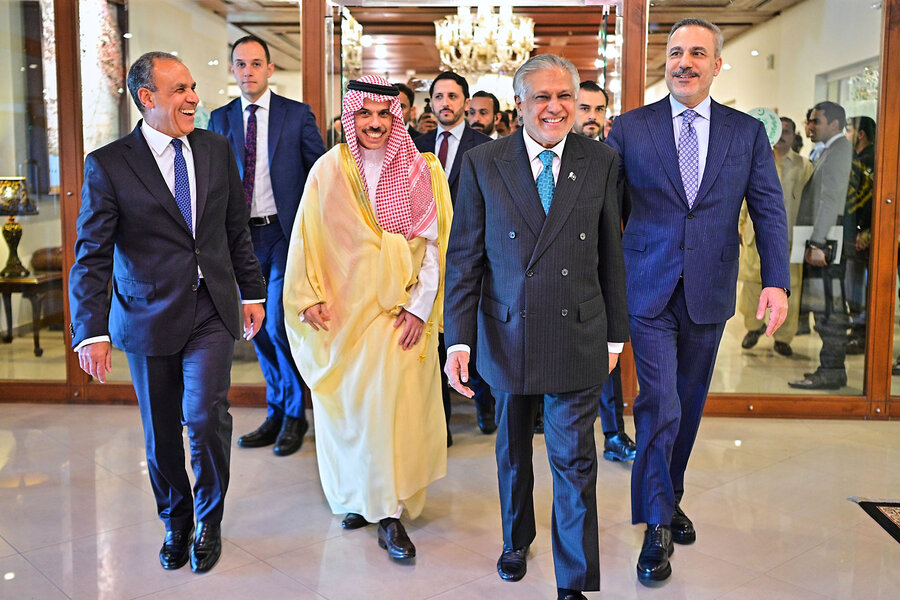
On the sidelines of a senior diplomatic meeting in Islamabad Sunday, Pakistani Foreign Minister Mohammad Ishaq Dar reiterated his country’s commitment to helping end the war between the United States and Iran.
“Pakistan will be honored to host and facilitate meaningful talks between the two sides in coming days,” he said at the meeting, attended by the foreign ministers of Saudi Arabia, Egypt, and Turkey. The goal, Mr. Dar added, is to reach “a comprehensive and lasting settlement of the ongoing conflict,” though it’s not clear whether Washington or Tehran intends to participate.
Still, the offer – which comes as the war enters its fifth week and just days after Pakistan said it opened a back channel between the U.S. and Iran – reflects Islamabad’s growing confidence in its ability to shape global events.
Why We Wrote This
Pakistan is leading the charge to bring the United States and Iran to the negotiating table, leaning on a budding friendship with Washington and deep ties to Tehran. But its role as mediator faces headwinds.
In the context of the U.S.-Iran war, it has reason to feel emboldened. By some estimates, Pakistan has the second-largest number of Shiite Muslims after Iran, giving it the cultural capital to engage Tehran. Its leadership, both civilian and military, has grown close to U.S. President Donald Trump over the past year, and has a good working relationship with his Middle East envoy, Steve Witkoff.
While there are other factors that might jeopardize Pakistan’s position as an interlocutor, these relationships make it one of a handful of countries that can act as a go-between.
“Pakistan is the only country that has direct access to both the American leadership and the Iranian leadership,” says Pakistani journalist Fahd Husain. “And not just access, but a level of trust which no other country enjoys.”

Barriers to peace
Yet many in Pakistan question whether there is sufficient appetite among the warring parties to cease their hostilities.
Iran has already rejected a U.S. peace plan delivered via Pakistan and has repeatedly said it does not intend to negotiate with the U.S. “I do not think resolution through mediation is possible on the terms of the aggressor,” says former Pakistani Prime Minister Shahid Khaqan Abbasi, about Washington’s proposal. “Iran has … absorbed the immense pain of a continuing unprovoked conflict.”
Indeed, even as a multinational effort to secure peace gains momentum, the fighting is escalating. Over the weekend, U.S. Central Command said an additional 3,500 sailors and Marines had been deployed in the region. Early Monday, the Israel Defense Forces said it was “currently attacking” government infrastructure “throughout Tehran.”
Pakistan is one of 29 countries that do not recognize Israel, and analysts say it’s difficult to imagine a way out of this war without buy-in from the Jewish state.
“The elephant in the room is Israel, which has been the tail wagging the dog,” says Maleeha Lodhi, who served as Pakistan’s permanent representative to the United Nations from 2015 to 2019. “Israel can play the spoiler even if the U.S. and Iran reach an understanding to pause the fighting. So the unanswered question is whether Trump can restrain [Israeli Prime Minister Benjamin] Netanyahu.”

Regional and local stakes
Pakistan is also having to placate its allies in the Gulf, many of which host American bases and have faced attacks by the Iranians.
With Saudi Arabia in particular, Pakistan has a defense pact in which aggression against one is seen as aggression against both. So far, Islamabad has refused to interpret the attacks by Iran on Saudi Arabia as triggering the pact. But if the scale or intensity of Iranian strikes increases, Islamabad might find it more difficult to reject any call from Riyadh to enter the fray.
“That would be the worst-case scenario for Pakistan, and I think Saudi Arabia also understands that,” says Mr. Husain, the journalist. “That would mean all efforts at diplomacy are dead and buried and the final conclusion is going to take place on the battlefield, and I think no country, including Saudi Arabia, would want that.”
Pakistan sees peace as essential to avoid being embroiled in a wider regional war, as well as to maintain stability within its borders.
After the assassination of Iran’s supreme leader, Ali Khamenei, considered a figure of reverence by many in Pakistan’s Shiite minority, riots broke out in major cities across the country. And given Pakistan’s heavy reliance on imported petroleum, there are concerns that the country’s fragile economy won’t be able to handle a sustained increase in oil prices. A similar uptick in energy prices after Russia invaded Ukraine contributed to an inflation crisis from which the country has only partially recovered.