Oxford has swapped its notoriously hard entrance exams for generic ones used by other universities, to ‘streamline’ the process for candidates.
Have a go at our questions from the new tests to see if you’d make the cut for Britain’s oldest university.
We selected questions from a range of practice test papers for different degree specialisms – although in reality a student will only be answering questions in their particular course area.
The university says the new exams are just as rigorous as the old ones, but will mean in future pupils will only need to take one test to apply to multiple universities.
The new exam for humanities subjects is the Test of Academic Reasoning for Admissions (TARA), which tests problem-solving and critical thinking skills and will be taken by those studying subjects such as history, politics and economics.
Meanwhile, maths and science applicants will take either the Engineering and Science Admissions Test (ESAT) or the Test of Mathematics for University Admission (TMUA).
Oxford’s old bespoke entry exams have long been seen as a barrier to those without the support of a private school or pushy family who can help with preparation.
The change, for applicants aiming for 2027 entry, comes amid a drive to become more inclusive by encouraging applicants from disadvantaged backgrounds.
In 2019, Oxford promised a ‘sea-change’ in admissions, saying it wanted to increase the proportion of students from deprived areas.
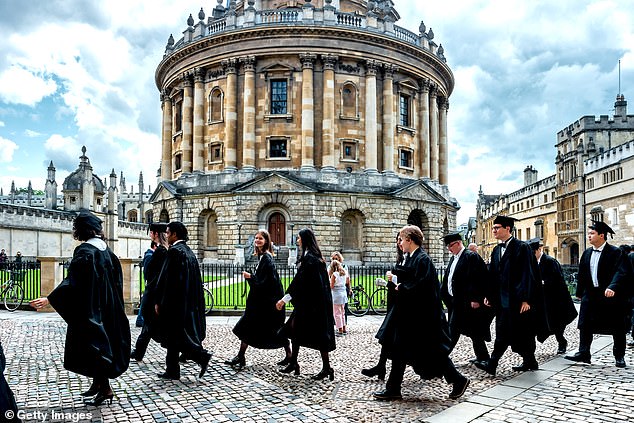
Oxford University (pictured) is to scrap its own admissions tests in favour of generic ones amid a drive to be more inclusive

Oxford’s entrance exams were dramatized in Alan Bennett’s 1980s nostalgia play The History Boys, which was made into a film in 2006 starring Dominic Cooper and James Corden
Evelyn Pike, a specialist in Oxbridge applications at William Clarence Education, said: ‘In our experience, when tests like these are introduced there is a tendency to see standardisation as simplification, which we know isn’t the case. The ESAT, TMUA and particularly the new TARA are designed to test beyond rote learning. They assess a student’s intellectual flexibility, capacity to deal with new information, and will push them to use their powers of reasoning.’
David Gibbon, director of Oxford and Cambridge Tutors, which provides Oxbridge preparation, said: ‘Removing some of the perceived mystique and individuality away from an application will benefit candidates who might be less familiar with the Oxford admissions process.’
However, he told Times Higher Education it may also mean the ‘loss of some highly regarded, subject-specific assessments’ which have ‘provided a level of challenge above and beyond’ other tests.
Professor Anthony Glees, security expert at Buckingham University who entered Oxford in 1967 via entrance exam to study history and German, said it risked reducing Oxford’s ability to select students specially suited to the university, by tailoring their own tests.
He said: ‘It could well be the end of the specialness of Oxbridge. I think it amounts to dumbing down because other universities don’t offer what Oxbridge offers, in terms of the tutor relationship.
‘If they’re all using the same application process, the uniqueness of Oxbridge has been removed. If it becomes generic, that selective factor disappears.
‘Something special should not be got rid of. We don’t want identikit minds in this country.’
Oxford’s entrance exams, dramatized in Alan Bennett’s 1980s nostalgia play The History Boys, have taken various forms in recent decades.
They were originally abolished in the 1990s in a bid to give state-educated pupils a fairer chance against those applying from well-prepared private schools.
However, since then they have been resurrected for many subjects, after Oxford realised top A-level grades were not enough to differentiate between good and exceptional candidates.
The new computerised exams are run by University Admissions Tests UK (UAT UK), a partnership between Imperial and Cambridge.
While previously, Oxford applicants took subject-specific tests, now they will take one of the three offered by UAT UK.
Gareth Davies, an adviser to potential Oxbridge applicants at the firm William Clarence Education, said administering the old tests had become an ‘expensive business’ for Oxford.
Meanwhile, on parenting website Mumsnet, many welcomed the change.
One user said: ‘As a move towards equity this is good. The Oxford-specific entrance exam surely gave advantage to pupils from schools with strong Oxford links and the ability meaningfully to support Oxford applications. We all know this need not correlate with merit.’
However, another described it as a ‘sad loss’ and added: ‘I can’t imagine that the Oxford maths department are very happy.’
A university spokesman said: ‘Oxford’s undergraduate admissions process is rigorous and designed to identify academic potential.
‘The university is continually reviewing its admissions processes and practices to ensure they best meet the needs of the university, schools, and applicants.
‘Our approach varies according to subject and considers a range of information as evidence of a candidate’s ability to thrive here.
‘All those offered a place to study at Oxford have been interviewed and every year more than 20,000 interviews for approximately 10,000 applicants are conducted, allowing tutors to assess directly a candidate’s ability to think independently and engage with new ideas – qualities that underpin learning at Oxford.’