As he sat down to dine in his undergraduate gown in the medieval hall of Wadham College, Oxford, at the start of his first term in 1958, it occurred to Melvyn Bragg that the only previous time in his life when he’d sat at long tables eating with scores of strangers was at Butlin’s holiday camp in Ayr, Scotland.
This working-class northern grammar- school boy felt out of his element, among the seated rows of mostly middle and upper-class young men (all men in those days), miles away from his home town of Wigton in Cumbria.
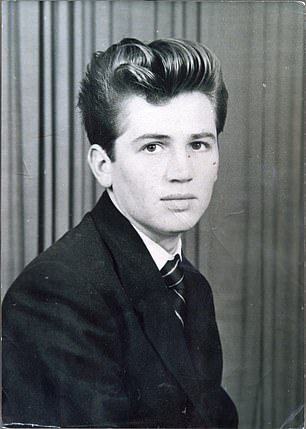
A young Melvyn Bragg
The future screenwriter Dennis Potter, another undergraduate a couple of years senior to him, remarked to him one day in the street, ‘They say there’s three working-class men here. There’s me. And you. Where’s the other bugger?’ The attentive reader of Bragg’s delightful memoir of his Oxford University years – which doubles up as a deeply touching memoir of his first love affair and how it ended – knows where at least one other former grammar-school boy was, even if it wasn’t a working class one.
Bragg was assigned to share his rooms on Staircase Two with a rather dull boy called Gerald, who ‘did up the top button of his pyjamas and brushed his hair before bed’. The two had been lumped together because of the grammar-school connection.
Much more heinous (in my view) than Gerald’s minor crimes of doing up the top button of his jim-jams and brushing his hair before bed was that he failed to make himself scarce when Bragg’s girlfriend Sarah visited.
All of us who devoured the first volume of Bragg’s memoir, Back In The Day, will remember Sarah, the dark-haired, lively-minded girlfriend, who was just as well educated as Melvyn, but, being a girl, was expected by her father to go and work at a local bank after leaving school, rather than go to university.
He was so homesick, and missed her so badly, that one day on a whim he hitchhiked to Wigton, knowing he’d need to be back for a tutorial in three days’ time.
On arrival he was overwhelmed with love for his home town. ‘You could not think of a better place to spend a life.’
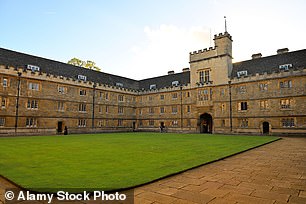
The quad and buildings of Wadham college
His publican father, who’d left school at 14 without the chance of a university education, greeted him ‘as if I was a messenger from Mount Olympus’. But Bragg was having seriously cold feet. Why bother with Oxford, which seemed ‘more of a theatre than a city’? He poured out his woes to his former headmaster, who strongly advised him to give it more time.
So he did. And things got better. Bragg has an unquenchable instinct to celebrate the minds of others – a skill honed in his 27-year stint as presenter of In Our Time, the Radio 4 cultural discussion programme.
Here, he pays homage to the young men on his staircase who became lifelong friends, and to a young man called Michael Wolfers, whom he met after climbing in through his ground-floor window late one night when the college was locked.
He evokes the thrill of history tutorials, which always began with having one’s essay dismantled, but ended with a wonderful sense of intellectual comradeship.
Then Sarah came to visit. Bragg’s new friends threw a party in her honour. But, thanks to his roommate Gerald’s lack of imagination, there was nowhere for them to have a proper tryst. Bragg had booked her into a B&B, but it came with the usual ‘no gents in the ladies’ bedrooms’ rule. ‘I kept a lookout for a dark and twisting alley or a deeply set doorway in Holywell Street,’ he writes, ‘but no luck.’
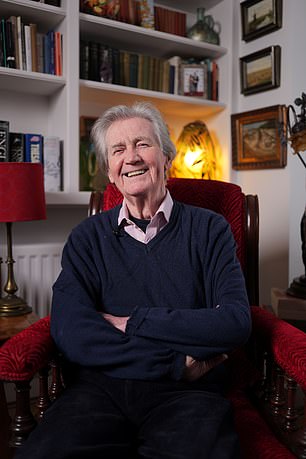
Familiar face, Melvyn Bragg at 86
The nearest they could get to a place of darkness and intimacy was at the back of the cinema, where they watched an Ingmar Bergman film. When Bragg mentioned to Sarah that he’d become the film critic of the university newspaper, she said, ‘You mean you want to be a reporter? You could have done that by getting a start in Carlisle with The Cumberland News.’
That hint of an aspiration-gap gives us the first inkling that they might one day drift apart. Not that Bragg had the remotest intention of ending the relationship. He adored her.
They went on holiday to Lindisfarne, naming themselves ‘Mr and Mrs Marrs’ to the hotel receptionist. They giggled their heads off in the pouring rain. Bragg bought an engagement ring in the Carlisle covered market, and proposed on a bridge over Bassenthwaite Lake. Sarah accepted.
Then, suddenly, out of nowhere, in a freezing hotel room in Bath, Sarah said, ‘I don’t think we should go on.’ Bragg was utterly taken aback. ‘I can’t. I just can’t,’ she said, citing ‘the dinner parties, the women with opinions and flowery dresses’ as the reasons.
She had simply ‘gone off me,’ Bragg writes. ‘It was not her words that wounded. It was the flinching away from me, not dramatic but noticeable.’
His life broke apart. ‘A trap door opened and I fell.’ He was thrown into depression – something he’d already experienced, terrifyingly, in his teens. ‘My body, the thing I was, that made me live, was simply dead. I humped it around, longing, even praying to get rid of this me . . .’
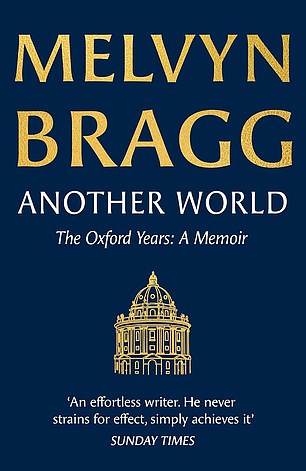
Another World is available now
He threw himself into solitary swotting – achieving such a good second-class degree in history that he was asked to stay on. But he said no, and applied for a BBC traineeship, which he got, thanks to one drama producer, Martin Esslin, spotting him and fighting his corner in the selection process.
At a party at the Ruskin School of Art, Bragg met the woman who would become his first wife: a young French aristocratic artist called Elisabeth, or Lisa, who seemed ‘enwrapped in sadness’, just like him.
She’d been abandoned by her American boyfriend. ‘We were both losers with, it seemed, nowhere else to go . . . we had an equality of uncertainty and unhappiness.’
She lodged in the attic of a don’s family house and she and Bragg ‘slipped into bed together without the excruciating testing time and obstacle course which was the Wigton custom’. She opened a whole new artistic world to him.
Bragg doesn’t mention it here, but he has spoken before about the tragedy of Lisa taking her own life in 1971, ten years into their marriage. This thoughtful, evocative memoir, marred only by occasional loose grammar and too many verbless sentences, makes you feel you know the people Bragg knew, and that you care about them almost as much as he did – and still does.