The Green Party of England and Wales has been on the outside of British politics looking in pretty much from its inception in the 1970s. It wasn’t until 2010 that the Greens won their first seat in the House of Commons, the United Kingdom’s lower house of Parliament.
But the party may be set to step away from the fringes and into the mainstream – thanks to a by-election in a longtime bastion of the working class.
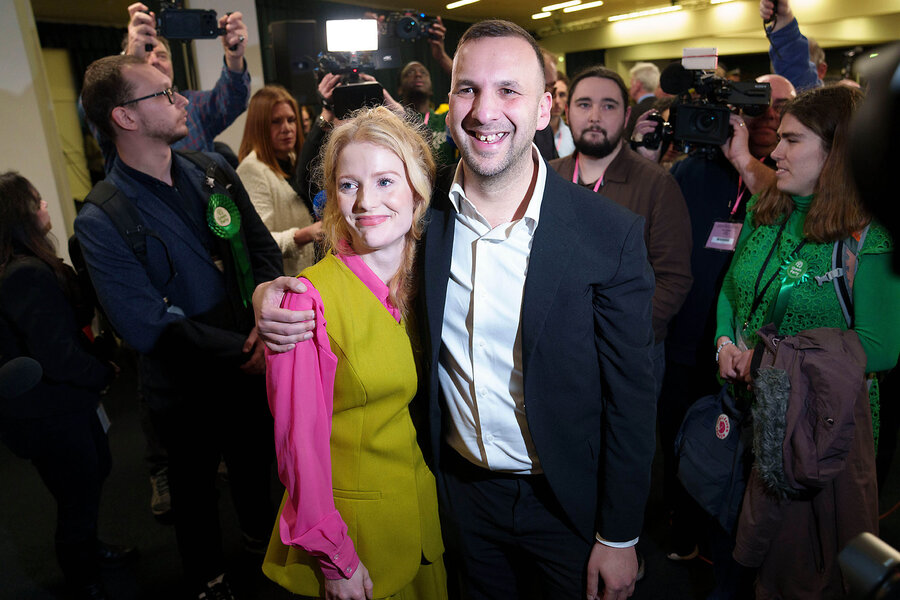
The recent election of Hannah Spencer as the new member of Parliament for Gorton and Denton in Greater Manchester has highlighted a potential political shift among voters toward her Green Party. The Greens swept to victory in the Labour stronghold with 40.7%, while Labour was left languishing in third at 25.4%.
Why We Wrote This
With the right-wing Reform UK party dominating polls, Britain’s Labour Party has been skewing to the center. But that appears to be alienating its traditional leftist base – and opening the door for the Green Party to potentially supplant it.
As Labour has shifted to the center to counter the rising popularity of the right-wing Reform UK party amid public frustration with mainstream politics, it has given the Greens an opportunity to occupy the political space of the mainstream left. The challenge will be whether they can build on their success in Gorton and Denton to create lasting political change.
“At the minute, the real trend for voters is this sense of frustration and disillusionment with the two main political parties, [Labour and the Conservatives]. Can we even call them main political parties anymore?” says Louise Thompson, a senior lecturer in politics at the University of Manchester. “All the trends point to voters wanting something different.”
Green dreams
Ms. Spencer’s public image as a triumphant political outsider – a young, enterprising, and enthusiastic plumber-turned-parliamentarian who never attended university – mirrors the story that the Green Party hopes to tell about itself, says Alex Prior, a lecturer in politics at London South Bank University.
“It’s a narrative that encompasses local voters [in Gorton and Denton]: hardworking, working-class voters that want an alternative vision,” he says.

Ms. Spencer’s campaign ran on unashamedly left-leaning policies in the Greens’ national manifesto, including moving to a four-day workweek, scrapping Britain’s unelected House of Lords, dismantling the country’s Trident nuclear weapons program, and easing restrictions on immigration. But she also ran on local issues like the cost of living, rent control, and illegal trash dumping.
“Working hard used to get you something. It got you a house, a nice life, holidays. It got you somewhere,” she said in her victory speech. “But now? Working hard? What does that get you? … Instead of working for a nice life, we’re working to line the pockets of billionaires.”
That sort of policy should appeal to a significant portion of British voters, who Ally Fogg, a writer, journalist, and community media organizer who lives in Gorton and Denton and campaigned for the Greens, argues lean further to the left than the current Labour Party leadership.
“When you ask the British electorate: Should there be a wealth tax on billionaires? Should the water industry be in public hands? Should the railways be in public hands? These are all of the big Green Party policies now, they’re hugely popular with a large percentage of the population,” Mr. Fogg says.
Rivals to Labour
Key to the Greens’ growth – the party now holds a record-high five seats in Parliament – is Labour’s seeming fumbling of its traditional base. For more than a century, Britain’s Labour Party has been the rallying point of the country’s political left wing.

Chris J. Ratcliffe/Reuters
But under the premiership of Keir Starmer, Labour has drifted toward the political center, seen by many as an attempt to fend off the growth of Reform UK. Most recently, Labour has sought to reshape the country’s immigration and asylum laws, making asylum in the U.K. a temporary, rather than permanent, status, and making it harder for those who move to the U.K. to gain citizenship.
Certainly, Reform has appeared an electoral threat to Labour. The right-wing party came second in the Gorton and Denton by-election, winning 28.7% of the vote compared to Labour’s 24.8%. (Labour’s traditional center-right rivals, the Conservative Party, won a mere 1.9%.)
But while Labour’s rightward shift may appeal to potential Reform voters, it alienated its own voters.
Elizabeth Harding says she felt that Labour, which she supported for years, was pandering to the right. She switched her vote to the Greens. “I’m not a radical. I just want a decent life for people,” she says. “I think we need immigration. This is a multicultural area. I have friends of all races and religions, and I really, really hate these lies that are told that stir people up.”
Nicola Chipman, who also voted Green after lifelong Labour support, says the Labour party no longer seemed to share her values of community. “I don’t feel like they’re sort of promoting that hopefulness that I think people need to feel at the moment. I understand it’s a very difficult situation that they’ve inherited, but for me, on balance, I’ve had to move away.”
Labour politicians echoed voters’ concerns in public statements. Labour MP Nadia Whittome wrote on social platform X: “In order to keep our voter coalition together we should be true to the progressive values that Labour is meant to stand for. The failure to do this meant large parts of our coalition fled to another progressive party.”
Mr. Fogg says he encountered a lot of resentment among voters that they were being taken for granted – both by Labour and by Reform, who they felt assumed they had no other options for their anti-Labour vote.
“There was a big bloc of voters – something like 70% or 80% – who absolutely despised Reform UK, and there was 70% to 80% of voters who absolutely despised the Labour Party,” he says. “If you imagine that as a Venn diagram, [those blocs] crossed over a lot, and the big bit in the middle was people who were prepared to vote Green.”
Is growth sustainable?
But the Green Party must fight to keep that momentum, especially if it hopes to prove that the result in Gorton and Denton was not an outlier.
That includes proving that the Greens, traditionally linked with local environmentalism, can take on larger national and international issues. It also means showing that the party can rally voters on its own merits, rather than only appealing to those who are unhappy with Labour and Reform.
That distinction, however, is not always clear.
“One of the reasons people were so keen to vote for the Greens is because they were keen to support our stance on Gaza and Palestine. Our stance on wealth taxation, billionaires – all those things got through,” says Mr. Fogg. “But a lot of that was in relief to what the other parties were standing for. Is that a positive vote or is that a negative vote?”