India has made two major trade breakthroughs in just as many weeks.
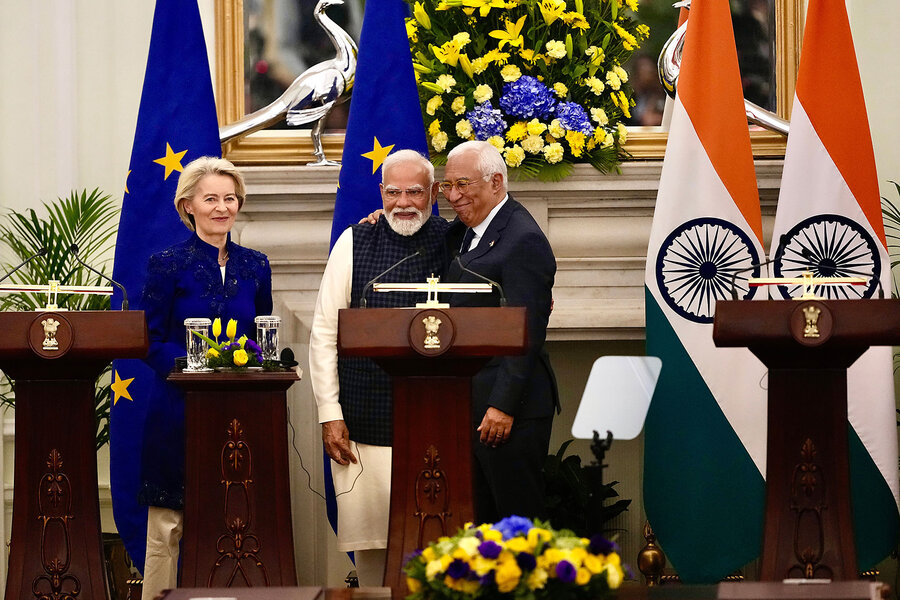
First, it announced a long-awaited free-trade agreement with the European Union, described by both sides as the “mother of all deals.” Then, it reached a fresh understanding with Washington that eases months of friction over tariffs. President Donald Trump said on Monday that tariffs on Indian goods would be reduced from a punitive 50% to 18%, after Delhi agreed to halt purchases of Russian crude oil.
Analysts say the near-simultaneous announcements are no accident, and come as Mr. Trump’s trade policy has unsettled long-standing alliances, prompting some middle powers – in Europe, Canada, and parts of the Global South – to rethink their economic ties. The developments have also revived debate over whether deeper integration with Western markets supports or undermines Prime Minister Narendra Modi’s goal of “Atmanirbhar Bharat,” or a self-reliant India.
Why We Wrote This
Shortly after signing a sweeping trade deal with the EU, Delhi has reached a tariff agreement with Washington. At a time when U.S. trade policy has alienated traditional allies and drawn middle powers closer together, what do these developments tell us about India’s position in the emerging global order?
“This parallel push suggests India is trying to preserve access to large markets amid rising trade uncertainty,” says Akhtar Malik, programs head at the Bureau of Research on Industry and Economic Fundamentals (BRIEF), a Delhi-based think tank. “But it also reflects a reactive strategy shaped by recent tariff shocks, particularly from the U.S.”
A deal – and a nondeal
India’s free-trade talks with the EU stretch back more than a decade and were repeatedly derailed by disputes over tariffs across a wide range of sectors. Officials say recent geopolitical uncertainty – including the unpredictability of U.S. trade policy – helped both parties set aside their differences. Still, full implementation of the agreement is unlikely before next year, with several politically sensitive issues deferred.

The U.S. announcement is narrower in scope. India has agreed to buy more American products – including petroleum, technology, and aircrafts – in exchange for tariff relief. The timeline for the ramp-up in U.S. purchases, and for the phasing out of Russian oil, is not yet clear.
“The India-U.S. announcement is not a trade deal in the legal sense,” Mr. Malik says. “India is buying time. The outcomes will depend entirely on the fine print.”
The agreements also have implications for the government’s push to make India economically self-sufficient.
Ministers say they will boost the country’s competitiveness, support local manufacturing and jobs, and anchor India more firmly in global supply chains at a time of slowing trade. Yet trade economist and former Jawaharlal Nehru University professor Biswajit Dhar is skeptical.
“Opening domestic industry to large global players will create serious challenges to India’s self-reliance,” he says.
He points to the European Union’s dense regulatory framework, including carbon border taxes and strict food safety rules. “These are not tariffs, but they can be just as restrictive,” he says, and create an uneven playing field for Indian firms trying to compete with larger, Western companies.

Courted by many
India’s deals are unfolding against a wider diplomatic backdrop, in which U.S. foreign policy is drawing middle powers closer together. At the same time, governments wary of overdependence on China are seeking alternative markets and manufacturing hubs, and many see India – with its massive population and economic growth prospects – as one potential alternative.
Canada, the United Kingdom, Oman, and others have stepped up outreach to Delhi, while Brazil’s president is scheduled to visit later this month.
For India, the challenge is turning that attention into influence in real terms.
“These deals position India as a credible China-plus-one option,” Mr. Malik says. “Its visibility has increased. But its influence remains constrained.”
Mr. Malik warns that overalignment with the West could also complicate India’s economic ties in Asia, particularly with China. The neighboring superpower remains India’s largest source of imports, particularly for manufacturing inputs such as electronic components and machinery.
For now, India appears to be navigating the global trade shuffle cautiously, but with growing confidence. Whether the new leverage translates into tangible economic gains, analysts say, will depend on reforms at home.