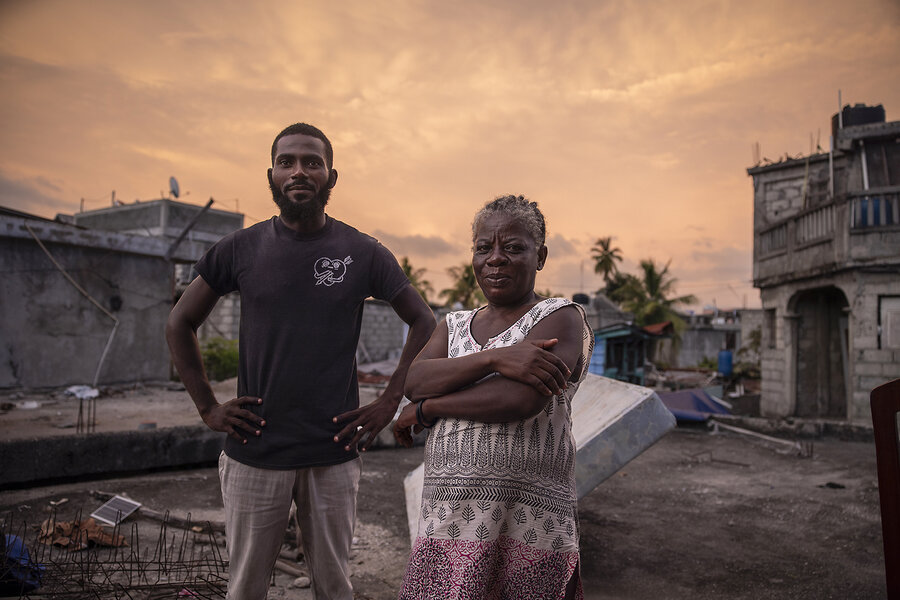
Paul Stanley learned early that once you joined a gang, you never left. Leaving meant you were a traitor. It meant you were weak.
“It could have you or your family killed,” he says.
But last year, Mr. Stanley knew he couldn’t continue. “I did things I never thought I would do,” Mr. Stanley says. “Inhumane things. You obey to stay alive, but you lose your soul.”
Why We Wrote This
Despite billions in foreign aid to Haiti, life for most Haitians hasn’t improved. “Solutions must come from the people,” says one local minister.
He grew up in Cité Soleil, one of the largest slums in the Western Hemisphere, located in the northern reaches of metropolitan Port-au-Prince. The name means “Sun City,” but as Mr. Stanley puts it, “When the sun rises, it is often light without hope.”
Haiti’s government remains in shambles after the assassination of its president and a devastating earthquake a month later in 2021. Haitian police are outnumbered and outgunned by more than 100 gangs, some of which formed a powerful alliance in 2024. They control almost 90% of Port-au-Prince and have driven more than 1.4 million residents from their homes.
Over the past 30 years, Haiti has been host to numerous international interventions, from the United States-led multinational force in 1994 that restored President Jean-Bertrand Aristide after a military coup, to United Nations peacekeeping forces even before an earlier deadly earthquake in 2010. Most recently, a Kenya-led international police force, which had fewer than 1,000 officers, ended its U.N. mandate this past October without making much of a difference against the power of the gangs.

The U.N. has since approved a stronger mission known as the Gang Suppression Force, which will have up to 5,550 police officers empowered to detain suspected gang members and conduct offensive operations. Its first officers arrived in December to begin the transition.
Amid what feels like a dizzying descent into lawlessness, Haitians are increasingly questioning the role of international intervention and what it has done for them. Solutions to Haiti’s problems, though small-scale and imperfect, are growing inside the country.
In the midst of his own despair, Mr. Stanley did discover a small ray of hope.
He heard of a pastor in Delmas, another area of Port-au-Prince, doing what few in Haiti dared: taking in former gang members and offering rehabilitation, education, and a place to stay.
Pastor Julio Volcy has been ministering to gang members for nearly 15 years. At his rehabilitation center, known as Haiti Teen Challenge, 18 new residents begin a yearlong program every six months. They are offered lessons in compassion, honesty, and respect, as well as training in everything from plumbing to cellphone repair.
In 2016, Mr. Volcy decided to found a church – which he called Rendez-vous – after he saw how many of the young men he helped get out of gangs were not welcome in other congregations in Port-au-Prince. Today, many of these former gang members are part of Rendez-vous’ ministries.
His work is largely funded by donations from the U.S., though donor fatigue is noticeable, the pastor says. The secret behind the church’s success, according to Mr. Volcy, is that it is led by Haitians. “If I were a foreigner, I would have left like everyone else,” he says.

During Mr. Volcy’s sermon on this morning, the four screens behind him glow with a single word: unity.
“Do politicians and ministers control the country’s future?” Mr. Volcy asks his congregation. “No,” he answers himself. “Solutions must come from the people.”
It’s a sentiment heard throughout Haiti. But enormous challenges remain, for both the Rendez-vous congregation and the nation itself. The rehabilitation center has space for only a fraction of the hundreds who apply each year. “Those who we turn away go back to the gangs,” says one of the teachers. “There’s nowhere else for them.”
Mr. Stanley finished the program months ago. Without anywhere to go, he stayed to help oversee new arrivals. In the absence of a functioning justice system or any systematic plan to reintegrate former gang members, even those who were able to escape face a dilemma. He is still wary of gang retaliation or acts of revenge from neighbors who recognize him.
Mr. Stanley tells new arrivals that he, too, struggled to adjust to the strict routine at Haiti Teen Challenge: waking early, cleaning, cooking, listening only to worship music, using phones only under staff supervision.
“There are many young people ready to change,” he says. “They just need a chance.”

Foreign support for Haiti is fading
Increasingly, scholars are asking why, despite billions of dollars in international aid pledged since the catastrophic 2010 earthquake, life for most Haitians has failed to improve.
“It hasn’t been done right,” says Isabelle Clérié, a Haitian transitional justice expert and development leader. “They haven’t been engaging with us in a way that allows our creativity and resourcefulness to come through.”
“Moving forward, Haiti will still need the assistance of the international community,” she asserts. “But it should be them listening to us.”
Haiti is one of the world’s most aid-dependent countries, and foreign support is fading. The U.S. provided over $590 million in 2024, but the Trump administration has shuttered U.S. Agency for International Development (USAID) programs and has cut foreign aid across the board.
Jessica Hsu, a cultural anthropologist who has lived and worked in Haiti for 23 years, argues that the rhetoric of international aid organizations – “victims,” “beneficiaries” – has stopped people from seeing themselves as agents of change and is instead fraying the social fabric.
“I see it constantly,” she says. “Neighbors work together until the first [nongovernmental organization] arrives. Then, they start competing over resources.”
Rosy Auguste Ducéna, a lawyer and program director at Haiti’s National Human Rights Defense Network, compares the failure of the latest international force with the U.N. mission that left Haiti in 2019, noting that it took only three years before the country was again in chaos.
“People should have learned from this and realized that the only way to resolve Haiti’s security crisis is to strengthen our own institutions,” she says, highlighting in particular the need to combat the corruption that finances the gangs.

James Buck/Special to The Christian Science Monitor
Jake Johnston, a senior research associate at the Center for Economic and Policy Research in Washington, argues in his book “Aid State: Elite Panic, Disaster Capitalism, and the Battle To Control Haiti” that foreign aid, rather than strengthening the Haitian state, has hollowed it out.
Decades of foreign aid flowing to international organizations and contractors, Johnston writes, created an “outsourcing” of the state, with education, health services, and infrastructure handed over to private actors and NGOs. Foreign donors effectively started to run parallel governance systems – what Mr. Johnston calls “the Republic of NGOs.”
And now, many of the donors are gone.
Deborah Bräutigam, a researcher in development policy, governance, and foreign aid at the Johns Hopkins University School of Advanced International Studies, says aid works well where there is strong governance. But in Haiti and other now aid-dependent countries, assistance was pumped in without robust institutions or functioning systems for raising revenue.
“Donors came in to fill many of those functions. Then, the incentive for local leaders to create their own institutions was short-circuited,” she explains.
Dr. Bräutigam argues that it is no coincidence that countries with long-term heavy dependence on aid have fallen into cycles of violence. “When the state is hollowed out, its ability to provide security is compromised.”
Local militias organizing to fight gangs
On a misty morning in Kenscoff, a town high above Port-au-Prince, Jean René, known here simply as Base San, “the one who fears nothing,” sits on a curb, his rifle balanced across his lap. His bloodshot eyes close, and then open again. He says he hasn’t slept in days.
“A warrior doesn’t sleep,” he says. “A warrior must always be ready.” Mr. René is a central member of a local militia known as BRICK, the French acronym for Communal Brigade of Kenscoff. Its members are well armed and wear handmade uniforms stitched with the brigade’s emblem.
Militia members meet weekly to assign patrol zones, establish checkpoints, and monitor who enters the town by car or motorcycle. They inspect abandoned houses to ensure no gang members are hiding inside.

Guerinault Louis/Anadolu/Getty Images/File
Kenscoff, about 30 minutes from the chaos of Port-au-Prince, once supplied lettuce, carrots, and avocados. Residents here believed the violence would never reach them.
But last January, the gangs arrived. Armed with rifles, drones, and motorcycles, they advanced from the lowlands, looting, killing, torching houses. Families fled down the hills, leaving behind their livestock and harvests.
Mr. René, a father of three and a former bodyguard, didn’t go anywhere, he says with pride. “Not even when I was the last man on my street. Not even when it felt like a hundred bullets were fired toward me.”
When police arrived from the city, they asked for his help. Unlike them, they said, he knew the terrain. They gave him a weapon “and showed me how to use it,” he says.
BRICK is just one example of a security movement spreading across Haiti’s capital and beyond. Increasingly disillusioned with the ability of national and international forces to protect them, civilians are organizing themselves – with growing sophistication – against the gangs.
“When gangs united in 2024, so did the self-defense brigades. Their collaboration with the police and local authorities intensified as well,” says Mac Archer, a research analyst with the Global Initiative Against Transnational Organized Crime, based in Haiti.
Kenscoff’s mayor, Jean Massillon, confirms that the BRICK militia is recognized by the municipality and that police have supplied it with arms. Several days a week, he leads meetings with the brigade’s elected committee to coordinate the group’s
activities.
“The police are not enough,” Mayor Massillon says. “They come from the city; they don’t know the terrain. Their morale is low because they feel unprotected. The multinational forces come and go, fight from their vehicles, never on foot, which is a problem in the mountains.”
“But the people of Kenscoff … this is their home. Their children are here,” he continues. “These people fight day and night, without pay, simply because they love Kenscoff.”
Scholars are warning about the brigades, as the line between them and the law is becoming increasingly blurred, with reprisals and extrajudicial killings carried out not only by gangs, but also by brigades and police forces – which sometimes hand gang members over to the brigades. They point to vigilante movements in the 1970s and 1980s that were armed by politicians and later turned into today’s gang problems.
“A lot of people say the only form of justice left in Haiti is bwa kale,” says Ms. Hsu, the cultural anthropologist, referring to a practice of mob justice often associated with the brigades. “It’s a long cycle of violence that needs to be interrupted, not continued.”

James Buck/Special to The Christian Science Monitor
In Les Cayes, still no running water
In the port city of Les Cayes, in a neighborhood known as Jon Grenn, a maze of narrow alleys is still scattered with piles of broken walls and bricks. Solitary walls still stand here and there.
Hundreds of thousands of civilians fleeing the gangs in the capital have arrived here – only to find a region still reeling from the devastating 2021 earthquake.
Most houses in Jon Grenn remain unrepaired. People have returned to their damaged homes, living for months under tarps stamped with USAID or insignia from U.N. missions. Community leaders estimate Jon Grenn’s population has doubled over the past three years with arrivals from the capital’s violence.
Outside Jon Grenn, a water station bearing a USAID logo has stood broken since the earthquake more than four years ago.
Dwindling aid has made life more difficult. But it has also revealed larger structural problems: Public institutions, including health and education authorities, are dependent on foreign aid.
Among the infrastructure damaged in the magnitude 7.2 earthquake was the public water system. The National Directorate for Drinking Water and Sanitation, or DINEPA, which relies on international donors for 98% of its budget, began the lengthy process of applying for aid to repair the system.
In Les Cayes, much of the promised funds for repairs came from USAID, which at the time was Haiti’s largest donor and supported nearly half of all contributions to Haiti’s 2025 humanitarian plan, including water and sanitation programs. Last year, just as DINEPA was finally set to begin the USAID-funded restoration of broken water pumps in Les Cayes, the funding was cut.
Philippe Eliscar, DINEPA’s director in the country’s south, says this is the problem with such reliance on foreign aid. He says he constantly pleads with the central government to prioritize the water agency, submitting budgets every year. “The Haitian state has no money. It stays attached to the idea that donors will take care of it,” he says.
In the meantime, local residents are trying to find their own solutions. Marie Jean, a community organizer in Jon Grenn, founded a group supported by local NGOs that built a concrete canal in the neighborhood. Beside the canal her group built, a small white pipe pumps out groundwater.
People with buckets wait their turn. “Everyone contributed to build it,” Ms. Jean says. “Otherwise, there would be no water.”

James Buck/Special to The Christian Science Monitor
Haitian kobit: community cooperation
In Haiti, young activists have been seeking an alternative to outside solutions and to rebuild Haiti’s social structure through a traditional concept called konbit. Throughout Haiti’s history, community members would work together in each other’s fields in an unpaid cooperative rotation. Activists use the concept to “study the history and sociology of the Haitian people to understand what unites and moves them forward,” says Cassandra Jean Francois, a leader of Gwoup Konbit, a community organizing nonprofit supported by voluntary donations from Haiti and abroad.
When the movement began in 2011 in Cité Soleil, it was called Konbit Soleil Lave, or Konbit of the Rising Sun. It was a direct response to the cash-for-work street-cleaning initiatives imposed by aid organizations after the 2010 earthquake, which in Cité Soleil often had the unintended effect of incentivizing residents to keep the area dirty and, according to Ms. Francois, providing short-term work for gang leaders.
The group began inviting people from different zones to clean the streets together and “rebuild relationships across divides,” Ms. Francois recounts. The neighborhood became known as one of the cleanest in Port-au-Prince.
Gang violence has since halted the Gwoup Konbit project in Cité Soleil, but the effort has taken root elsewhere. And in a country where garbage trucks barely run, clean streets carry their own power.
It’s a way to show the neighborhood that change is possible, says Pastor Volcy, who organized a similar sanitation practice around his church. Every Wednesday, the young men he helps to stay away from gangs head out with brooms and trash pickers, sweeping streets and pulling weeds.
Mr. Stanley, the former gang member, finds comfort in building instead of destroying. “When I see what I’ve built, I feel proud,” Mr. Stanley says, adding that he has begun to dream of opening a school in his neighborhood. “Before, I didn’t think I could do anything. Now, I know I can.”