
There are few more enjoyable sights than government ministers in full retreat, pretending they are following the plan they always intended. “No, no, dropping our weapons and running away screaming is the strategy!”
Which brings us to the House of Lords Digital Committee, which is looking at the government’s brilliant idea of giving away everyone’s copyright to American artificial intelligence giants, in return for a bag of magic beans that can only be seen by the very wisest ministers. A consultation on this last year found it was supported by just three percent of respondents, which must be some kind of record. That’s even smaller than the number of people who believe that the Loch Ness monster is real, or that Keir Starmer is doing a good job.
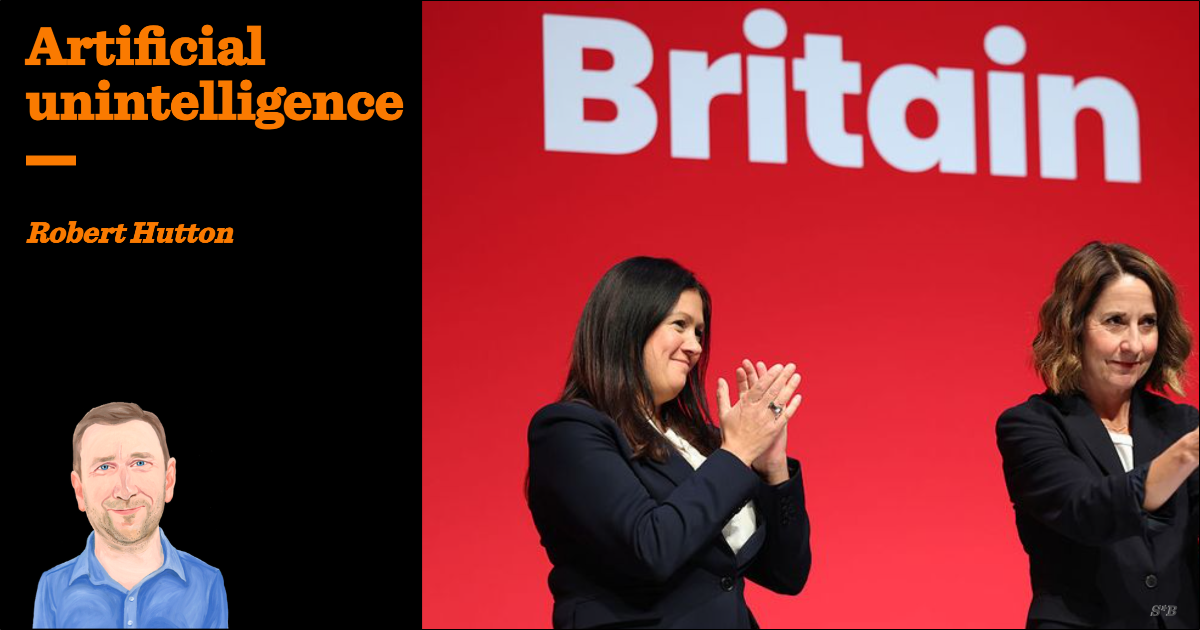
On Tuesday, the committee was treated to a joint appearance from Technology Secretary Liz Kendall and Claims-To-Be-Culture-Secretary Lisa Nandy. Two secretaries of state at once! Or one-and-a-half, anyway. “I don’t think our secretaries of state need much introduction,” Committee Chair Baroness Keeley said. Other opinions are available.
They had come, it turned out, not to defend their own proposals, but to bury them. “We are having a genuine reset moment,” Kendall explained. As bad as that, eh? It turned out, she said, that people who create stuff want “control of their art, what they produce.” You don’t say! More than that, she said, they also want to be paid. Imagine!
In fairness to Kendall, she has only been in her current job since September. The same couldn’t be said for Nandy, who now piped up. “One of the learning points for this government,” she said, “was that it was a mistake to start with a preferred model.”
“Not a terribly popular preferred option,” Kendall observed.
If you’d come to the hearing knowing nothing, you might imagine that this was all part of a careful and deliberate policy approach
So the proposal for copyright that ministers spent 18 months drawing up has been junked. What will replace it? “If we rush into this and get it wrong, then we could make a mess,” Nandy explained, speaking very much from experience.
The pair did a good job of making chaos look like coherence. If you’d come to the hearing knowing nothing, you might imagine that this was all part of a careful and deliberate policy approach. Thus it was helpful to have a running online commentary from Thangam Debbonaire, who would have been Culture Secretary had the voters of Bristol Central not had other ideas. She had, she explained, set out the need for a policy that protected creators way back in 2023. This had been Labour policy in opposition. The implication about the actual Culture Secretary’s grip on the issue was clear.
We’d heard earlier from tech industry representatives. A feature of the spokespeople for AI companies is that they increasingly sound like chatbots. Roxanne Carter, for Google, was eager to make her users happy, thanking them for their very interesting questions. Let’s hope her answers were more reliable than Google’s AI-generated summaries.
“The creative industries are incredibly important to Google, and we see them as a partner,” Carter said soothingly. It’s now a couple of decades since Google “partnered” with the news industry, a relationship that left Google very rich and newspapers out of business.
“We need an enabling copyright framework,” she went on. This is in rather the way that burglars need enabling window locks. Might the company hand over money to people who made things? “It’s not a question that we won’t pay. It’s that we need to have certainty of what we are paying for.” They could start by asking the people who are quite certain what they’re not being paid for.
A peer concerned about the Elon Musk AI’s make-anyone-naked option asked whether the material on which Google’s AI was trained was all wholesome stuff. “It is not just that you want high quality data, you need the good, the bad and in cases the ugly as well,” Carter said. “If you’re training the model to be safe, you need to show it what is harmful.” This was not entirely reassuring.
Alphabet, which owns Google, is valued at £3 trillion, a number that we should keep in mind as we listen to the company’s expensively turned out chatbots explain that there is no money for people who actually make things, rather than just take each other to lunch to discuss the best way to get stuff without paying for it.
Guy Gadney, of the smaller company Charismatic.ai, was a former publishing man, and had more sympathy for creatives. “Look at where the money is going, who has it, and how much of that money is going to creators themselves.” It seems a safe bet that Google is currently giving more of it to its lobbyists than it is to writers and artists.
And so far it has paid off. Nandy explained that there had turned out to be “challenges” with ideas the government had previously championed “that we hadn’t anticipated or fully understood.” Although this was not for lack of people trying to explain this to ministers. “What we don’t want to do is bring forward legislation without having thought this through,” said the Secretary of State For-Bringing-Forward-Proposals-Without-Having-Thought-Them-Through.
Kendall said there will have to be a compromise: “Not everybody will get everything.” This may be a disappointment to Google, which has become very used to getting everything.
Kendall finished with an impassioned defence of artificial intelligence. It would drive economic growth and deliver “hard power” to nation states. If this is true, then ministers need to get better at explaining it. It’s not obvious why ChatGPT giving incorrect answers to questions about cake recipes will determine which country is top nation in 2036