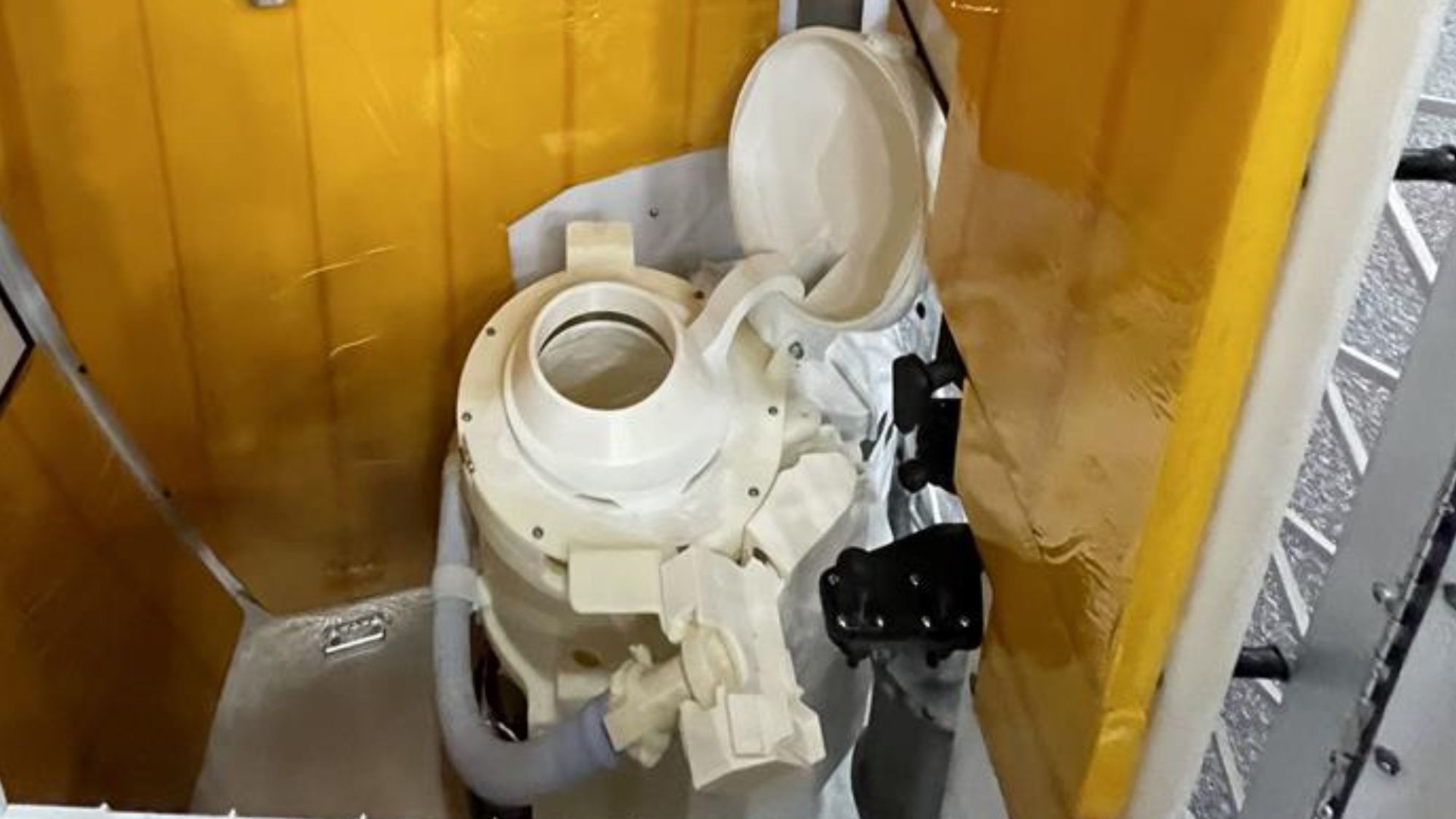
ASTRONAUTS aboard Artemis II reported a worrying burning smell coming from its state-of-the-art £17.4million loo – just hours before it was restricted to “faecal use only”.
The temperamental toilet had previously packed up shortly after launch, forcing the four crew members to hold their bladders for six hours.
Mission specialist Christina Koch eventually came to the rescue, fixing a problem urine hose in the waste management system.
But just days later the pricey lav has reared its ugly lid once again.
Koch radioed Mission Control to report a concerning burning aroma drifting into the spacecraft.
She said: “Regarding the smell, I just wanted to make sure you all were tracking the EGS notes of the kind of burning heater smell that was coming from toilet several times.”
Read more about the Artemis

“It was never identified as the source, what it exactly was, but it was identified as an unknown smell.
The crew described the scent as similar to that of an old electric heater that’s been left unused for a while.
Initially, Nasa flight controllers suspected the smell was coming from the orange insulation on the toilet’s hygiene bay door, but they have yet to confirm the cause.
Despite the mystery, Mission Control cleared the crew to keep using the high-end loo, assuring there were “no major concerns” about the strange aroma.
But just hours later, the astronauts were told that the troublesome toilet would have to be restricted to number twos only.
A second waste water was noted by the crew as “lacking volume”, meaning all liquid must now with “collapsible contingency urinals”.
The latest dump lowered the quantity of waste water to 15% and the Orion spacecraft has now rotated to a position that will allow the sun to shine on waste water vents and thaw any liquid inside.
The Orion is now two-thirds of the way to the moon and is on course for a lunar flyby by Monday.
The Artemis II – the mightiest rocket ever built – thundered into the sky on April 1, leaving the Earth‘s orbit yesterday to start its three day mission to the Moon.
It is the first manned Moon mission since Nasa’s Apollo 11, which made its lunar visit in 1972.
The four crew on board are Nasa’s Koch, Reid Wiseman, Victor Glover and Canadian Space Agency’s Jeremy Hansen.
The crew won’t pause for a stopover or orbit the Moon like Apollo 8’s first lunar visitors did so famously on Christmas Eve 1968.
But the four astronauts stand to become the most distant humans ever when their capsule zooms past the Moon.
They will then continue another 4,000 miles beyond, before making a U-turn and tearing straight home to a splashdown in the Pacific.
Breathtaking pictures from onboard the Orion show the Earth from approximately 100,000 miles away.
A jaw-dropping full view shot taken from the Orion capsule shared yesterday shows the divide between night and day, known as the terminator, cutting across Earth.
Another striking image reveals a spectacular green aurora lighting up the atmosphere, while faint zodiacal light is also visible.
Commander Wiseman snapped the pictures after the aircraft thundered out of Earth’s orbit to start its three-day journey to the moon.
“It was the most spectacular moment, and it paused all four of us in our tracks”, Wiseman said, describing the view.
But the high-stakes mission has not been without tense moments.
Engineers ran into issues on launch day, facing two technical scares and a one-hour delay before liftoff.
Canadian Hansen, 50, revealed the “tense” moment in the crew’s first live interview from space.
He said: “We did get a warning message for ‘cabin leak suspected’”.
Cabin leaks can be deadly – they could lead to the structure of the spacecraft being compromised, risking exposing the crew to space’s powerful vacuum.
Fortunately, the crew investigated and found the alert was a mistake, and onboard cabin pressure remained at normal levels.
During a post-launch press conference, the space agency said the crew were “safe, they’re secure and in great spirits”.
The US is now targeting a return to the lunar surface by 2028, before China does in 2030.