The best art books offer fresh discoveries with each turn of the page, helping readers see the world differently. This year’s standouts include four coffee table books that celebrate an aspect of nature’s beauty in photographs, paintings, and drawings. They showcase birds, butterflies, common flowers, and coastal habitats as you’ve never seen them before. All are sure to spark delight and awe. But they also serve as a reminder of the fragility of the natural world.
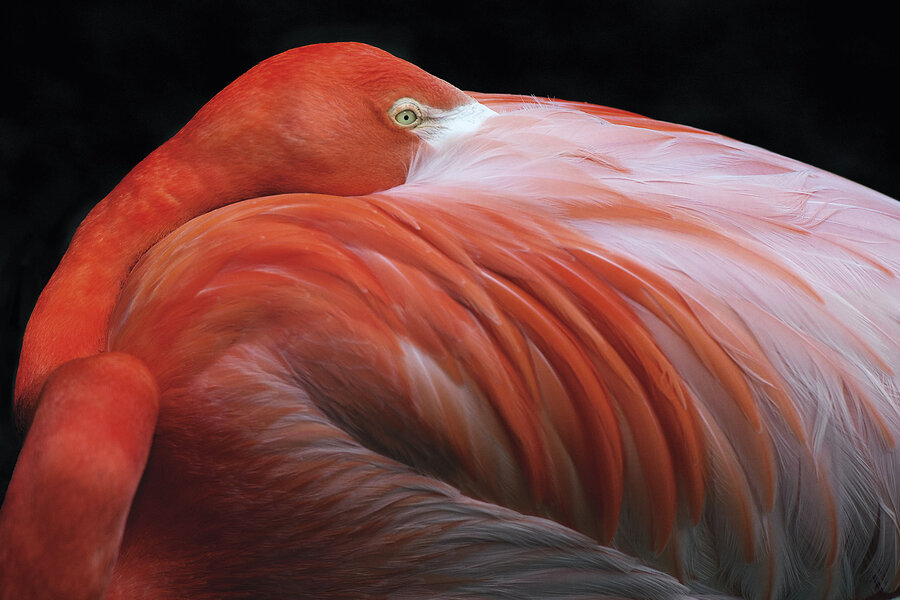
Bird photography has soared in the 21st century, thanks in part to technological advances, including faster shutter speeds. Aviary: The Bird in Contemporary Photography by Danaé Panchaud and William A. Ewing, is neither a book of nature photography nor a handbook for birders organized by species or habitat. Instead, these photographs highlight the complex relationship between birds and humans. Many are carefully lighted, staged studio portraits of individual birds. Set against black or white backgrounds, these arresting portraits evoke fashion photography more than wildlife photography.
The work of several photographers stands out, often in strikingly different images of birds in the same biological family. Lukasz Gwizdziel’s “Lazy Morning (Cranes),” a wonderful landscape shot of a flock of cranes silhouetted against an exquisite pink and purple sky, creates quite a contrast with Randal Ford’s two studio shots of a pink powder puff-plumed African Crane.

Why We Wrote This
Beauty can be found in a bird’s plumage, a coral reef, a butterfly wing. Our reviewer shares her picks for art books that celebrate nature in all its vibrancy and endless variety.
New York City Parks Commissioner Thomas Hoving was reportedly the first to call rock dove pigeons “rats with wings,” a phrase that became popular from Woody Allen’s 1980 movie “Stardust Memories.” No one would say that about the spectacular pigeon species featured in “Aviary.” Tim Flach, whose “Victoria Crowned Pigeon” adorns the book’s cover, is a British photographer known for stylized portraits of animals that highlight their personalities and human aspects. In his “Red Splash Jacobin Pigeon,” the bird, clearly ready for its closeup, gazes out from its spectacular hooded “fur” collar like a Park Avenue socialite. Randal Ford’s “Bantam White Polish Hen” looks like she just got out of bed and hasn’t yet brushed her tousled white hair.
But sometimes what shines through a portrait is more color than mien. Leila Jeffreys’ “Nicobar Pigeon” is all about the extraordinary range of iridescent blues and greens she’s captured in the bird’s plumage. In Tim Flach’s “Mandarin Duck and Wood Duck,” it looks like Nature went to town with a huge box of crayons.
You’d be hard put to find more magnificent landscapes and seascapes than in Peter and Beverly Pickford’s Wild Ocean: A Journey to the Earth’s Last Wild Coasts. The married wildlife photographers spent four years of far-flung travel and intrepid fieldwork to produce this gorgeous record of some of the most remote places on Earth.

The Pickfords set off from their home on the west coast of South Africa to visit marine habitats stretching from South Africa’s Transkei Coast to the icy waters of British Columbia and Alaska, and from the reefs of the South Pacific Coral Triangle to the King Penguin breeding colonies in the subantarctic. Their book eloquently captures what humanity stands to lose if these stunning locales are not protected.
In the Indian Ocean’s Ningaloo Reef in Western Australia, the authors encountered swarms of whale sharks attracted by the corals. They also managed some beautiful shots of a juvenile polka-dotted barramundi and dainty lemon damselfish poking contentedly through bountiful cabbage coral.
In the Jardines de la Reina in Cuba, a lilac and gold basslet stands out against a patterned carpet of coral that looks like a William Morris design. The couple’s travels through Alaska took them close – sometimes too close for comfort – to grizzlies, walruses, humpback whales, harbor seals, and wolves. These offered a sharp contrast to the giant tortoises, mockingbirds, iguanas, and flamingos populating Ecuador’s Galapagos Islands that they also captured.
The word “breathtaking” aptly describes both the Pickfords’ often-scary scuba dives and the book in which they have documented their incredible journey.

From “Butterfly: Exploring the World of Lepidoptera”
With Butterfly: Exploring the World of Lepidoptera, Phaidon editors repeat the winning formula of “Bird” (2021) by chronicling the titular subject through images that span centuries and cultures and run the gamut from ancient relics to fine art, fashion, jewelry, and advertisements.
The appeal of this book lies in the diversity and unexpectedness of its finds, which convey a sense of the butterfly’s broad allure throughout history, often as a symbol of beauty or fragility. Highlights include a remarkably well-preserved fossilized butterfly from about 34 million years ago, a Tiffany inkstand and diamond bracelet, and paintings by Vincent van Gogh, Pablo Picasso, Hokusai, Andy Warhol, Yayoi Kusama, and Faith Ringgold, among others. All feature these cherished but increasingly endangered insects – which evolved from their less-beloved fellow lepidoptera, moths.

Many of the book’s selections are amusing. The editors have juxtaposed Rea Irvin’s famous 1925 New Yorker cover of a dandy peering through his monocle at a butterfly with a whimsical butterfly-strewn parasol designed by Elsa Schiaparelli in 1937 on the facing page. In Frida Kahlo’s self-portrait from 1940, two gossamer lepidoptera have alighted on her head. A Jean Dubuffet collage from 1955 incorporates a mosaic constructed from various types of butterfly wings.
A detailed anatomical drawing of a butterfly wing by Vladimir Nabokov, 20th century novelist and lepidopterist, along with trays of pinned specimens for study remind us of the serious business of classification. A contender for the book’s most peculiar entry is a photograph taken in Botswana in 2007 by Hermann Brehm that features a gathering of lovely green, black, and white butterflies all aflutter over what we learn is a fresh mound of elephant dung, which is completely obscured by the feasting insects.
“Butterfly” offers a different kind of feast.
Hilma af Klint: What Stands Behind the Flowers, edited by Jodi Hauptman, was published by The Museum of Modern Art as the catalogue for its recent exhibit of the Swedish artist’s botanical drawings. These exquisitely detailed watercolors reward even casual browsers, though art lovers who have rediscovered af Klint’s intriguing works will find them especially interesting.

In 1919-1920, after years spent creating the colorful abstract paintings filled with geometric and organic forms for which she is best known, af Klint, then in her 50s, produced a portfolio of nature studies in her native Sweden. What distinguishes them from traditional botanical drawings are the marginal abstract diagrams – colorful spirals, nested squares and graphs – that represent the spiritual qualities she assigns to each blossoming plant. The show’s curators have studied the artist’s notebooks and translated her obscure symbolic diagrams in order to reveal the traits she associates with each plant. Orange calendula, for example, is said to reflect a love of truth, while hairy violet and sweet violet convey willpower and humility, respectively.
These assessments may strike many as baffling, and more indicative of af Klint’s personality than the flowers’. For those who want to dive further, this thorough book includes excerpts from her notebooks along with explanatory essays. But the watercolors alone – like the other images in these four outstanding art books, provide plenty to marvel at.