An Egyptologist has proposed a new theory that the Ark of the Covenant was not merely a sacred container for the Ten Commandments, but a radical reimagining of ancient religious symbols.
David Falk, who holds a PhD in Egyptology from the University of Liverpool, argued the Ark was modeled on Egyptian ritual furniture, specifically shrines designed to hold a statue or idol.
But unlike Egyptian shrines, the Ark contained no idol, meaning it was built to show that God’s presence did not require a physical representation, Falk suggested.
In ancient Egypt, sacred chests and shrines were often decorated with uraeus cobras that spat fire, symbols meant to protect and sanctify holy space.
Winged goddesses also appeared on Egyptian thrones and shrines, their outstretched wings signifying protection and divine power.
Falk argued the Ark borrowed this visual language but flipped it, creating sacred space not inside the box but above it, between the wings of the cherubim on the mercy seat.
If Falk is correct, the Ark’s design reveals a deliberate theological innovation: a sacred object built to reject the religious norms of its time, while still using their symbols to mark it as holy.
The theory implies that the Israelites did not just abandon Egyptian religion, but they intentionally weaponized its symbols against it through the Ark.
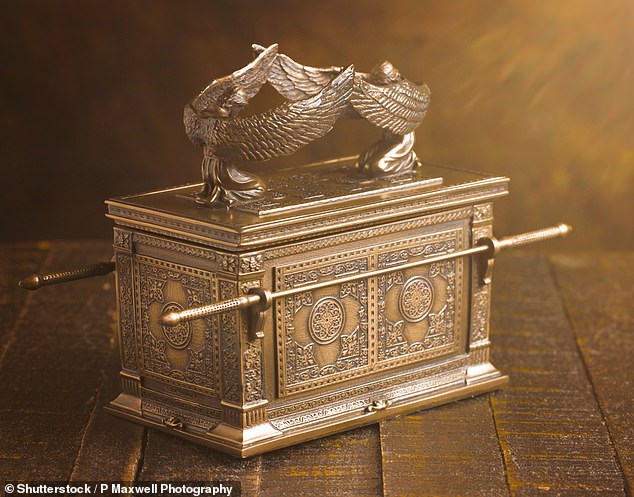
A new theory has suggested that the Ark was built using ancient Egyptian religious symbols as a theological rebuke, a statement that the Israelite God was superior to Egyptian gods because he required no idol, and because his presence was not confined to a statue
The Bible states that the Israelites spent generations in Egypt, which would have led to absorbing all aspects of its culture and religious imagery.
Falk’s theory suggested that, rather than simply abandoning these influences, the Israelites intentionally borrowed and reworked them.
The biblical relic would then function as a theological rebuke, a statement that the Israelite God was superior to Egyptian gods because He required no idol, and because His presence was not confined to a statue.
The Ark of the Covenant is one of the most iconic artifacts in religious history, yet it remains one of the most mysterious.
According to scripture, Moses placed the Ten Commandments inside the Ark, which was kept in the Tabernacle, a sanctuary built shortly after the Israelites’ Exodus from Egypt, traditionally dated by some scholars to around 1445 BC.
The Book of Exodus describes the Ark as a gold-covered acacia wood chest with precise dimensions and carrying poles.
Its lid was topped with two cherubim facing one another, their wings outstretched to form a sacred space known as the ‘mercy seat,’ where God would commune with Moses.
While the fate of the Ark remains a mystery, it vanishes from the biblical record before the Babylonian sack of Jerusalem in 586 BC.
Join the debate
How do you think ancient symbols shaped the way religions competed and defined themselves?
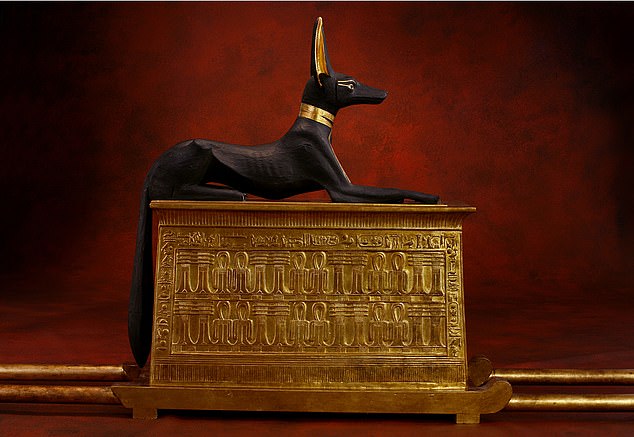
The theory pointed to ancient Egyptian chests, noting how similar they are to the Ark
Falk noted in Biblical Archaeology that ‘the Ark was constructed using a visual language that everyone knew 3,300 years ago, but is mostly lost to us today.’
His theory centers on the idea that the Ark was intentionally modeled on Egyptian ‘shrine’ furniture, which was often built to house a statue or idol of a deity.
These shrines were typically gold-covered and decorated with protective imagery.
The most common protective figures were the uraeus cobra, often depicted spitting fire, and winged goddesses, whose outstretched wings signified divine protection and power.
Falk argued that these symbols were not mere decoration, but active markers of sanctity, a way of announcing that a sacred presence was contained within.
However, rather than containing a physical god, the Ark may have been designed to create a holy space above its lid, between the wings of the cherubim on the mercy seat.
The mercy seat, a golden cover placed atop the Ark, featured two cherubim facing each other.
Their wings form a protective canopy, suggesting a sacred ‘throne room’ in the space between them. This, Falk argued, is a deliberate rejection of idol worship, a way of saying that God’s presence cannot be captured in a statue.
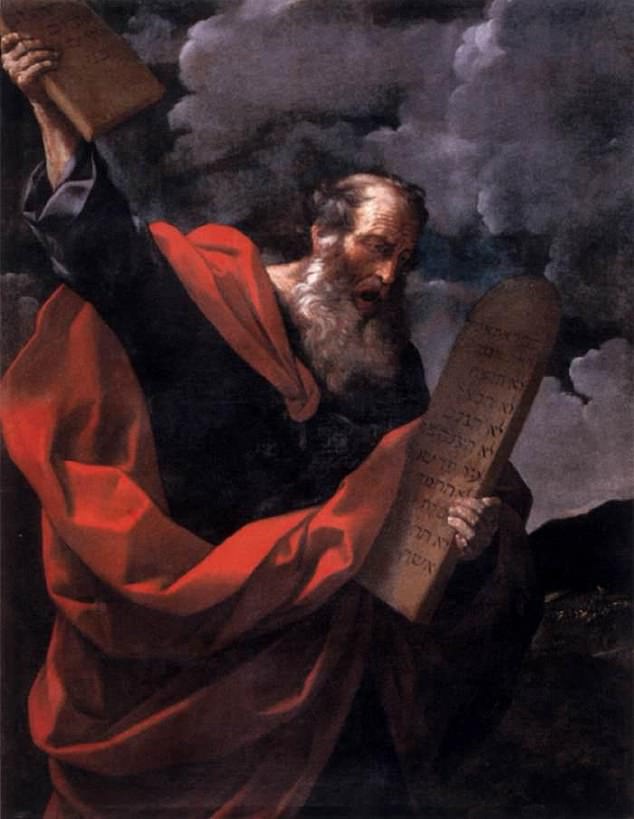
According to scripture, Moses placed the Ten Commandments inside the Ark , which was kept in the Tabernacle, a portable sanctuary built shortly after the Israelites’ Exodus from Egypt , traditionally dated by some scholars to around 1445 BC
The Ark’s carrying poles also support Falk’s argument, as in the Exodus description, the Ark was transported using poles that ran through rings attached to its sides.
Falk noted that this is consistent with Egyptian ritual chests, which were similarly designed to be carried by poles.
However, the Egyptian versions were built to carry idols, while the Ark was built to carry nothing inside.
This, Falk said, is the key difference: it retains the form of Egyptian sacred furniture, but removes its defining function.
If Falk’s interpretation is correct, the Ark becomes a powerful symbol of Israelite identity and resistance.