A withering letter by Howard Carter celebrating the death of a Daily Mail journalist who invented the ‘Curse of Tutankhamun’ has been uncovered nearly a century later.
The British archaeologist, who discovered the pharaoh’s tomb in the Valley of the Kings in 1922, states that the curse ‘had no basis and was a menace to archaeology’.
He also describes the passing of Mail reporter Arthur Weigall, whose theory gained prominence after the unexpected death of Lord Carnarvon, as a ‘real blessing’.
Mr Weigall was a distinguished Egyptologist working for the Mail in Luxor in February 1923 when the tomb was opened and wrote at length about the historic moment.
But the journalist had been angry with Carter and Carnarvon after they struck a deal with a rival correspondent at The Times for exclusive access to their discovery.
He had watched Carter’s financial backer Carnarvon enter the tomb in a jovial mood and told a reporter: ‘If he goes down in in that spirit, I give him six weeks to live.’
Carnarvon died six weeks later from a mosquito bite, after Mr Weigall claimed that any person disturbing the mummy of a pharaoh faced bad luck, illness or death.
He promoted this mythical theory in many columns which captured the attention of superstitious readers – but left Carter unimpressed as it spread around the world.
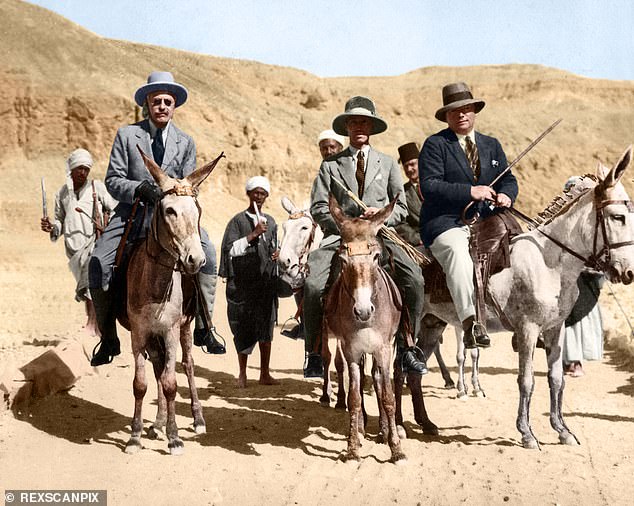
Daily Mail journalist Arthur Weigall (right) travels to Tutankhamun’s tomb in February 1923, alongside Sir Louis Mallet (left) of the Foreign Office and politician Sir Philip Sassoon (centre)
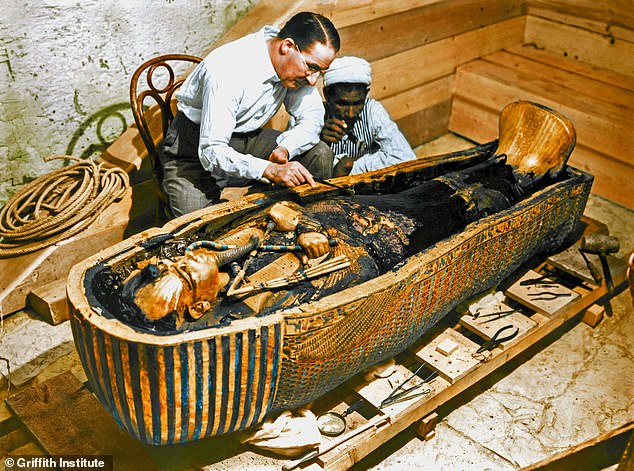
Archaeologist Howard Carter examines Tutankhamun’s tomb after its discovery in 1922/23
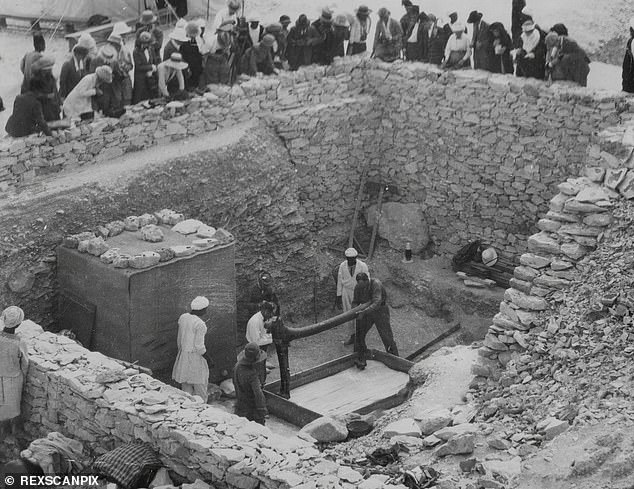
Tourists watch the removal of artefacts from Tutankhamun’s tomb in Luxor in February 1923
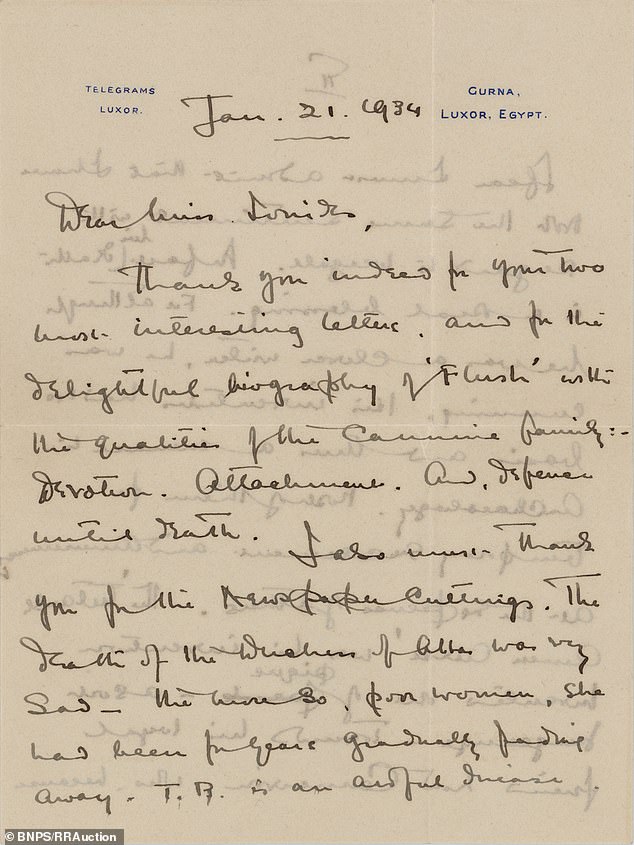
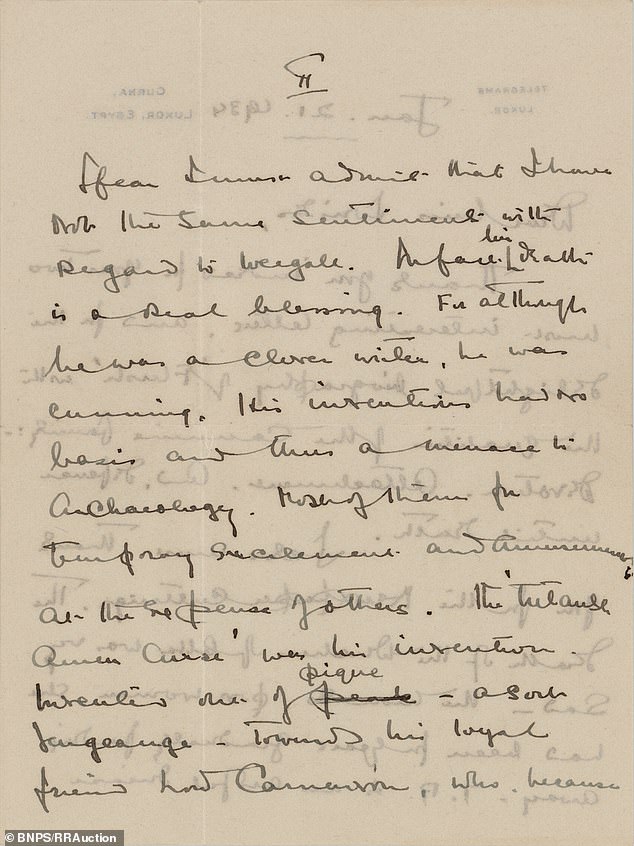
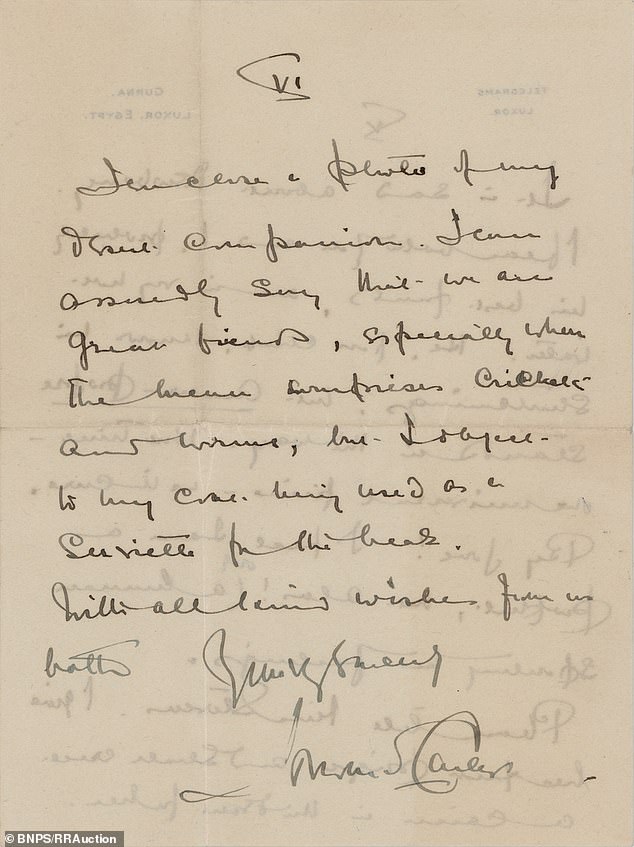
The newly-unearthed letter by Carter to a woman named Helen Lonides in January 1934 said: ‘The death of the Duchess of Alba was very sad – the more so, poor woman, she had been for years gradually fading away. T. B. is an awful disease.
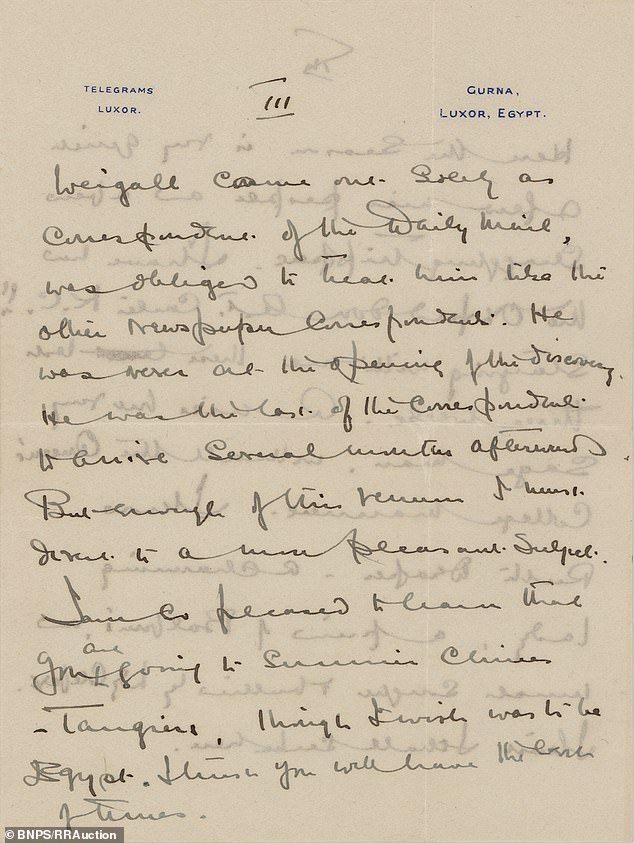
‘I fear I must admit that I have not the same sentiments with regard to Weigall. In fact his death is a real blessing. For although he was a clever writer, he was cunning.
‘His inventions had no basis and thus a menace to archaeology. Those of them for temporary excitement and amusement at the expense of others. The ‘Tutankhamun Curse’ was his invention. He was never at the opening of the discovery.
‘He was the last of the correspondents to arrive, several minutes afterwards. But enough of this venom, I must direct to a more pleasant subject.’
Carter, who died in 1939, had tipped off The Times’s Cairo correspondent Arthur Merton about the dig – and signed an exclusive deal with the newspaper on January 9, 1923 in exchange for £5,000 and 75 per cent of the syndication profits.
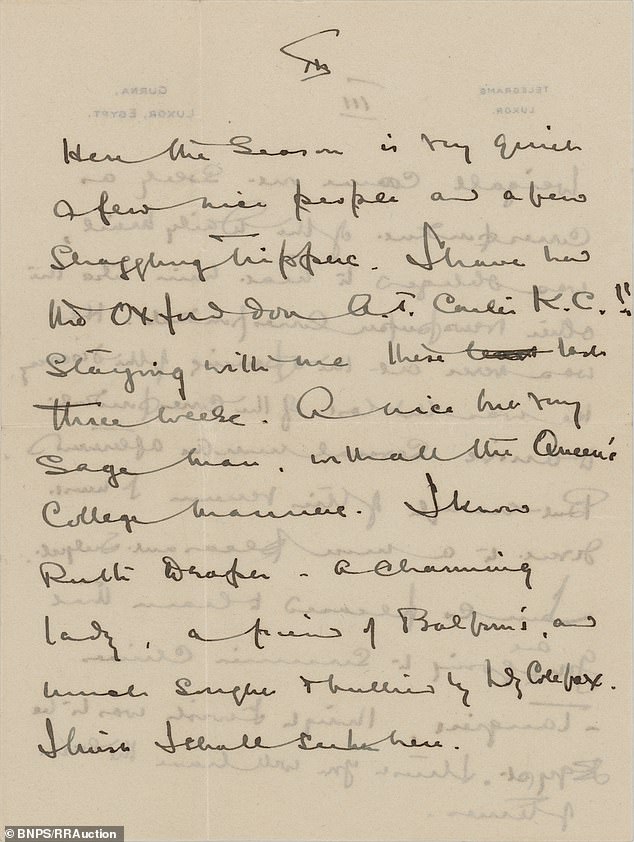
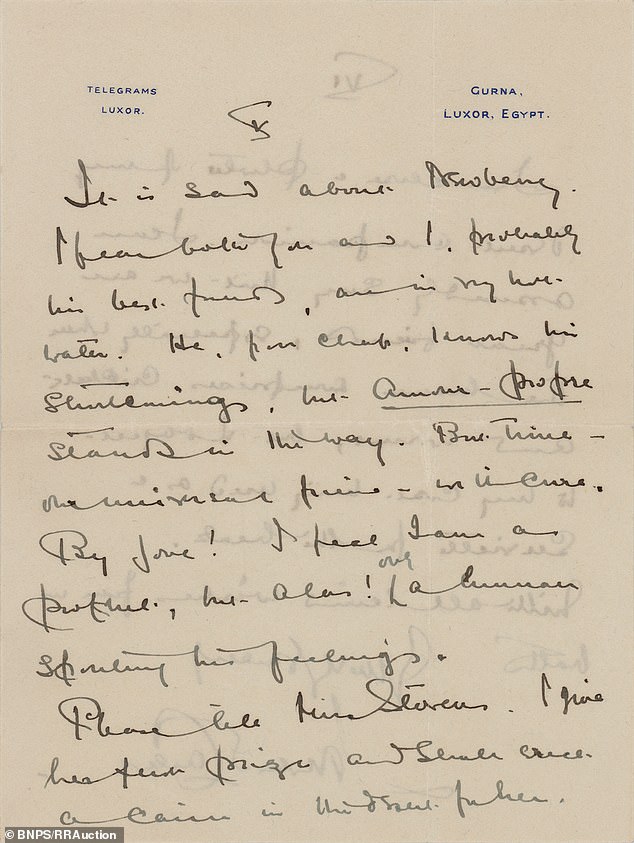
The three-page handwritten letter, with a letterhead stating ‘Curna, Luxor, Egypt’ – referring to the Kurna area near Luxor, has come to light through its sale at auction.
It exceeded expectations by fetching £12,530 ($16,643) at RR Auction in Boston in the US.
After Carter and Carnarvon gave The Times exclusive access to the discovery, Mr Weigall wrote in the Mail about his displeasure at the arrangement.
He wrote in 1923: ‘The thrill of discovery will make us forget our anxieties. But at the moment, people’s nerves are decidedly on edge. And one might imagine that the malevolence which is sometimes supposed to linger around the bones of the ancient dead had been at work.’
Mr Weigall later wrote about the idea of Tutankhamun’s tomb being gripped by an evil spirit.
Carter first uncovered the 3,300-year-old tomb in 1922 in one of history’s greatest archaeological finds.
But until just weeks before Carter’s find, a system was in place in Egypt to allow foreign excavators to keep roughly half of their finds.
However, this was changed before the discovery to mean the Egyptian government would be able to keep all historically significant or high-value items, with the foreign teams permitted to take home lesser or duplicate pieces.
A new documentary on Channel 4 in January accused Carter of stealing from the tomb, as it revealed unpublished letters on camera for the first time which appeared to confirm the long-held allegation.
Mr Weigall is known to have sent Carter a letter himself in January 1923, one month before the tomb was opened, stating bluntly: ‘You and Lord Carnarvon made the initial error of thinking the old British prestige in this country is still maintained and you could do more or less what you liked, just as we all used to do in the old days.
‘You have found this tomb, however, at a moment when the utmost diplomacy is needed, when Egyptians have to be considered in a way to which you and I are not accustomed, and when the slightest false step may do the utmost disservice to our own country.’
Carter had joined the British-sponsored archaeological survey of Egypt at the age of 17 and also discovered the tombs of Hatshepsut and Thutmose IV in the early 1900s.
He began work with the 5th Earl of Carnarvon in 1907, an antiquities collector who wanted Carter to supervise excavations, and they discovered the first signs of Tutankhamen’s tomb on November 4, 1922.
A second sealed doorway was reached by November 26, behind which the treasures were found. Carnarvon famously asked: ‘Can you see anything?’ And Carter replied: ‘Yes, wonderful things!’
Carter also wrote in his diary: ‘It was some time before one could see, the hot air escaping caused the candle to flicker.
‘But as soon as one’s eyes became accustomed to the glimmer of light the interior of the chamber gradually loomed before one, with its strange and wonderful medley of extraordinary and beautiful objects heaped upon one another.’
On February 16, 1923, Carter and Carnarvon formally opened the burial chamber.
He then spent the next decade supervising the removal of the tomb’s contents, which can now be viewed in the Grand Egyptian Museum in Giza.
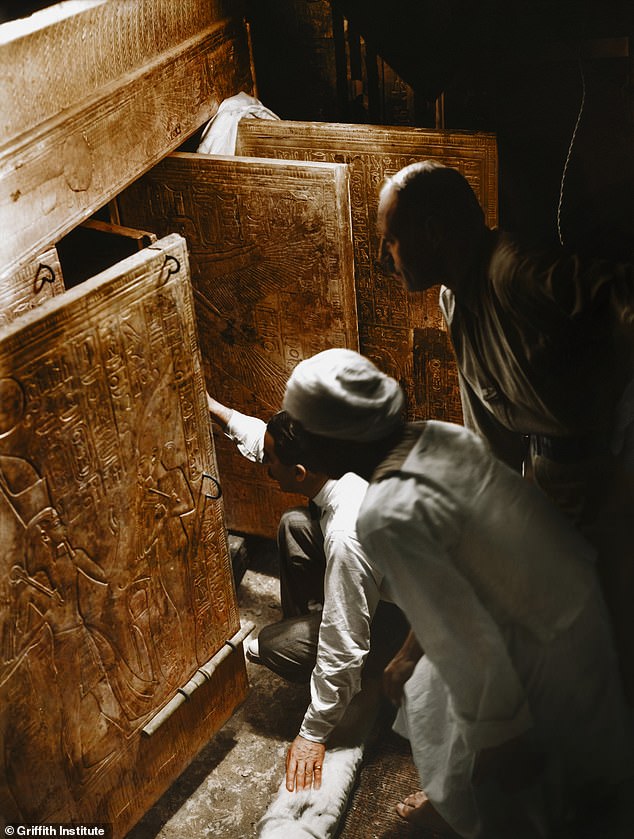
Howard Carter (kneeling) and some of his team looking through open doors of the four gilded shrines towards the quartzite sarcophagus within the tomb of Tutankhamun
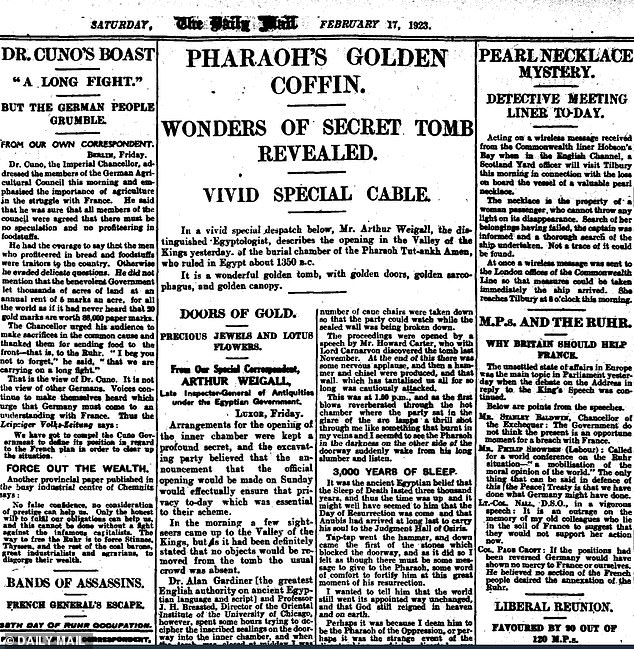
On February 17, 1923, one day after the burial chamber had been formally opened, Daily Mail journalist Arthur Weigall an article headlined ‘Pharoah’s Golden Coffin’ about what he saw
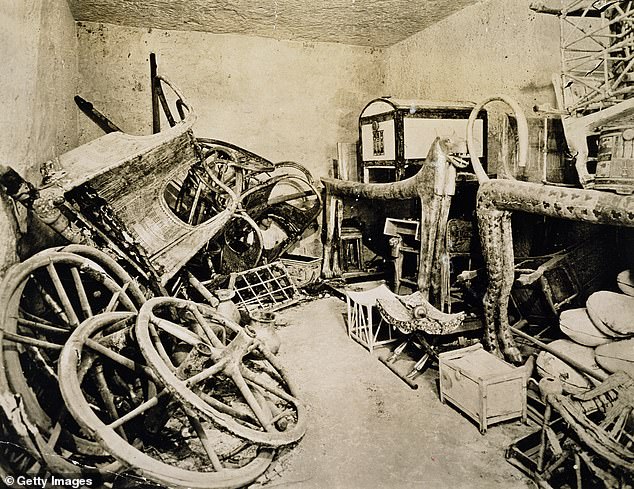
The antechamber of the Tutankhamun’s tomb following its discovery in November 1922
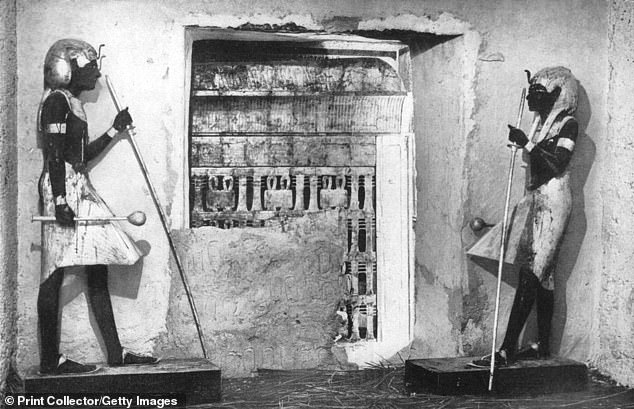
The sight that met the eyes of Howard Carter when he broke down the sealed doorway in 1922
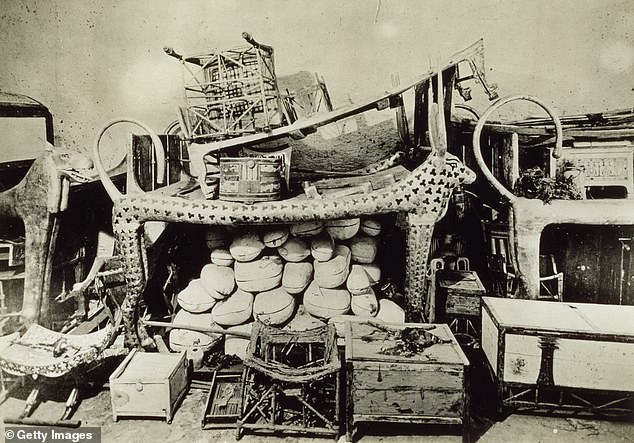
The antechamber of the Tutankhamun’s tomb following its discovery in November 1922
The 4,500 treasures included chariots, household items, jewelled ornaments and Tutankhamun’s iconic golden mask.
On February 17, 1923, one day after the burial chamber had been formally opened, Mr Weigall wrote a fascinating article in the Mail about what he witnessed.
In his piece, headlined ‘Pharoah’s Golden Coffin’, he said: ‘Tap-tap went the hammer, and down came the first of the stones which blocked the doorway, and as it did so I felt as though there must be some message to give to the Pharaoh, some word of comfort to fortify him at this great moment of his resurrection.’
Mr Weigall later added: ‘The amazed discoverers now turned to gaze at a huge statue of a goddess in the form of a lioness which is described as a superb work of art, and from this their eyes passed to a little chamber on the right leading from this burial room.
‘This was seen to be full of glorious objects – superb chariots of gold, a marvellous box of ivory and ebony and many chests, vases, and statuettes. It was a sight which took the breath away and the eyes of the discoverers turned in bewilderment from one side to another.’
Mr Weigall was fascinated by Egyptology from a young age and first worked at Abydos in the country – before being made Chief Inspector of Antiquities for Upper Egypt aged 25 in 1905.
He took over the role from Carter, who had been forced to resign over the ‘Saqqara Affair’, which saw him eject a group of drunken French tourists who were fighting with Egyptian guards at a series burial vaults – before refusing to apologise when the French tourists complained.
Mr Weigall held that post until 1914 when he returned to London just before the First World War and began working in the theatre and cinema – later being appointed as a film critic for the Mail in the 1920s. He was then sent back to Egypt to cover the opening of the tomb.
Mr Weigall later moved to America and married twice. His first wife was Hortense Weigall, with whom he had five children. They later divorced and he married Canadian divorcee Frances Muriel Weigall.
Mr Weigall died aged 53 on January 2, 1934 at the London Hospital.
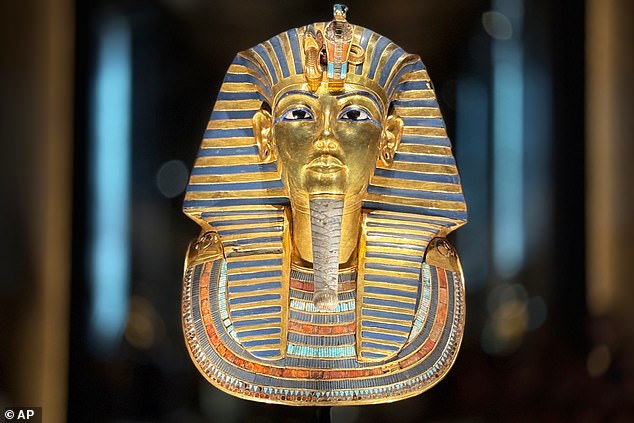
The golden burial mask of King Tutankhamun, displayed at the Grand Egyptian Museum in Giza
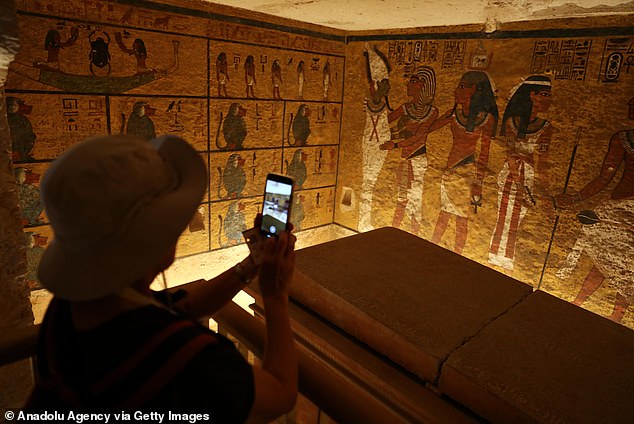
Visitors take photos inside Tutankhamun’s burial chamber in the Valley of the Kings in 2022
Tutankhamun died aged 18 or 19 between 1323 and 1324 BC, with genetic and radiological studies suggesting malaria combined with a bone disorder as his cause of death.
He was mummified and buried in the Valley of the Kings inside three nested coffins, the smallest weighing 110kg, all placed within four gilded shrines.
Mr Weigell’s grandson, a London schoolteacher called Peter Weigall, spoke about him in an episode of TV documentary ‘Find My Past’ on Yesterday in 2012.
He said at the time: ‘Arthur was a professional archaeologist and he deeply disapproved of Carter and Carnarvon, who he regarded as amateurs.
‘Arthur was horrified when he saw Carter and Carnarvon running around the tomb laughing. He didn’t like the fact they’d given exclusive rights to the story to the Times – although he himself had a similar contract with the Daily Mail.
‘He thought the tomb belonged to the world – and especially to Egypt. Carter and Carnarvon shut the Egyptians out and Arthur was so annoyed he’s supposed to have predicted their deaths.
‘He whispered to a nearby journalist, ‘I give him six weeks’. Sure enough, within six weeks Carnarvon was dead. That was the origin of the Curse of Tutankhamun.’
Carnarvon died of blood poisoning after a mosquito bite became infected – and, incredibly, the postmortem on Tutankhamun found a lesion on the pharaoh’s left cheek, in the exact spot where the mosquito had bitten Carnarvon.
Evie Leatham, the great-great-granddaughter of Lord and Lady Carnarvon, also spoke in the 2012 documentary, saying: ‘I have no idea if there really was a curse, but Peter thought his grandfather had an intuition Carnarvon would die. Perhaps that’s as close to a curse as he would go.’
Speaking about the letter, an RR Auction spokesperson said: ‘Lord Carnarvon, the financial backer for the search for and excavation of Tutankhamun’s tomb in the Valley of the Kings, had granted The Times exclusive access in exchange for £5000 plus 75 per cent of profits generated from the King Tut story.
‘Although this helped to finance the work, it created resentment both from other newspaper reporters-most notably Weigall, an Egyptologist covering the story for the Daily Mail and from the Egyptian authorities, whose own press was also excluded.
‘Weigall reportedly witnessed Lord Carnarvon joking as he prepared to enter the tomb, turned to a fellow reporter, and said: ‘If he goes down in that spirit, I give him six weeks to live.’
‘Carnarvon died after being bitten by a mosquito within the allotted time, and the ‘curse of the pharaohs’ was born. Howard Carter applauds the recent death of Arthur Weigall, who he calls “a menace to archaeology”.’