Ed Miliband, the Net Zero zealot in charge of UK energy policy, comes from that breed of politician which thinks if you repeat even an obvious lie often enough, people will eventually believe you.
He was at it again this week, claiming that his latest mega contracts for offshore wind would usher in a new era of cheap, reliable energy.
Nothing could be further from the truth. Yet, as Reform UK and the Tories were knocking lumps out of each other, Miliband continued unimpeded in his one-man mission to take the country to hell in a handcart by locking us into ever higher electricity prices for as far as the eye can see.
It’s all because of his madcap ideological fixation with decarbonising the electricity grid by 2030, whatever the cost – a socialist strategy which neatly fuses extreme environmentalism requiring a huge expansion of state power with total government control of energy policy. Hence its appeal to Miliband.
If ever there were a Labour policy against which the Right needed to unite, instead of being convulsed by their own narrow ideological obsessions, it is Miliband’s determination to inflict rack and ruin on the nation with his barmy energy policy. Sensible folk on the Left should be opposed too, given what it’s doing to jobs and living standards.
Let us start with the fact that, under Labour and equally complicit Tory governments, a 20-year rush to renewables – led largely by wind power and costing tens of billions – has lumbered Britain with the most expensive industrial energy costs on the planet and among the world’s very highest prices for domestic consumers. So much for cheap renewables.

Ed Miliband, the Net Zero zealot in charge of UK energy policy
Yet Miliband has the temerity to claim his new state-sanctioned expansion of offshore wind power means cheaper electricity bills for all – largely because, he says, electricity created by wind turbines is now 40 per cent cheaper than gas-generated electricity. None of this is true.
Last year, the average wholesale price of electricity was £80 per megawatt hour. Yet, to lure big energy companies to invest in offshore wind, Miliband has had to guarantee a minimum ‘strike price’ of £91/MWh – index-linked to inflation for the next 20 years.
Moreover, that £91 is based on 2024 prices. So it’s already £94/MWh at the start of 2026. Corporate welfare never tasted so sweet. Germany’s RWE energy giant lapped it up, snaffling 83 per cent of the capacity on offer. So much for green energy revitalising British industry.
Labour MPs, probably mindful that their party is struggling to hit even 20 per cent in the latest polls and the need to big up any good news they can concoct, flooded social media to hail Comrade Ed’s great work. In doing so, they promulgated a lie – and demonstrated they have no idea what they’re talking about when it comes to energy policy.
All of them based their ‘wind is 40 per cent cheaper’ propaganda line on the official claim that electricity generated by a new gas-fired station would cost £145/MWh – clearly more than the latest wind power strike price.
But that figure assumes gas-fired stations would operate at merely 30 per cent capacity, because the Government only wants to resort to gas when the wind doesn’t blow enough (or blows so much the turbines have to be shut down). Naturally, that raises the cost of gas-fired electricity.
Furthermore, in another sleight of hand, the £145 includes carbon taxes imposed on gas as part of the Net Zero crusade, adding around £40/MWh to the price. That is a policy choice. There is nothing immutable about it. Strip away the carbon taxes and run the gas-powered stations at a higher, more efficient level – over 80 per cent – and the price of electricity generated comes in at below £70/MWh. That is far lower than the £91 cost to which Miliband has locked us in real terms for the foreseeable future.
Furthermore, the Government’s price of wind doesn’t take into account all the extra costs of upgrading a national grid increasingly carrying electricity generated by intermittent renewables.
Offshore wind farms tend to land their electricity on isolated coasts, to which new transmission lines have to be constructed. Grids built to carry predictable, reliable electricity generated by fossil fuels or nuclear need expensive upgrading to deal with the vagaries of renewables, including the constant switching between wind and gas.
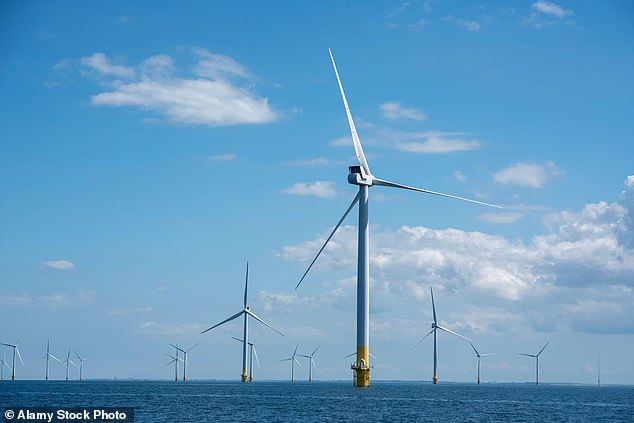
The Government’s price of wind doesn’t take into account all the extra costs of upgrading a national grid increasingly carrying electricity generated by intermittent renewables

Net Zero Secretary Ed Miliband with Prime Minister Sir Keir Starmer during a visit to the SSE National Training Centre to promote Government energy policies
Then there’s the cost of keeping gas-fired stations on standby to rev up when wind power is inadequate. The Government reckons it will still need all the existing 32 gigawatts of gas-fired capacity as back up by 2030, when the grid is supposed to be decarbonised, even though it would run for only 5 per cent of the time.
That’s an expensive fallback – and needs to be included in the cost of renewables.
Take all that into account and the true cost of wind power is closer to £125/MWh versus under £70/MWh for gas. That gives you a more accurate picture of the damage Miliband is determined to inflict on what’s left of British industry and the household fuels of the ‘working people’ Labour is supposed to look after.
Energy policy is now based on a number of fantasies that have been rattling around in Miliband’s head for years: renewables are much cheaper; they also mean more secure energy because they’re home grown; and renewables will bring down your bills.
Miliband once claimed renewables were ‘nine times cheaper than fossil fuels’. He doesn’t say that any more. Labour promised in the 2024 election to cut fuel bills by £300 a year. It doesn’t say that any more, either. The scale of the folly on which we’ve embarked is scarcely appreciated, thanks to a compliant media, so much of which is content to recycle the claims of the Net Zero lobby without question. It is journalism by Press release.
Nowhere more so than BBC News, the broadcasting arm of the Net Zero zealots. It greeted Miliband’s latest licences with the headline that he’d ‘secured a record supply of offshore wind’.
In fact, nothing has been ‘secured’. The biggest licence in the previous offshore round, held by Denmark’s Orsted, was frozen indefinitely when it was found to be uneconomic. The cost of offshore wind farms – from high interest rates on the billions borrowed to the cost of copper for transmission to the expense of imported turbine blades – is soaring. No wonder RWE expects over £1.5billion a year in subsidies to proceed. Even then there’s no guarantee it will.
Nor is there anything homegrown about wind power. Just about all we do in Britain is erect the turbines. Nearly all their parts – from gear boxes to blades to the rare earth metals, transformers and steel required – is imported. Even their erection is largely done by foreign-owned companies.
As for security of supply, not only does Miliband’s fatwa on North Sea energy mean we’ll have to import a lot more oil and gas – his rush to renewables means we’ll also import a lot more electricity to balance the system when wind power is weak. Last year we imported 10 per cent of our electricity needs via cables vulnerable to Russian attack.
Though you’d never know it from the reporting of most of our media, we are in the midst of a renewables energy policy in which generating and grid capacity will have to double – all at a cost of tens of billions – simply to be able to produce and transport the current level of electricity. It is energy madness on stilts.
But the reach of Miliband’s wrecking ball goes far beyond energy. The rush to renewables, which he instigated when last a Labour energy minister in 2008, has speeded up the de-industrialisation of Britain. Steel, chemicals, aluminium, glass and other heavy industries have been decimated – or even disappeared – thanks to high energy costs.
The loss isn’t just well-paid jobs in areas that badly need them, though that is a tragedy in itself. It is the loss of a national capacity to provide in bulk the basic inputs for food production, pharmaceuticals, clean water and defence at a time of national peril.
That is just how devastating the Miliband mission is turning out to be – and why those opposed to it must unite in opposition. There is no higher political priority.