The world emitted a collective sigh of relief on Thursday when President Trump extended his five-day ‘ceasefire’ with Iran – which was about to end yesterday – for another ten days, to Easter Monday. In truth, it is no cause for even mild satisfaction, never mind celebration.
It is merely further proof that the President has run out of road, has no idea what to do next and is simply playing for time. Nor does it do anything to halt the global economy from continuing down its rocky route to hell in a handcart.
For a start, it’s not a ceasefire. All Trump has done is desist, for a second time, from carrying out his previous threat to ‘obliterate’ Iran’s energy infrastructure. Iran, for its part, has agreed not to do the same to the energy assets of America’s Gulf allies. I suppose for such small mercies in these miserable times we should give some thanks.
But Israel and the US are still pounding just about everything else in Iran while Iranian missiles and drones are still making their way to the Gulf states. In the past 24 hours alone Israeli jets struck at targets in central Tehran while Iran hit two seaports in Kuwait. People are still being killed, valuable economic assets destroyed.
Above all the Strait of Hormuz remains closed to all ships bar those from countries of which Iran approves. We must assume it will stay shut at least until April 6. If and when it opens after that is anybody’s guess. Not anytime soon is mine. And every extra day it remains closed exacerbates the looming energy shock and drives another nail into the coffin of the global economy.
Trump’s ‘it’s all going swimmingly’ schtick is becoming increasingly hard to bear. A daily stream of gibberish, obfuscation and outright lies now emanate from the White House – bad enough at the best of times, disgraceful and indefensible at a time of war.
Trump claims it was the Iranians who wanted to extend the ‘breather’. He says they asked for another seven days. He graciously gave them ten. I don’t believe a word of it. Tehran thinks it has Trump on the run. It’s not even in a hurry to start peace talks.
One minute Trump claims Iran is ‘begging’ for a deal, the next he says it ‘better get serious soon’ or face terrible if unspecified consequences. Clearly, the second statement contradicts the first.
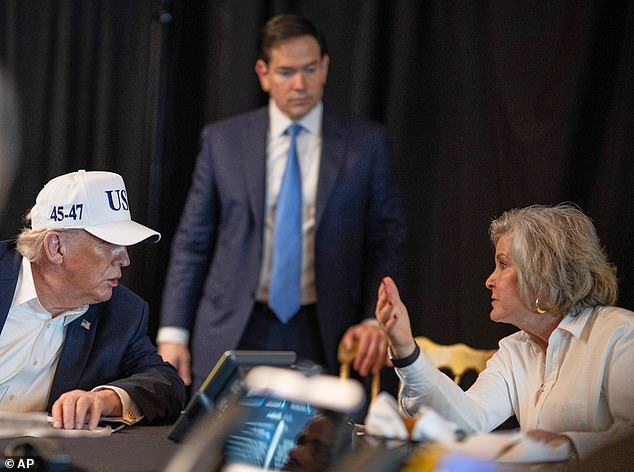
Donald Trump talks to chief of staff Susie Wiles as Secretary of State Marco Rubio listens. His ‘it’s all going swimmingly’ schtick is becoming hard to bear, says Andrew Neil
Iran’s foreign minister says his country ‘has no intention of negotiating for now’. It speaks volumes for America’s current global reputation that world leaders are more inclined to believe the tyrants of Tehran than the President of the United States.
Trump wants us to think that peace talks are already making progress. In fact, there are no direct talks, despite American requests. Messages are being exchanged through mediators (like Egypt and Turkey). There is talk of Pakistan, which is on decent terms with both Tehran and Washington, being a suitable venue for direct talks.
But nothing is fixed – and the gap between the two sides looks currently unbridgeable.
America insists Iran junk its nuclear bomb programme; hand over its 400kg stockpile of enriched uranium refined to 60 per cent purity (close to weapons-grade); agree to limits on the range and quantity of its ballistic missiles; and desist from any further military or financial support for its terrorist proxies (like Hamas and Hezbollah) in the region.
Iran, for its part, wants America to close all its bases in the region; pay reparations for all the damage caused by the US-Israeli strikes; give it permanent suzerainty over the Strait of Hormuz; and swear never to attack Iran again.
You don’t have to be Henry Kissinger to see there’s no prospect of a deal any time soon – if ever. I’m told the mediators – those passing the messages between Iran and America – are gloomy about any chance of a breakthrough. They’re surprised by how content the Iranians are just to let Trump swing in the wind.
Trump, of course, is trying to concentrate Iranian minds by supplementing US air and sea assets with troops. Already over 7,000 – a mixture of Marine Corps and the 82nd Airborne – are assembling in the region.
There’s talk in Washington of sending another 10,000. But to what purpose?
A deployment of up to 20,000 is nowhere near enough to constitute an invasion force.
Even more limited objectives – such as occupying Kharg Island or seizing Iran’s enriched uranium – have the hallmark of disaster all over them.
The enriched uranium is stored underground in gas form in canisters deep in heavily-defended tunnels in the Iranian heartland. Access to it is likely blocked, at least partially, by previous US-Israeli airstrikes. It is difficult to transport and has to be handled delicately, given its nature.
The idea a US military snatch squad, operating hundreds of miles inside Iran, could somehow seize the uranium and safely skedaddle with it is for the birds. It makes the kidnapping of Venezuelan dictator Nicholas Maduro look like a piece of cake.
What about Kharg Island? Most of Iran’s oil exports flow through it. It is well-fortified but would probably fall to a US amphibious/airborne assault. Then what?
There’s no prospect of getting the oil on to global markets as long as the Strait of Hormuz is closed. The Iranian regime would suffer from the loss of oil revenues. But it’s shown it can take a lot more pain than America ever contemplated. Meanwhile the occupying US forces would be sitting ducks for all manner of Iranian attacks.
There’s every chance the Kharg energy facilities would be destroyed in any incursion, which would have terrible long-term consequences for a global economy already braced for the worst. It is only a matter of time before the full impact of rising oil and gas prices will be felt at the petrol pump and in home heating bills.
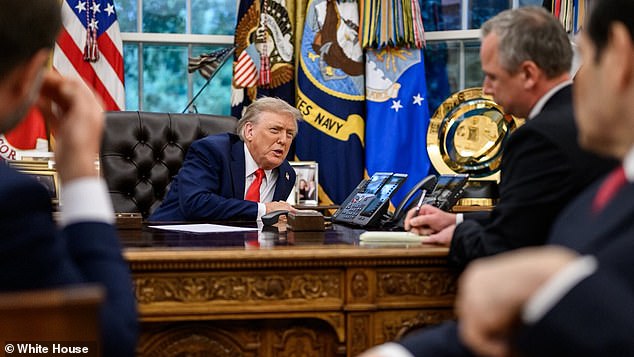
At some stage Trump will declare victory and go home. But it will be a Potemkin Village of a victory – artificial, constructed out of lies, misleading, of no lasting worth
The knock on effects will soon be seen in everything from food prices to pharmaceuticals – anything constituted from the by-products of fossil fuels. The Gulf states are now a major source of fertiliser. Over 20 vessels packed with varieties of the stuff are languishing in the Gulf unable to get out. Russia and China, the world’s two biggest producers of fertilisers, are curbing exports.
So a critical global shortage of fertiliser beckons – just as the spring planting season is getting underway. For poorer countries, like Pakistan, India and Bangladesh, there is the prospect of widespread shortages, even a risk of starvation. For richer countries, like Britain, it will mean major food price inflation down the road.
Britain will also suffer in other ways. We are particularly vulnerable. The OECD, a club of rich economies, forecasts that the UK will be one of the hardest-hit. It has downgraded UK growth more than any other major economy this year as a result of the Iran war, from 1.2 per cent to only 0.7 per cent.
It also expects UK inflation to rise to 4 per cent – probably an underestimate. There is a whiff of stagflation in Britain’s immediate economic future.
The Trump ‘ceasefire’ does nothing to alleviate any of this. Indeed, by prolonging the closure of the Strait of Hormuz indefinitely the President is merely piling up future problems for the world economy.
Two days after the first US-Israeli strikes on Iran I wrote that, despite misgivings about the attack, I hoped the President would ‘stay the course’.
That was before it became obvious there was no ‘course’ – no consistent and clear war aims, no plan to keep the strait open, no scheme to topple the regime as the bombs and missiles rained down, no exit plan.
Trump has blundered into a war without any of the above. His options are now bleak. In a recent Reuters/Ipsos poll a mere seven per cent of Americans supported a major deployment of troops on the ground. Behind closed doors – for now – leading Republicans in Congress are expressing mounting concern about what they now call Trump’s War.
At some stage Trump will declare victory and go home. But it will be a Potemkin Village of a victory – artificial, constructed out of lies, misleading, of no lasting worth – an unsatisfactory end to an unnecessary escapade, leaving the Middle East in even worse shape than it was.
The world will have to deal with the fallout from his folly for some time to come. But, sad to relate, it looks better than any realistic alternative.