This article is taken from the March 2026 issue of The Critic. To get the full magazine why not subscribe? Get five issues for just £25.
Arriving in Damascus in the middle of the night after 14 years of civil war and 20 years of personal absence feels strange. At passport control, the visitor is no longer asked if they have been to occupied Palestine, but whether they might have Iranian nationality. Outside the airport, first impressions are of dark, electricity-less building complexes and talk of the soaring cost of living. Israeli tanks are parked a few miles away, in Syrian land claimed in the hours following the Assad regime’s collapse.
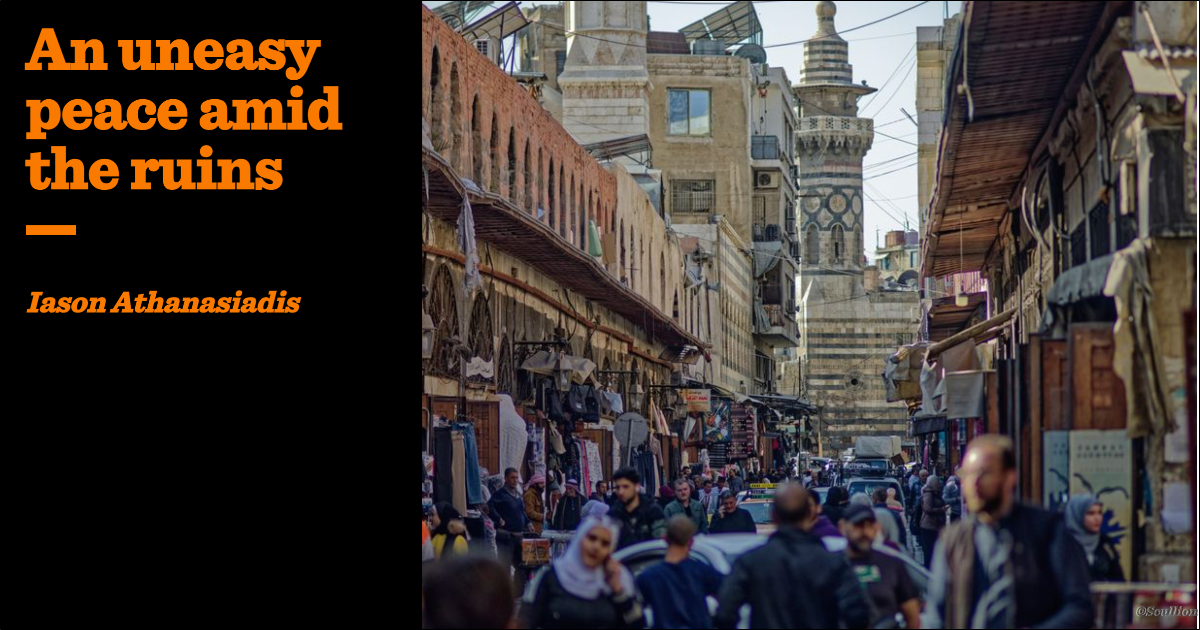
But in the Old City the lights are on, and the changes easier to spot. Armed, ice cream-slurping jihadis emerge from Bekdash, a storied purveyor of frozen mastic dairy dessert in the ancient Hamidiyah market, to wander towards an illuminated, now gender-segregated, Umayyad mosque. At the Azem Palace, the Roman and thereafter Ottoman seat of power in Damascus, the security forces protecting diplomatic limousines are now moustache-less and long-bearded in true Salafi style.
A kilometre away, past medieval markets, colonnaded Roman-era streets and clumps of Ottoman bay-windowed wooden houses, bars and restaurants hum with revellers in the Christian districts of Bab Touma and Bab Sharqi. A few hardy tourists emerge from palaces converted to boutique hotels in the Jewish Quarter, pausing in the glittering glare to absorb Damascus’s dusty anomie. After 20 years of absence, the city is a study in disorientation. It is changed yet familiar; dense with the accumulated energy of an eternal city, yet also saddled with the malaise of a decade-and-a-half of death and dislocation.
Whilst the centres of historical cities such as Aleppo and Homs were largely destroyed, the heart of Damascus — the Hellenistic, Medieval, Ottoman and French colonial-era core — is still there. But as Diane Darke, a British architectural historian and author of several books about Syria puts it, “It’s an almost schizophrenic tale of two cities between the historical old centre and the residential suburbs.” War-shattered Syria begins half a kilometre beyond the city’s historical centre with the rubble extending for thousands of square kilometres.
Battered and exhausted, Damascenes anticipate a brave new era. Syria’s former leader Bashar al-Assad fled in December 2024 and is now reportedly adapting to life in a Moscow suburb. The new president is Ahmed al-Sharaa, who combines efforts at international bridge-building and pragmatism with his past as an Al-Qaeda fighter in Iraq.
Captured there by the Americans, he did time in Abu Ghraib and Camp Bucca prisons before becoming a central figure in the Al-Nusra Front and the succession of rebel alliances that fought Assad and ultimately took the Syrian capital after 14 years of war. The slack-jawed, demobilised fighters who have been roaming Damascus’s streets since toppling the 54-year Assad regime adhere to Afghan jihadi chic: worn military fatigues and long hair trailing from complicated turbans, with the occasional pakol or subcontinental skullcap on display.
They are unfailingly polite and entirely unused to negotiating a city. After asking for directions in various regional accents, they lean forward and extend their palms out in gratitude. I comment to a taxi driver that they resemble characters from a historical TV series. “They’ve come to the right place, then,” he quips.
Though largely happy to be rid of the Assad mafia, Damascenes are not much enamoured with their new conquerors. They disparage them as being common, overly religious and unworldly. In turn, the Idlibis (so-called after the Turkish-occupied corner of north-west Syria to which they were confined for over a decade) fail to appreciate Damascus’s allure and have imposed a nightly curfew on the city’s bars and restaurants.
“How can Cham (a synonym for Damascus) be in such a poor state, dirty and unmaintained?” one director of a ministry freshly arrived from the Turkish-occupied opposition stronghold of Idlib, asks.
“You mean it should be more like Istanbul?” I reply, thinking of the Turkish megalopolis’s ability to combine skyscraper zones alongside clumsily renovated, touristy heritage districts.
“Dubai!” he exhales. “That’s what Damascus needs.”
“All the charm of a Hollywood backlot”
The site of Damascus was inhabited as early as 8000 BC. In around 1200 BC, it stepped properly into history at the head of a powerful Aramean state, and subsequently an Assyrian one. Alexander of Macedon seized Persian treasure there in 333 BC; the Romans took it in 64 BC to avenge the humiliation inflicted by the Parthians at the Battle of Carrhae. It became Byzantine in 395 AD.
It was the first city conquered by the Muslim Arabs after they burst out of the Fertile Crescent, and it passed through several Turkic dynasties before becoming Ottoman for four centuries until T.E. Lawrence and his Arab allies claimed it in the First World War. There followed the French Mandate, a series of civil and military regimes, and then the Assad dictatorship — the first example of home-grown stability the country had experienced in centuries.
“You have to think of Damascus as a port, a port of the desert,” said Charles al-Hayek, a Lebanese historian. “So, it’s the natural place for the incoming trade from the Mediterranean ports, the trade ascending from Yemen through the Hejaz, the trade descending from Aleppo, and the route that goes to Mesopotamia and Persia.”
By 1999, when I spent the last year of the 20th century studying Arabic in Damascus, the “pearly white city upon its carpet of green” described by Scottish minister John Kelman in his 1908 book From Damascus to Palmyra had already faded. The once-fertile Ghuta plain had been replaced by a cement-grey sprawl stretching from below Mount Qasioun to smother the black, basalt buildings of the Ottoman and French colonial periods and medieval minarets and palaces of the Old City.
“Each time I returned to Damascus, it seemed as though another set of centuries-old buildings was being bulldozed for the new boulevards and office buildings,” wrote Antoine Touma, a collector of Syrian arts and crafts. “In many corners, Damascus has come to have the charms of a Hollywood backlot.”
Yet my 20-year-old self could not miss what I had not experienced, and enough remained in the extraordinary city to animate my daily movements through its medieval, colonial, Soviet and neoliberal-era districts. I rented a room in an old wooden courtyard house inhabited by a Christian emigrant family from the Hawran agricultural region. Unlike my original hosts, who were stuffy Damascenes, my new family did not seek to regulate my studies or monitor guests and nocturnal movements.
For a year, I observed a country steeped in caution: not just the silence derived from fear, but a restraint impregnated by centuries of multiple communities arriving at the conclusion that the secret of coexistence lies in reserve. Towards the end of my time, the Syrian dictator Hafez al-Assad died, the presidency passed on to his son Bashar, and Syria became another one of the jumlukiat (inheritable republics) towards which the region was transitioning before the Arab Spring changed everything a decade later.
Long the butt of Lebanese jokes about how stuck in the past Syria was (the internet was so strictly regulated that we used to visit Lebanon to check email), Bashar al-Assad’s arrival ushered in a period of political and economic liberalisation. Newer car models replaced Havanaesque jalopies with a seemingly obligatory picture of Assad Sr stuck on the rear window. Punishing import duties were lifted, and a ruling discouraged the new president’s photo being publicly displayed.
In countless walks through lively markets and a semi-deserted Jewish Quarter, I caught the tail end of a fairytale Old City suspended in time. By the mid-2000s, new planning permissions unleashed a first wave of touristification with restaurants, cafés and boutique hotels intruding upon the old city’s palpable sense of history.
Surviving Yarmouk
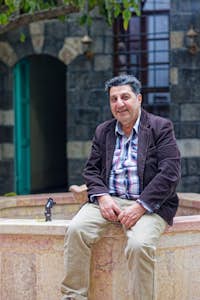
The Old City I had glimpsed was that of Boulos Hallaq’s childhood. The 62-year-old Damascene with origins in the Christian-dominated Qalamoun mountains was born a stone’s throw from where the Christian, Sunni, Shia and Jewish neighbourhoods converged, appropriately, at a Sufi shrine. As his playmates on the cobbled lanes changed with the ebb and flow of migration, he witnessed the Old City’s demographics shift from old bourgeoisie to lower-middle-class migrants.
“New faces and accents came,” he said, sitting in the courtyard of the traditional Damascene house he restored. “As the important old Christian families left their homes for more modern extra muro accommodation, rural Christians moved in, transforming the Old City.”
Hallaq attended religiously — mixed schools administered by nuns where the pupils’ different faiths were largely suppressed, unlike social differences. One social marker was whether lunch was a sandwich rolled in pita bread or a baguette. Languid reception rooms in palaces abandoned by aristocratic dynasties now burst at the seams with scrappy countryside families. The 1948 Palestinian refugees settled by the state in stately homes engaged in spontaneous construction in their yards.
As this generation came of age in the 1990s and moved out to the concrete apartment buildings that would be destroyed in the civil war, the Old City emptied out again. A new-found appreciation of heritage resulted in UNESCO establishing guidelines banning construction and regulating renovation materials. At peace negotiations brokered by the United States in 2000, Syrian officials submitted lists of Jewish-owned properties, offering the prospect of a return for Damascus’s Jews as a quid pro quo to Israel adopting the Palestinian right of return.
It was not to be. After Hafez al-Assad died in May 2000, his son, Bashar, lacked the popular legitimacy for the kind of painful national concessions that his father could have implemented.
By now, camps such as Yarmouk which had been assigned to Palestinian refugees, had grown high and semi-permanent, blending into the city’s other new districts. Once the 2011 revolution against the Assad regime escalated into civil war, armed opposition groups moved into Yarmouk’s labyrinthine streets, seeking to take advantage of its geographical position to push towards central Damascus. When the regime besieged and shelled the district, thousands of Palestinian refugees streamed out, forced into a second displacement.
Life and Death under siege
Abu Hossam was one of those who stayed behind.
I encountered the balding, 60-something descendant of refugees from Safad, an ancient town on the Lake of Tiberias, sitting in front of the only functioning shop in a destroyed neighbourhood. His pressed shirt and upright posture did not suggest he was a survivor of one of the current century’s worst starvation sieges. Yet he had been amongst the 18,000 people stuck in Yarmouk and captured in the infamous 2014 photograph of the human wave emerging from a shattered urban warscape to queue for food parcels.
For 15 years, Abu Hossam watched what he described as “the happiest place in Syria” turn into a starvation ghetto so bad that the largest mosque’s imam issued a fatwa permitting the eating of cats, dogs and donkeys.
An initial occupation by Free Syrian Army soldiers was painless — the majority of camp residents remained neutral, in line with an unspoken agreement not to participate in national politics. Then, in 2012, Islamic State’s black pennants appeared at the camp’s outskirts. The aknaaf (Hamas-affiliated camp militants) failed to repel them, and Abu Hossam found himself a citizen of an expansionary Islamic State.
“The day the Da’esh (Islamic State) entered the district, we were hit by a regime barrel bomb that destroyed our house,” he told me. Worse was to come: one son was badly injured, whilst the other disappeared at a regime checkpoint. Snipers shot people moving around the streets. At rare food distributions, “the guards terrified us by engaging in pretend-confrontations using their weapons, or would distribute barely 200 boxes from morning to evening, then announce they’d given out 2,000 and keep the rest for the black market”.
The intermittent Islamic State occupation culminated in an inter-Islamist civil war, with fighters from the Al-Qaeda-affiliated Nusra Front under the command of Syria’s current president clashing with Islamic State gunmen. “At that point there was no more intervention from the regime, so we were at least spared the barrel bombs,” Abu Hossam recalled. “Many people died and homes were burned; people who went out in search of food often didn’t return home.”
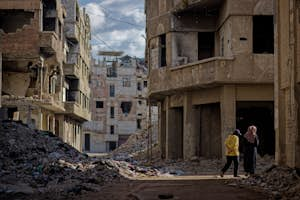
I walked through treeless, dusty streets devoid of birdsong, past families unloading their belongings from pick-up trucks and children laughingly chasing chickens through the rubble. Climbing up a staircase slippery with broken masonry, I emerged onto a roof with a panoramic vista of Gaza-scale destruction: wrecked apartment blocks interspersed with damaged minarets and water-towers as far as the eye could see, rolling towards the undamaged neighbourhoods of central Damascus and Mount Qasioun.
The Japanese-designed, modernist presidential palace gleamed atop a hill in the distance, and I imagined afternoons a decade ago when Bashar al-Assad might have watched his artillery and air force planes elicit distant puffs of smoke from the urban sprawl. Later, whilst walking down a deserted, wrecked street, I encountered an elderly woman covered in a black chador. As she approached, I noticed she was blind in one eye.
“My 28-year-old daughter died, my sons were imprisoned, my money was stolen and I lost my eye,” she replied to my question of how the past 14 years had been for her. “How much patience do these catastrophes require? How much?” She peered deeply at me with a single kindness-emanating eye. “Our fate is only what Allah wrote for us,” she continued. “Allah takes little and gives plenty.”
She had not been back to her city of origin, Aleppo, since her sister’s passing, a few years before the war began. Now it was even more thoroughly destroyed than Damascus, and yet she was engaged in rebuilding one more time, tending to two small vegetable gardens scratched out of the rubble.
“Never mind, we must wait until the next life,” she tells me, hobbling off to her Quranic class. “This world has an ending, but the next one doesn’t.”
Ambient violence
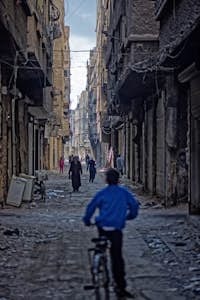
Crushed neighbourhoods necklace central Damascus’s veneer of normality. Normal streets peter out into a post-apocalyptic wasteland of gnarled and pancaked concrete sliced by projectiles of every diameter.
It was the early attempts to take the capital that caused the worst damage, a period when most Damascenes acquired new survival skills as mortar shells whistled down and checkpoint detention could transform a morning of errands into a leave from life. People learned to mind their own business and mentally distance themselves from reality.
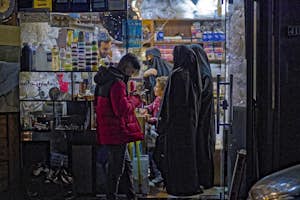
Thus whilst there is a Damascus of bustling markets, full hotels and businessmen eyeing reconstruction contacts, there is also the muffled silence of districts to which active life has not returned. Signs urging women to not limit themselves to hijab but adopt full niqab fluttered on the city’s main square. In mid-November, it was announced that several statues of Venus had disappeared from the National Museum, a treasure trove of antiquities. The gossip was that the statues’ nudity resulted in them being conveniently “stolen”.
I took a taxi to Jobar, a mixed modern and medieval district gutted in the fighting. Abbas, my wiry taxi driver, supported the former regime. He told me that his Shiite-sounding name had resulted in his being kidnapped at a Free Syrian Army checkpoint during the civil war. He negotiated a $37,000 ransom, the entirety of savings he amassed over several years working in Dubai. But the hardest part came when his beloved younger brother, whom he had put through school, was stopped at a regime checkpoint and killed during an altercation with the soldiers.
“Don’t bury him till I get our revenge,” Abbas told his father after bringing the body back, before returning to his car. He claims he then drove to the checkpoint with a machine gun and two hand grenades, and killed 12 soldiers and four officers, dispatching one by stuffing a grenade into his mouth. Covered in blood, Abbas got back in the car and drove to the family village, disassembling his weapon into 14 pieces on the way and throwing them one-by-one from the car window.
I could not find a trace of such an incident on the Arabic-language web, so I enquired amongst friends. “A lot of bad things happened,” one said. “We stopped discussing them after the first few years.”
“You have to realise that death became random and life worthless,” another wrote. “So many friends and acquaintances died simply driving on the highway, minding their own business, when a sniper took a potshot.” Another described mortar bombs landing near his children’s school as he waited for classes to end to escort them home.
Gyms and photorealistic skyscrapers
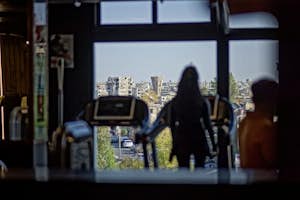
Abbas dropped me off in front of a newly-built mall on the edge of Jobar’s destruction. On the second floor, a gym’s expansive plate-glass window showcased young women in Lycra training gear and earphones jogging on treadmills. The bizarreness of exercising to a vista of destruction made me enter the gym, but the dystopia might as well have been invisible to those inside. One 20-something patron excitedly recounted growing up in a Jordanian refugee camp. Now his family had returned from exile, they were opening a petrol station to fuel all the reconstruction vehicles.
City sounds fell away as I walked into Jobar, my ears re-adjusting to the sound of compressed silence leavened only by the distant sounds of traffic running on the Damascus to Homs desert highway. A gigantic new Syrian flag flapping amidst the ruins was the only visible post-war state intervention in a district already stripped of valuable materials by scavengers whose rebuilding was stalled by deadlocked negotiations between property developers and landowners. The warren of criss-crossing tunnels the besieging rebel forces had dug to outfox the regime’s air dominance now stood as the greatest obstacle to construction.
“The regime lost the property deeds,” said historian of Damascus, Abdalrazzaq Moaz. “People want their homes but in the absence of a digital register, they were offered shares in the new construction.” Online, an army of influencers promote a Gulf aesthetic, often through AI-enabled social media videos, pledging to transform one of the world’s oldest cities with skyscrapers. One video depicts a group of helicopter-flying avatars defying the laws of physics to winch a building from Dubai onto a Mediterranean mountainside; in another, Damascus is replaced by a gleaming Gulf aerotropolis replete with Duty Free emporia, highways and high-rises.
Cultural destination or war zone?
I returned to the Old City. The Aga Khan Foundation was engaged in renovating four adjoining palaces to turn them into a luxury “cultural hotel”. Syrian architect Bishr al-Barri, who oversees the project, was born in a marble-floored house in the traditional neighbourhood of Midan.
Al-Barri was studying architecture when his uncle demolished their historic home to build “a very ugly apartment building”. He fell in love with the Old City whilst renovating one of the abandoned Jewish palaces the state had begun restoring. “Part of the magic of Damascus is discovering it,” he said, leading me through a succession of elegant courtyards and rooms, past the cables and equipment of a camera crew filming a historical serial.
Al-Barri explained that these houses had mostly been built from the 18th century onwards as Damascus opened up to the world and Ottomans and Europeans increasingly tapped its elites for important administrative, commercial and consular roles. One of the most ostentatious was the Farhi palace, constructed by a Sephardic Jewish family in the early 18th century after fleeing to Istanbul to escape the Spanish Inquisition and serving as financial advisers to the Ottoman sultans before moving to Damascus.
Old Damascene families like the Quwatlis, Baroudis and Mardam-Beys competed with each other by constructing baroque-influenced palaces intended to exude western sophistication and efficacy, al-Barry explained, as he pointed out cosmopolitan wall paintings of imperial Istanbul, naturally-illuminated reception rooms, and internal courtyards rendered symmetrical by the painting of non-existent doors and windows onto blank walls.
Once restored, the four houses’ courtyards would form the public spaces of an exclusive hotel run by the Aga Khan’s Serena brand, a hospitality chain specialising in hostile environments. The belief that it is “unacceptable for a client who’s paid as much as $5,000 a night to be unable to close the door and be left alone in such a room” drives faithful restorations unencumbered by air conditioning units, plumbing or even electricity, with the majority of bedrooms shunted to the upper floors and a new wing constructed on the site of a former school. This permits the elaborately-restored courtyards and reception rooms to house cafes, restaurants, nightly musical events and lectures where guests and locals mingle.
The Aga Khan Foundation’s vision of a peaceful Damascus frequented by domestic and foreign cultural afficionados is enticing. But bleak events followed my visit. There was a week of sectarian killings in Homs in November, followed in December by widespread fighting in Aleppo between militants affiliated with the new regime and the Kurdish-dominated Syrian Democratic Forces (SDF).
This culminated in the government troops storming large, Kurdish-controlled prison camps on the Euphrates in January and liberating thousands of Islamic State fighters.
Damascus continued to exist in an inflationary, overcrowded, sectarian pressure cooker, warily observing its inscrutable new leader for signs as to how he would handle the escalating domestic fighting against the backdrop of the confrontation between Israel and Iran.
What of Ahmed al-Sharaa, the new leader? “Sharaa is a creation of the Brits,” a diplomat told me in reference to the coaching the new Syrian president received in 2023 as part of his rehabilitation from Inter-Mediate, a political consultancy founded by Jonathan Powell, now Sir Keir Starmer’s national security advisor. “Sharaa himself is a Salafist but a patriot, he prefers the homeland to the umma, but he’s also walking on eggshells.”
Despite Sharaa’s seeming about-turn from jihadi to Israeli interlocutor and Trumpian collaborator, the diplomat and other informed observers argue that his policy positions have remained consistent. He remains pragmatic in his alliances. Unswervingly anti-Muslim Brotherhood, he never expressed regret to the Americans for fighting their occupation in Iraq, and barely mentions Israel.
In November, he might have been the target of a rocket attack on his home district, just after returning from a trip to Washington, where he had declared Syria’s participation in the anti-Islamic State coalition.
It did not escape observers that many of the people he pledged to fight were, until very recently, his comrades-in-arms. When Sharaa’s troops surged against the Iraqi border in late January, amidst strong neo-Umayyad rhetoric about fighting the “Abbasids”, I wondered for how long could he keep on fleeing forward from his contradictions?
Unscathed as Damascus might have emerged from the 14-year civil war, it is more imminently threatened by drought. The near-drying of the Fijeh spring was compounded by the Israeli Army’s seizure, on the same day that Sharaa entered Damascus, of Mount Hermon, the Levant’s second-highest peak and main source of water for the Syrian capital.
“It’s a city that might have to be abandoned in a few years because of water problems,” historian Charles al-Hayek mused. “There’s something symbolic about the desert reconquering the city, given the currently ruling desert mentality.”