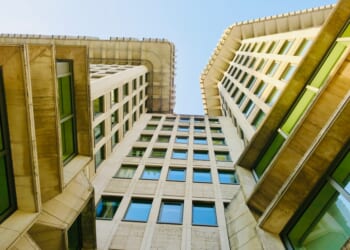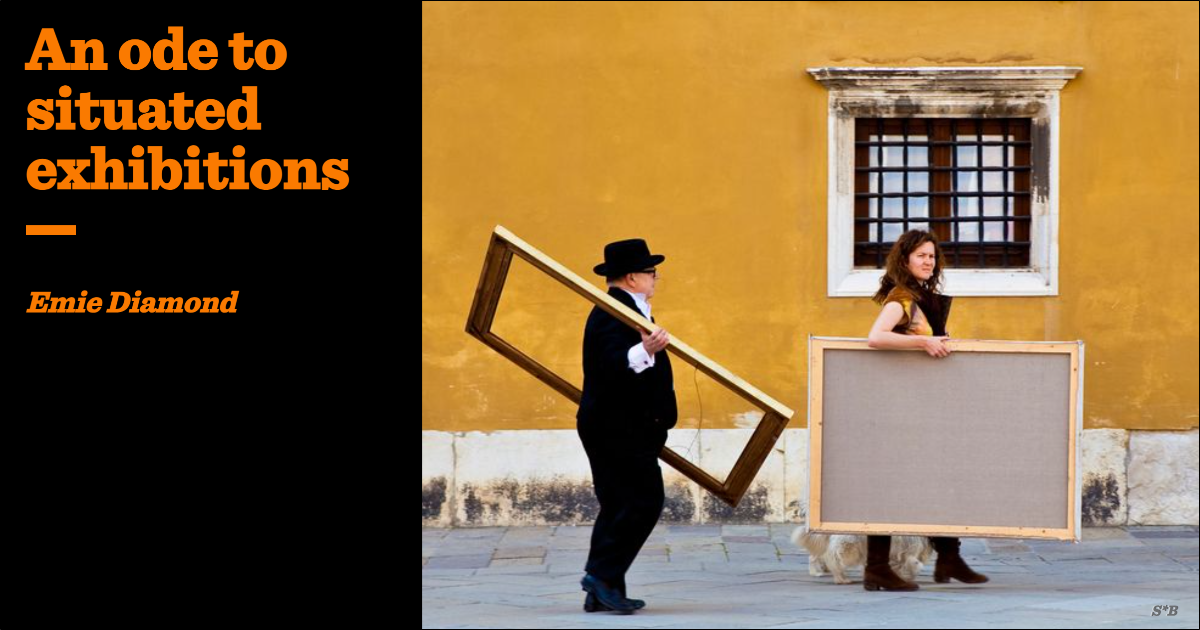
Exhibition-making is undergoing a quiet shift. Unlike art movements of the past, there are no manifestos or slogans, but I have observed it firsthand while working in this field. From my earliest curatorial projects, I sought out spaces with layered histories, where the atmosphere served as an extension of the narrative. Such locations have ranged from a deconsecrated convent in Beaune, to a historic schoolhouse in New York, to a Victorian factory in London. These sites do not function as backdrops but serve as active participants in meaning-making.
In contemporary art galleries and institutions, art is often presented on white walls and in relative isolation, free from competing stimuli. The art fair booth, uniformly white and consistently lit, is perhaps the clearest visual symbol of art’s standardised detachment from place. Neutrality in these instances is a conviction and is often regarded as a form of respect. Therefore, historically, when exhibitions step outside pre-existing presentation standards, they are regarded as eccentric or risky. In recent years, this separation of situated art from the established canon has continued to narrow, as more institutions and galleries look to new models. Situated exhibitions offer an experience that is different and yet complementary to traditional structures.
When I first began visiting artist studios, I would ask: if you could show your work anywhere, where would you like to see it? Almost always, the artist said that they had never considered this. At the time, I underestimated how much this question would come to shape my thinking. When I began curating shows in alternative locations, it soon became clear that the sites were far from neutral and shaped the narrative in distinct ways: how a viewer’s attention drifted towards certain types of light, how sound travelled, how bodies moved in space. Over time, my work led me to think of exhibitions increasingly as an encounter. In such spaces, these complex histories, architectural quirks, and traces of previous lives are expansive rather than challenging. Situated exhibitions can offer another stratum of meaning. The patina of a stone wall, the asymmetrical window or an unusual view, does not diminish but widen the field in which the art is received. Place does not compete but deepens an experience by reminding us that all acts of looking occur in a space and time shaped by what has come before. It is a continuous reminder of our place in history.
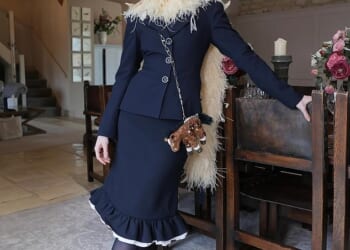
To be clear, situated does not exclusively mean site-responsive, where artwork is created with a specific environment in mind. A textile hung in an aged building, a sculpture placed within a fertile landscape, or a painting displayed in a religious site. Situated can also refer to instances in which art and place are intentionally in dialogue. It is best not to romanticise authenticity or theatricalise a setting, but to acknowledge and draw connections from a place of deep research and consideration. A work of art does not exist in isolation; its context always affects it. This includes not only the physical place, but also the audience’s perspective, the viewing conditions, and broader cultural factors.
For the past four years, I’ve explored this curatorial philosophy through exhibitions in heritage locations across the Burgundy region of France. Through this initiative, I have worked within spaces of varying architectural styles and historical significance, including a Napoleonic-era château, an oratory chapel, a former monastic winery, a vineyard landscape, and a maison de vigneron. In these exhibitions, the text becomes a conversation between art and site. Soil, rhythm, and light shape the region and also determine the narrative. The result is a context in which art meets place with distinct sensitivity, and a new resonance emerges.
More recently, I’ve formalised my ideas into a curatorial framework grounded in research, resonance and responsibility. This evolving text is intended to serve as a lens rather than a doctrine, by translating philosophical insights into practical applications. At the heart of this theory is the idea that sites can be understood as collaborators, holding traces of time, absence, and human presence. To situate art within these types of spaces is to enter into a relationship with what came before. This is not only about atmosphere, but about respect. When a site is read thoughtfully, it becomes a form of knowledge and expands art’s meaning rather than instrumentalising it.
There is a spiritual hunger for encounters that are real and rooted
The growing interest in situated exhibitions points to a broader cultural shift. In this era of digital abstraction, overloaded with images, and packed with frictionless consumption, we are left with few intimate, grounded moments of encounter. This results in overstimulation and numbness — a sense of seeing everything while feeling very little. It is therefore unsurprising that audiences are drawn toward encounters that offer depth and spatial presence. People are looking for an experience that requires the body. A viewer can photograph a painting in the attic of a chateau. Still, they cannot capture the warmth of the light passing through the old window, the reverberation of a poem recited in the distance, the weathered texture of a wooden beam, or how their posture changes with the curve of the floor. There is a spiritual hunger for encounters that are real and rooted.
This is not a screed against white walls, but an appeal to expand our imagination. Neutrality and resonance both have a place in contemporary curation. Through situated exhibitions, new registers of meaning can emerge. Art in place is not simply contextualised, it is activated and its impact deepened. In an era yearning for genuine meaning, this form of exhibition-making feels timely.