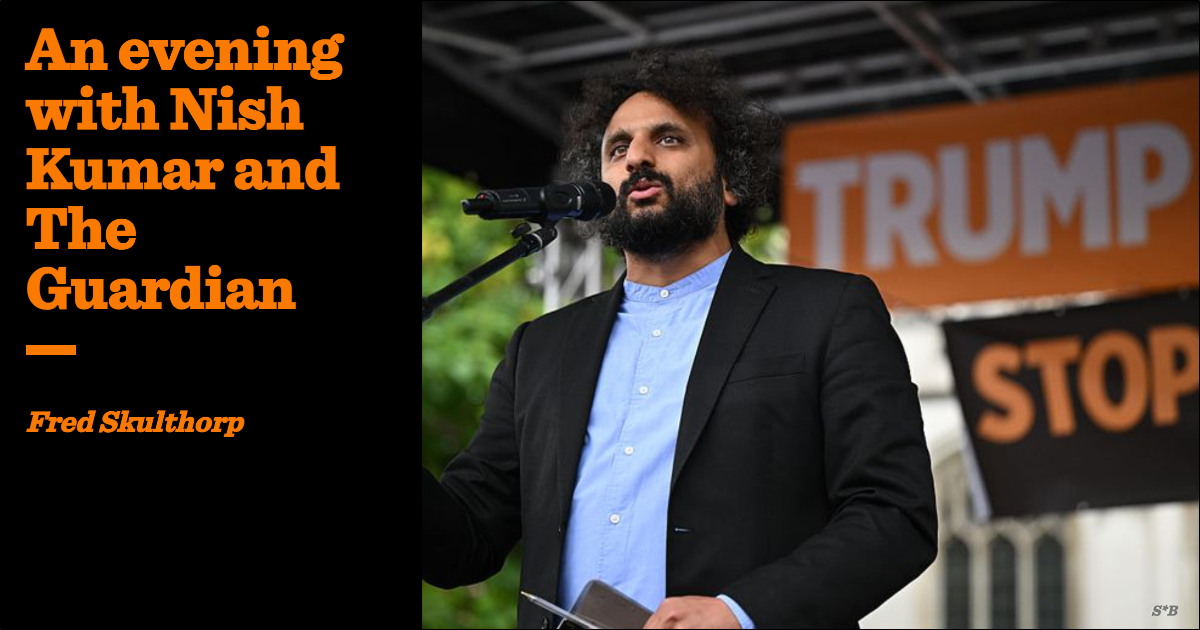
“I assume I am here,” Nish Kumar told his intimate audience, “Because I am what would happen if the Guardian newspaper were a guy.” Nervous laughter turned to a brooding silence as we contemplated this sudden incarnation of British liberalism upon the stage.
Nish Kumar was once the face of BBC comedy. Now he was hosting an Evening With The Guardian Saturday Writers — an event no one seemed to really understand. Amidst the calibrated mood lighting and jaunty bon mots, it was possible to imagine, if at least briefly, that for £37 pounds we had paid for access to one of those well renowned North London Dinner parties.
“I hope you’re not watching online pornography,” Kumar announced to an online audience apparently watching from home. We were in for a long evening. On stage were food writer Meera Sodha, television critic Stuart Heritage and star columnist Tim Dowling who looked slouched and confused. The venue was Kings Place, a complex that sits next to the Guardian HQ. This, Kumar assured us, was one of the “weirdest buildings in London,” where it was possible to imagine “eyes wide shut orgies,” taking place in the many rooms that were actually intended to serve, according to the website, as a hub for dialogue, music and food
This prompted the audience to take stock of each other. Like many of Kumar’s one-liners, it didn’t really make sense. Lurking in the hushed darkness, was something more akin to a gathering of the Newbury Corn Exchange than a secretive debauched elite. Retired primary school teachers, people who worked for the council and childless, sullen couples in their early forties whose life had become a silent downward spiral of Time Out “Things to Do in London”. The topics of conversation this evening would be vegetables, Tim Dowling’s Wife and The Traitors.
For the last decade, the idea of “metropolitan liberal elite” has loomed large in the national conversation. This has always been a confusing label, attached to everyone from the Davos Set to Gary Lineker. When everyone from Lee Anderson to Peter Turchin conjures up the overeducated, downwardly mobile, haywire plight of the urban liberal middle classes, they are actually, for the most part, talking about the sort of people who work in marketing, live in Walthamstow and get their thrills from Richard Osman and BBC6 music.
Our popular conception of the liberal metropolis is skewed. Britain, unlike the US, even France, doesn’t have anything remotely approaching an intellectual, discerning liberal bourgeoisie. Liberal Americans have the New York Times — a publication that has survived the decline of prestige media to become a global institution read reliably even by the people who despise it. Britain has the BBC, The Guardian and The Rest is Politics. Yet I suspect they’ve been happy, Kumar included, to lean into the “liberal elite” slur over the past decade because it very much flatters to deceive.
Watching Kumar up close on stage prompted a close study in this illusion of prestige. All the ingredients of a righteous, anti-establishment firebrand were there: the hulking, manic physique, the wild hair, the impassioned stance against all the “isms” (Kumar had recently worn a black t-shirt emblazoned with the words Designed By An Immigrant) The style was so calibrated, contrived and ridiculous, it betrayed some sordid, hidden world of calculated yearning. As if Tom Ripley, instead of trying to fit into the jet setting, mid century American elite had conspired to get a slot on Mock the Week. Now in 2025 the outcome was positively monstrous: Andy Parsons had somehow been fused with the monologues of Jon Stewart to create a persona that even Kumar no longer seemed to know what to do with.
What was it all for? It’s easy to laugh at Kumar’s fall, much harder to forgive his rise. Over the summer of George Floyd, Nish Kumar and his “anti-racism” went from a tedious and unfunny career bit to the ruling ideology of the British state. As the Kate Clanchy episode has confirmed, this was never an intellectual crusade about “progressivism”, but a jealous, cruel and vindictive romp played out by middle class people who hated each other.
Kumar’s own little Waterloo came at the 2019 Lords Taverners Christmas Lunch. Strewn before him, done up in tuxedos and bloated with prawns and chablis, lay a ruddy, dandruffed valley of bigoted octogenarians ready for the taking. But even this, he somehow fumbled. “Stop throwing bread at me,” was his comeback when heckled for his jokes about the Queen, “I’m trying to cut back on my carbs.” You will never dismantle white supremacy with these gags. In hindsight, an MCC member throwing bread at a BAME comedian for making a joke about Jacob Rees-Mogg was about the only transgressive thing the last decade offered.
Surely we couldn’t sit here wittering away about cabbage for an hour and half when we were heading for a fascist dystopia?
But so much had changed, and fast forward to 2025 we were now talking about cabbage. “I just love cabbage. I think it’s an underrated vegetable,” chimed Meera Sodha. “You chop it up. It’s so dense. You could feed four people from one cabbage for 70p.” The week before, Nish Kumar had told Middle East Eye that he now felt unsafe walking the streets. Even I could feel his frustration. Surely we couldn’t sit here wittering away about cabbage for an hour and half when we were heading for a fascist dystopia?
As it turned out, we could. It was Sodha who initiated a more serious turn in conversation when she brought up her “breakdown”. Ears pricked up. Here was something the audience could presumably relate to. But as Kumar tried to pry further, the discussion of one tragedy led only to another. Judging by the gradual expression of bemusement on Sodha’s face, talking about anything remotely serious with Nish Kumar was like being forced to confess your inner emotional life to a dog.
Next up was Tim Dowling. There were many Tim Dowlings sitting in the audience. Late middle-aged Guardian men who had been forced to inhibit so many of their senses in order to protect themselves from the reality of modern Britain that they had forgotten who they were. The appeal of Dowling was that he was nice. His columns provided an insight into the mores and manners of Britain’s unspeakably dull, liberal middle class: book club faux pas, lunch guests turning up late, how to turn cottage cheese into a mousse. But such light relief churned out weekly in 800 words had only turned into a study of the complete and total oblivion facing an entire generation.
While they were talking about Tim’s boring life, I picked up one of the many Saturday supplements that had been strewn across our chairs. I wanted to get a proper sense of what these people were reading. The curated content of any given social media feed can be an erratic and tasteless experience. But this was a different magnitude of bizarre voyeurism. A glossy spread of “people displaced by climate change” (or brown people as Kumar would have called them) was intermixed with Jessie J’s cancer and tips for ambient mood lighting at dinner parties. It suddenly became acutely disturbing to be surrounded by people who laboured on, under the impression that the Guardian Saturday supplement was somehow an enlightened prism through which to view the world.
Back in the room we were talking about The Traitors. “Why do you think celebrity traitors worked?” asked Kumar, worryingly animated as he leaned into the panel. There was a hushed reverence as we spoke of the quiet success of the programme. After Brexit, everyone had written off the idea of the nation “coming together” again. For the last confused and uncertain decade, “fighting populism” had been a tedious matter of labouring through the translated fiction of the Guardian’s review pages, pretending to read the latest Thomas Picketty and demanding the local constabulary be abolished in the name of black rights. Now it was possible to believe that Nigel Farage could be prevented from becoming Prime Minister by a deference to the kindness of people like Stephen Fry and Alan Carr.
It was all too easy. The room was howling with laughter as Kumar began to lampoon the Daily Mail as the cause of all of our ills. On stage, a faithful Guardian reading couple had appeared to discuss their disagreement over whether it was necessary to iron their tea towels. Never, perhaps since the eve of the First World War, has such a naive, dull, provincial, gentle and misguided view of Britain on the eve of such profound upheaval enchanted so many people. It was time to leave. Outside, across the Kings Cross skyline a new London was being built. The station was fronted by a mixture of lost asylum seekers, seedy tramps and self-confessed demonic mendicants well beyond the wit of Nish Kumar. I had, with some relief, escaped back to reality.