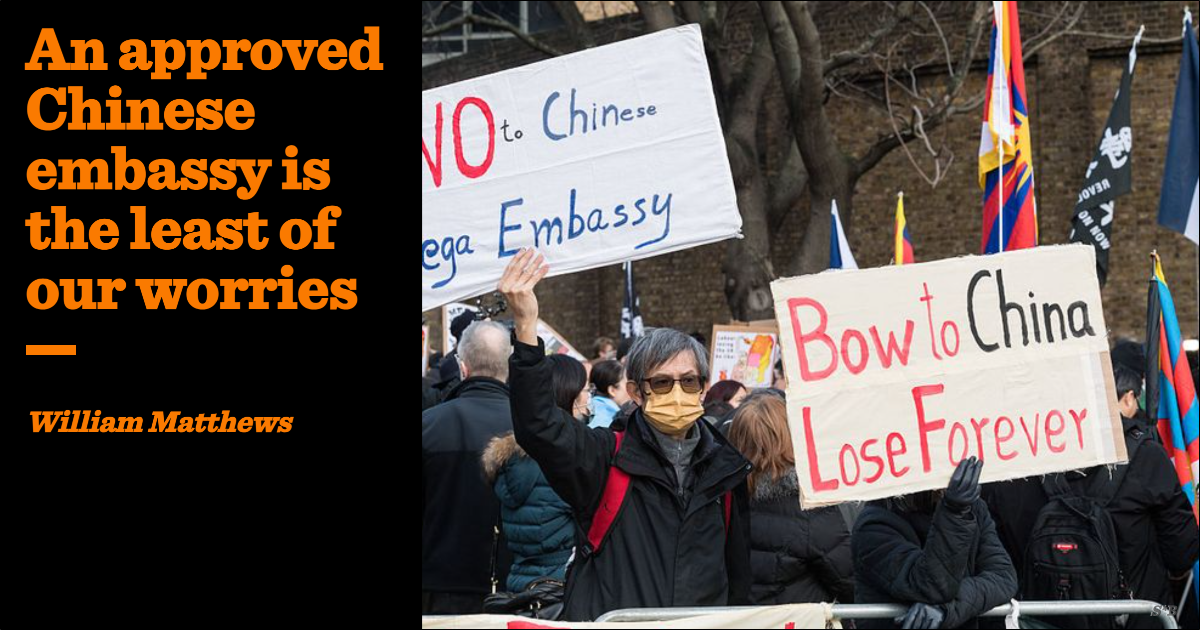
In the long, tortured saga of British governmental attempts to deal with China, and the even more tortured sideshow of the associated Parliamentary and public debate, China’s now-approved “mega embassy” is the Current China Thing. In fact, it stands out for having been the Current China Thing several times, jostling for the top spot with espionage scandals, British Steel’s ownership, Great British Energy’s supply chains, and other such competitors which succeed, temporarily, in getting Britain’s political and pundit class to think about China for five minutes through a single-issue lens.
As with all Current China Things, the embassy raises genuinely serious issues, ranging from national security concerns to wider geopolitical implications. But, as with all Current China Things, a myopic focus on the Thing itself distracts from the much more important systemic challenges posed by China which we are continually failing to deal with. In a world where China dominates the supply chains required for a successful economy, is set to outpace the United States as the leading technological power, and is able to project economic and political influence globally, approving the embassy or not is ultimately of little consequence.
The objections raised to it are all reasonable concerns, though not quite as seismic as they seem when put into broader perspective: national security risks, for example to communications cables; China’s ability to engage in transnational repression of dissidents on British soil; loss of easy public access to historic sites; the disapproval of the United States. But a string of espionage and interference scandals, the potential leverage conferred by digital backdoors in Chinese technology already widespread in the UK, a succession of British governments willing to sell off our cultural heritage to the highest bidder, and a President in Washington happy to threaten tariffs if he does not receive allied territory, all suggest that on each point of objection, Britain already has much bigger problems.
That means the decision on the embassy is really one of weighing up the relatively small impact on each area of risk on the one hand and maintaining an effective diplomatic relationship with Beijing on the other. In an ideal world, would the embassy be approved? Surely not. It does raise national security questions, it is deeply unpopular with local residents, and the symbolism of allowing an often-adversarial foreign power with a predilection for economic statecraft to occupy the Royal Mint, of all buildings, is something that no self-respecting country should have permitted in the first place.
However, we are where we are, and the reality is that any successful long-term strategy requires productive engagement and, given stretched resources and the ever-growing power imbalance between Beijing and London, picking our battles carefully. Trade-offs are unavoidable, especially when current decisions were set in motion several Prime Ministers ago and have become diplomatically difficult to roll back. Set against the need for a working relationship, the wider challenges of security and supply chains, and broader shifts in the global balance of power, approval of the embassy does not fundamentally change things.
Considered in that context (or, for that matter, the normal course of international relations), the idea popular with some critics that approving the embassy has uniquely demonstrated the government’s eagerness to “sell out” to Beijing or even “betray” Britain makes little sense. It also suggests as worrying a grasp of the long-term geopolitical environment our country faces on the part of the official and emerging political opposition as it does on the part of the current government.
The latter may be chronically unable to develop a serious approach to China that navigates successfully between security and economic opportunity, but the solution in the minds of many of its most vocal opponents within and beyond Parliament seems to be to cut off all interaction with China and simply pretend it doesn’t exist. If, faced with the biggest geopolitical challenge Britain has seen in centuries, the response of potential future members of government is simply to say “no” to any engagement with Beijing, on the grounds of human rights, national security, Communism, or anything else, they will have to come up with a very creative answer to the question of how we deal with the concrete reality of growing Chinese power.
This is the real China challenge, and goes far beyond any current concerns with national security or human rights, no matter how legitimate. China is not the Soviet Union — an ideological opponent with serious military clout but lacking the economic heft and technological expertise to compete in the long-term. We are not in the Cold War, when we could count on economic superiority, the inadequacy of our rival’s system, and the security afforded by a friendly United States to ultimately prevail. China represents something entirely new: a non-Western economic and technological superpower effecting a tectonic shift in the global civilisational centre of gravity away from the West. The future we face is one in which China becomes more powerful and we become weaker, with little we can do about it. That will take place in a world in which we continue to face a hostile Russia and a United States willing to transform mutual economic and security ties into instruments of coercion leveraged against us.
We will be lucky if we can secure ourselves a position analogous to that currently occupied by the wealthier Southeast Asian states — accepting that we are on the receiving end of great power interests and dependent on others for technology and infrastructure, but learning to adapt to it, to balance ourselves geopolitically, and to do what we can to ensure reasonable prosperity. We in Britain do not have the luxury of America’s size, wealth, and geography. We cannot pretend this is not happening and retreat to our own continent. In a world dictated by power and national interest, the internationalist liberalism which still prevails in the ruling political class is wholly inadequate. But so also are the notions that somehow, by sheer force of patriotic will, Britain can somehow regain a role as a major power and see off China, or find lasting security from Beijing’s growing influence in the arms of a US that cares nothing for our national interests.
We cannot ghost Beijing on the off-chance that Xi Jinping will call us to sheepishly apologise for spying and human rights abuses
We have to face reality. We can and should be much more robust in asserting our domestic interests and in imposing meaningful consequences on Beijing when it interferes with our internal affairs. But we cannot ghost Beijing on the off-chance that Xi Jinping will call us to sheepishly apologise for spying and human rights abuses. We should pursue re-industrialisation and lessening our dependence on Chinese supply chains. But we must accept that those are gradual processes that will involve continued reliance on Chinese suppliers, and that we will need to access superior Chinese technology in the long term.
Denying the trade-offs at best prolongs inaction and at worst deepens the risks we face. We are a country facing a world in which China increasingly sets the parameters, and in which we can no longer rely on a “special relationship” with the sole Western great power. This is unlike anything Britain has faced before. To survive it, we must pick our battles and adapt to the world as it is. That cannot happen if our political class is unable to forge an approach to Beijing beyond reaction to the Current China Thing.