Many Americans feel buffeted by a cycle of tit-for-tat political rhetoric, whipsaw policymaking, and norms breaking. A recent poll found that 82% of voters believe the way people talk about politics contributes to violence. Only one-third say it is possible to lower the temperature on political rhetoric.
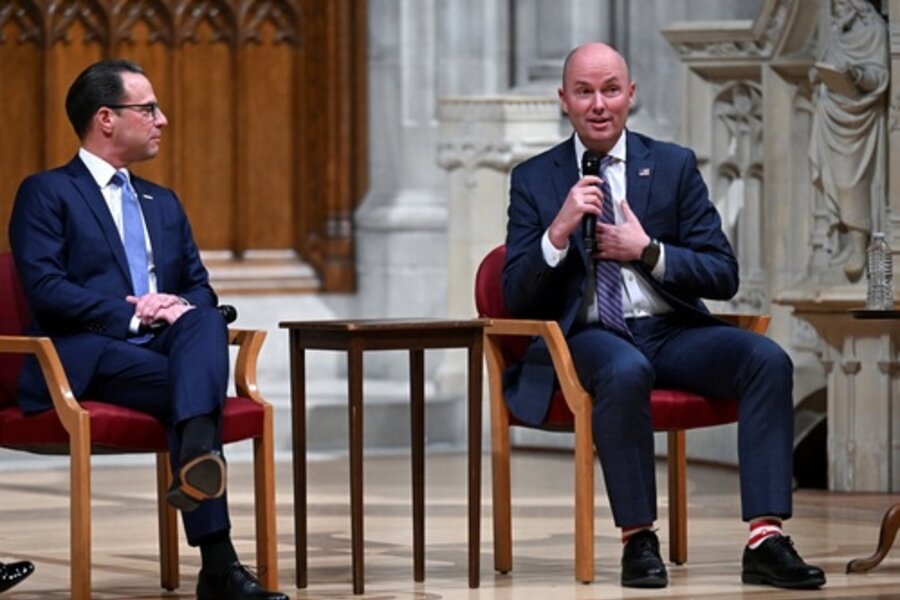
Yet, in recent weeks, more voices are calling for civic civility. They are based on a mix of political principles as well as moral and religious values. On Dec. 9, for example, two governors – a Democrat and a Republican – clasped hands after modeling respectful political dialogue at the National Cathedral in Washington.
Democrat Josh Shapiro of Pennsylvania and Republican Spencer Cox of Utah both often share how their faith traditions imbue their public service. Speaking to The Washington Post, Mr. Cox noted, “Bridge-building is the hardest thing I’ve ever done. It takes … strong faith and strong courage.”
A couple of days later, a bipartisan group of Indiana state senators voted down a bill that would have redrawn an electoral map to skew the state’s current 7-2 Republican advantage in Congress to 9-0. Several cited an ethical desire to reduce partisanship. “I hope that this is the beginning of the country stepping back from the brink,” said one Republican state senator.
Such a stance fits research that shows how the words and actions of elected officials can cue either positive or negative public sentiment. A Cornell University political scientist who has studied the campaign approach of Mr. Cox – who refuses to demonize opponents – found that it “had a significant [positive] effect” on public views.
Americans look to political leaders for moral clarity, says Governor Shapiro. Elected officials in a few states appear to recognize this, as they decide whether to push redistricting to lock in House wins in 2026 or whether to abide by political norms.
“California’s gerrymandering is not fighting back. It’s cheating,” Democrat Patricia Sinay of the California Citizens Redistricting Commission said about the Proposition 50 referendum that passed in November.
“It’s not all just about getting re-elected,” Kansas state Rep. Brett Fairchild, a Republican, told The New York Times. It’s also about “principle and … morals and ethics.”
Many Americans might now be seeking deeper values that can guide civic life. In the dialogue series that hosted Mr. Cox and Mr. Shapiro and similar events, for example, the National Cathedral has laid out one approach: “We start with two fundamental ideas,” its website notes. “First, every person is a beloved child of God, regardless of who they vote for. And second, Americans yearn for a better way to be in relationship with one another.” Perhaps the yearning has found its voice.