A pretty interesting story from the LA Times today suggests that an amateur codebreaker in West Virginia may have solved both the famous Black Dahlia murder, which happened in Los Angeles in 1947 and the Zodiac killings which took place in 1968-69 in northern California. There are a lot of kooks out there calling themselves investigators these days, but Alex Baber seems to have really done it.
The notorious Black Dahlia killing involved the murder of a woman named Elizabeth Short who was killed and cut in half, apparently by someone with surgical experience. Police suspected a former boyfriend who initially lied about living with her for several weeks. His name was Marvin Margolis. He’d seen some very traumatizing service in WWII and wanted to become a surgeon. He was studying to be a doctor at USC but eventually dropped out.
Police initially believed that Short had been kidnapped and held by the killer for several days. That timeline gave Margolis an alibi because he’d been seen elsewhere in the days before the murder. He was never ruled out as a suspect, but he eventually moved to Chicago and started going by a different name. Years later he moved back to California.
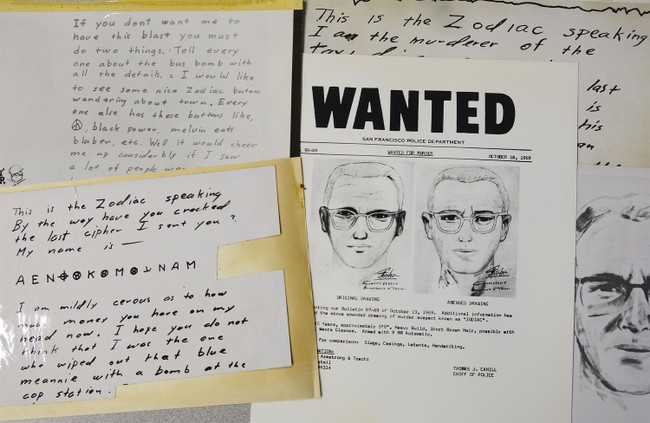
In 1968 and 69 a killer calling himself Zodiac murdered five women and left a series of cryptograms for police. One of those allegedly contained his real name.
The toughest to decipher was the letter he sent in April 1970 to the San Francisco Chronicle, with the words “My name is —” followed by a 13-character string of letters and symbols. It came to be called the Z13 cipher, and its brevity has stymied generations of PhDs and puzzle prodigies.
Alex Baber, a 50-year-old West Virginia man who dropped out of high school and taught himself codebreaking, now says he has cracked the Zodiac killer’s identity — and in the process solved the Black Dahlia case as well…
He became interested in the Bay Area killings when he saw David Fincher’s 2007 film “Zodiac.” He learned that the Z13 cipher is regarded as the Holy Grail of Zodiac studies; the killer sent it to the newspaper after the head of the American Cryptogram Assn. publicly dared him to put his real name in a code.
To attack the problem, Baber used artifical intelligence and generated a list of 71 million possible 13-letter names. Using known details of the Zodiac killer, based on witness descriptions, he cross-checked those names against military, marriage, census and other public records.
“This takes me nine months of working 18-20 hour days,” he said. “I’m starting to kill this onion. I’m starting to eliminate layers: Too tall, too short, or wrong race.”
Eventually he narrowed the list down to one name: Marvin Merrill. That’s the alias that Marvin Margolis starting using after the killing of Elizabeth Short. Baber presented his conclusions to two LAPD homicide detectives both of whom became convinced. They shared the results with crime novelist Michael Connelly who did a podcast about it. For the podcast he brought in a former NSA codebreaking expert to check Baber’s work.
Connelly found Ed Giorgio, a mathematician who served as the chief codemaker and codebreaker for the National Security Agency, and who agreed to check out Baber’s solution to the Z13 cipher…
“All of Alex’s work checked out to me,” he said. To verify his work, Giorgio contacted two other former NSA crypto-mathematicians, Patrick Henry and Rich Wisniewski.
Not only did they endorse the Z13 solution, but Henry discovered another detail cementing the link between the two unsolved cases: the Zodiac code was generated by the key word “Elizabeth.”
The odds that so many interlocking discoveries might be coincidence, Giorgio said, are vanishingly small. “The probability that anything else is correct is orders of magnitude smaller,” he said. “It is the greatest sleuth story ever told.”
And there’s yet another bit of proof which seems to connect the cases. Margolis was married twice and had four kids. Baber approached one of them, claiming he had questions abut his father’s service in the war. The son, Roark Merrill, had inherited a drawing which his father had done as he was dying of cancer. It was called Elizabeth.
The sketch, called “Elizabeth,” depicts a woman who is peering with one eye through a curtain of hair that hangs over her face. She is naked from the waist up. Her lower half is not visible, as if cut off above the navel. One of the nipples appears to be severed. The torso bears a series of marks that might be stab wounds, amid an area of shading that suggests blood. It is signed “Marty Merrill ‘92,” reflecting another alias Margolis used.
The word “Zodiac” also appears to have been included in the shading of the image. Baber saw it as a dual confession. He also found another connection between the two cases. No one has ever proven where Elizabeth Short was killed, but Baber thinks he knows. He identified a motel in Compton which, in 1947, was one of the few that had bathtubs in the bungalows. Reports the day after the killing suggested a man had been driving from one hotel to the next looking for a room with a bathtub, which he said his wife needed.
Baber found a newspaper ad for it. It was called the Zodiac Motel.
I haven’t listened to the podcast yet but it really does sound like Baber has solved not one but two cases that resulted in six mysterious deaths. Marvin Margolis died in 1993, so it’s too late to bring justice to the (alleged) killer. Still, it’s amazing after all this time that the cases might really be solved.
Editor’s Note: Do you enjoy Hot Air’s conservative reporting that takes on the radical left and woke media? Support our work so that we can continue to bring you the truth.
Join Hot Air VIP and use the promo code MERRY74 to receive 74% off your membership.