Reinaldo Hernández just celebrated his 86th birthday in the dark.
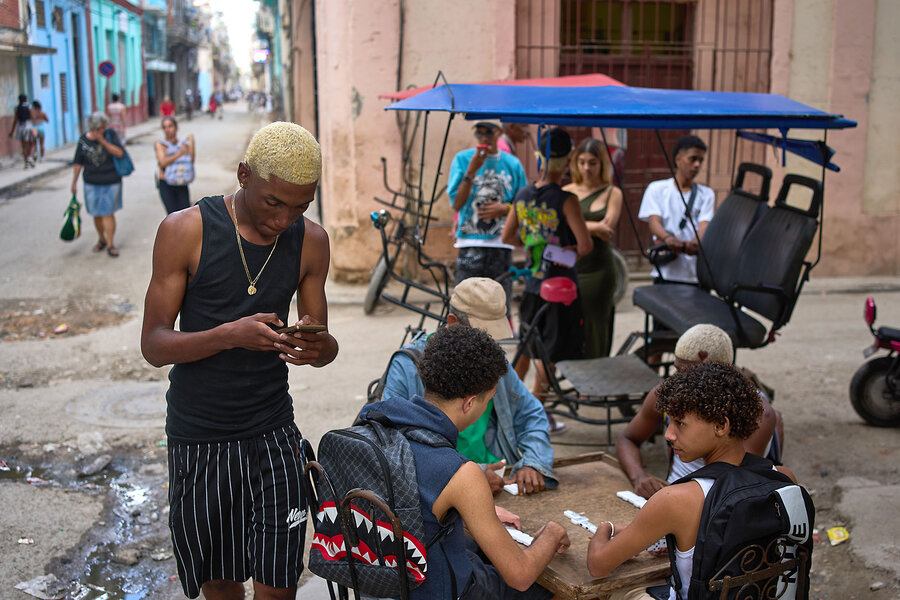
The lack of fuel and incessant power outages hitting the island of Cuba since the United States imposed an oil blockade in late January have made quotidian tasks like traveling on public transportation, accessing health care, or even keeping food refrigerated, all wildly difficult.
“It’s very sad to reach this point in life where one might expect, let’s say, some comfort … some care,” he says. “And for all of that to vanish.”
Why We Wrote This
The U.S. is blocking oil shipments to Cuba, where people are struggling to make ends meet. Ordinary Cubans are also defying the risks that come with criticizing their government and asking for political change.
Mr. Hernández has lived through a dictatorship, a revolution, and the various stages of Communist Cuba’s evolution. That includes the dire economic hardship following the collapse of the Soviet Union, a vital benefactor of the Cuban government. But people today are reaching their limit, he says. The octogenarian’s relatives now living abroad pooled their money this year to gift Mr. Hernández with a small generator.
“Everyone is starting to agree,” he says, seated in a once-grand, high-ceilinged Havana apartment in need of a fresh coat of paint. He shares the place with his daughter and adult grandson. “The people of Cuba – I’m almost shouting this – they need change.”
To be sure, Cubans still hold a range of opinions about their government. But one important shift in recent months is a new willingness to speak openly about the need for political change, says Michael Bustamante, a Cuba expert at the University of Miami. This is something that has been building over the past six years – “a slow drip,” he says.
“There’s a nihilism that’s taken root,” says Dr. Bustamante. “People are ready for something that’s dramatic and that can change the equation, even if it comes with big risks.”
Careful complaining in public
Those speaking out against Cuba’s Communist government risked execution in its early days, and today still face imprisonment or torture.
The social contract between Cuba’s government and its people in Cuba was based on a “cradle to grave” system that meant government-subsidized education, health care, and culture.

“You were taken care of. And the price was political loyalty,” says Katrin Hansing, an anthropologist at the City University of New York who studies migration, inequality, and memory in Cuba.
This arrangement between the party and the people has frayed over time, but it remained nominally intact until recently. Now that public services and access to daily necessities are harder to come by because of U.S. pressure, old inhibitions around speaking out are fading.
The government “hasn’t known how to solve the country’s problems and they have accumulated over time,” says Sergio Almaguer, who is in his 60s and works at a nongovernmental organization in Havana. “We’re paying the price for this incompetence.”
Cubans began complaining publicly in the 1990s, during the so-called Special Period of economic hardship after the fall of the Soviet Union.
“Standing in line and kind of saying something negative about wait time – it was seen as pretty critical,” says Dr. Hansing. “People had real problems and there was a collective sense of solidarity in carefully complaining.”
But the current economic situation has created a new willingness to openly voice grievances, even if the critiques are about the situation and not lodged directly at the communist government. “That’s where the nuance lies,” says Dr. Hansing.
Pressure mounted first with the COVID-19 pandemic and then a bungled 2021 currency plan that drove up inflation. A decaying electric grid has led to increasing blackouts. Through this period, Cubans have gained broader access to the internet.
That has allowed ordinary citizens to see the repressive responses from their government, including in July 2021, after widespread public uprisings sparked by hunger and frustration. More than 1,000 people were arrested. Most of them were young, and many are still imprisoned.
The “Cuban state has lost its monopoly on information,” Dr. Bustamante says.
And, then, there’s Venezuela.

“People are anxious for change”
The United States reoriented its foreign policy after President Donald Trump began his second term.
In January, the U.S. captured and ousted Venezuela’s Nicolás Maduro. Last month, U.S.-Israeli airstrikes killed Iran’s supreme leader.
Amid the geopolitical uncertainty, a speedboat carrying 10 Cuban exiles from the U.S. – including at least two with American citizenship – exchanged fire with the coast guard off Cuba’s shoreline, killing four. The six survivors were charged with terrorism for what Cuban officials say was a plan to sow chaos on the island. Loved ones of those captured say they were trying to instigate much-needed change in their home country.
“What I’m hearing more of from people inside Cuba is ‘rather than hurt me, why don’t they just send in the F-16s,’” says Dr. Bustamante.
At the same time, new pressure is mounting on Cuba, which lost a key partner with the removal of Mr. Maduro. And Cuba has seen other allies, such as Mexico, pause critical oil shipments to the island under U.S. pressure. Tourism, a crucial economic engine for Cuba, never recovered after the pandemic. For three years straight, the island’s economy has contracted. And an estimated 2.5 million Cubans – many young and educated – have fled since 2020.
This is all in addition to a six-decade-long U.S. economic embargo on the island.
Since late January, schools and state workplaces have been opening only sporadically. Several international airlines have canceled flights.
“You have to buy food little by little,” says Estefany Hernández, an industrial design student at the University of Havana, who no longer spends money on meat because she worries about it going bad during a power outage. She started riding a bike to get around the city after public transportation offerings dwindled, and says her university classes are frequently canceled.
“We live in fear. Who knows how many days the power will be out?” she says. “People are anxious for change, especially young people.”
The government blames the U.S. embargo for the situation. Despite encouragement from allies over the years to open its economy a la Vietnam or China, Cuban officials have stuck with a strict state-controlled model. “They thought they’d be weakened politically and ideologically by economic reform, and that would present a problem for them, given their proximity to the United States,” says Cuban economist Carmelo Mesa-Lago.
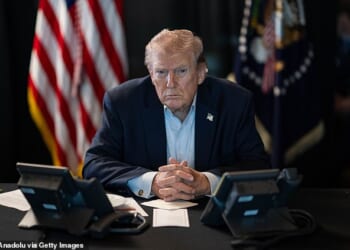
What happens next for Cuba could depend on Washington. Members of Secretary of State Marco Rubio’s team have reportedly met with Cuban officials, including the grandson of former President Raúl Castro. President Trump told reporters at the White House recently that Havana has “no money, no anything right now.”
“Maybe we’ll have a friendly takeover of Cuba,” he added.
Cuban President Miguel Díaz-Canel said on March 3 that his country’s private sector needs more autonomy, calling for “urgent” change to Cuba’s economic model. The statement was seen as a direct response to U.S. pressure, though Cuban leaders have promised reforms over the years without following through.
The Cuban government might be feeling the heat, but it’s also spent more than 60 years as though it was under siege, says Dr. Hansing. “You operate differently if a war-like mentality has always been your point of reference.”
Much like the shift with citizens’ willingness to call for change inside Cuba today, Mr. Rubio recently had something of a change in rhetoric, as well.
The secretary and former senator, who came up among Miami’s conservative Cuban diaspora, has long called for a political overhaul on the island. But at last week’s Caribbean Community conference on St. Kitts, he appeared to nod to the fact that change in Cuba might look different from other examples this administration has called attention to this year: “It doesn’t have to change from one day to the next,” Mr. Rubio said.
Whitney Eulich reported from Mexico City; Rudy Cabrera Arcia, from Havana.