Joe Nosel remembers well the yellow ribbons that supported the troops in the Gulf War with Iraq in 1990.
Then there was the shock and anger of 9/11, which produced a different reaction in 2001 – vengeance and retribution for what was, in effect, Pearl Harbor II, he recalls. There were ribbons on display everywhere then, too.
But today, he isn’t seeing similar public gestures of support, says Mr. Nosel, who lives in a retirement community in Okatie, South Carolina, and supports President Donald Trump’s decision to join Israel in an attack on Iran.
Why We Wrote This
When the United States has gone to war in the past, Americans have come together around a shared experience. In its early days, the Iran war has not yet become part of the country’s consciousness in the same way that other conflicts have.
But there’s been no attempt by leaders to build up public support as in the past, he says. And there’s little evidence of national unity as American service members put their lives on the line.
Three F-35B Lightning jets have just pierced through the sky over what he calls “an old people’s neighborhood,” flying low as they tilt home to Marine Corps Air Station Beaufort, 20 miles away.

“I’m in my own little bubble. I guess until it starts affecting us more, we won’t think much about it,” says Mr. Nosel, who cast a ballot for Mr. Trump in 2016. “But I think it’s a good thing we went into Iran. They killed thousands of their own people.”
The detachment that Mr. Nosel observes is perhaps part of a wider national mood. Americans are still processing a war that arrived without much warning and has yet to summon the shared rituals of prior conflicts. The yellow ribbon, that most familiar of American homefront symbols, is conspicuous in its absence.
The symbol originated with a conflict with Iran. In November 1979, Iranian militants seized the U.S. Embassy in Tehran, and a campaign spread across the country, inspired by the 1973 hit “Tie a Yellow Ribbon Round the Ole Oak Tree.” People began to tie ribbons around trees and lampposts – a gesture that meant, “We see you; we are waiting; come home safe.” The ribbons surged back during the Gulf War, and reappeared after 9/11, enduring through two decades of war.
Its relative absence at the start of the current conflict does not imply indifference, to be sure. There is something more complicated happening in a country caught between a conflict it did not fully anticipate and a political moment that has made support for troops hard to coalesce, let alone display publicly.
Measuring the national mood
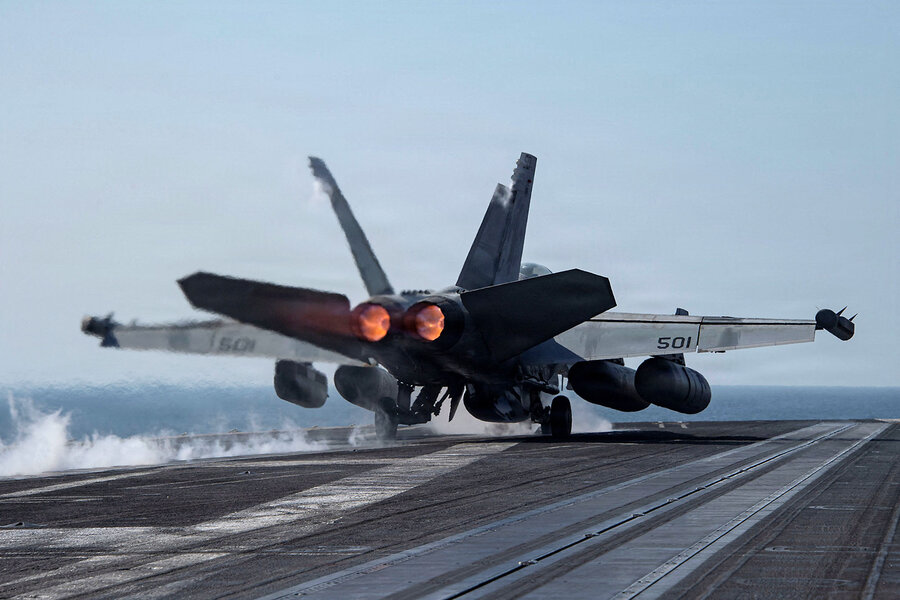
Xavier Dempsey finished his tour of duty in the Navy last May. Four years ago, he was a seaman aboard the USS George H.W. Bush, the nuclear-powered carrier that is completing exercises off the U.S. coast in preparation for deployment to relieve the war-weary USS Gerald Ford. The ship’s sailors have been at sea for over 250 days – including, now, in the Red Sea supporting the Iran war. Mr. Dempsey cuts hair at a barbershop inside a Walmart in Hilton Head, South Carolina.

Henry Gass/The Christian Science Monitor
“From what I think of it, it’s more like who wants to be on top,” he says of the conflict. But more than the geopolitics, it is the human cost among people he knows that weighs on him. The war is affecting friends still in uniform, he says.
“When I was in the Navy, a lot of the stuff going on was at bay,” says Mr. Dempsey. “But now, it’s spiked out of control. A lot of my friends signed up in peacetime, thinking, ‘It ain’t going to happen.’ Now, all this stuff is coming up, and it’s like, ‘Dang, I didn’t really want to do this. …’ I need it to stop,” he says. “I want it to stop.”
When the bombs fell on Baghdad in January 1991, American support for the Gulf War surged to 79% in public polling. President George H.W. Bush’s approval rating climbed to 89% – the highest Gallup had ever recorded for a president. Yellow ribbons appeared on trees and bumpers from Maine to California.
A decade later, the pattern repeated with greater force. Two days after the twin towers fell, 93% of Americans backed military action against those responsible. Flags flew from porches and freeway overpasses. When U.S. forces entered Afghanistan that October, less than 1 in 10 called it a mistake. The second Iraq war, in 2003, drew 72% support at the outset.
Now, two weeks into Operation Epic Fury, a Washington Post poll published Thursday finds Americans nearly evenly split, with 42% supporting the military campaign and 40% opposing it – a modest shift toward support since the strikes began, but still a far cry from the general unity of prior wars. Across 10 polls since the fighting started, the Post’s average shows 38% approving and 49% disapproving.
“No president in the modern polling era has launched a major military operation with the public already against him,” wrote data expert G. Elliott Morris recently on his Substack “Strength in Numbers.”
Andrew Swiler, who studies how information moves through large groups, sees the absence of visible expressions of support for troops as a symptom of a fractured media landscape as much as of a fractured national mood. In past conflicts, he argues, visible symbols created a self-reinforcing cycle – ribbons and flags put collective feeling on display, and that encouraged more of the same.
“Today’s situation with Iran is different,” emails Mr. Swiler, founder of the data optimization company AnswerManiac. “So a shared national experience never truly takes hold and a common goal feels missing. No one story connects everyone. It is just more content fighting for attention before people go to something else.”

Patrik Jonsson/The Christian Science Monitor
What has been missing, in effect, has been a “grand narrative,” as some observers point out. Pearl Harbor gave President Franklin D. Roosevelt one. Iraq under Saddam Hussein and his invasion of Kuwait gave President George H.W. Bush one. And the ruins of 9/11 gave his son President George W. Bush the moral authority to defend the nation’s very soil.
In his nearly two-hour State of the Union address on Feb. 24, just five days before the first missiles and combat sorties were launched, President Trump devoted three minutes to Iran.
As the U.S. attack was launched Feb. 28, Mr. Trump posted a video address, framing the effort as a necessary response to a regime that for 47 years has been “targeting the United States, our troops and the innocent people in many, many countries.” The U.S. operation aims to prevent Iran’s regime “from threatening America and our core national security interests,” he said. “They will never have a nuclear weapon.”
“Like you’re not connected to it”
True, the conflict is just two weeks old, and the president has been sending mixed signals about how long it will last, and how much sacrifice it will require. He has called it both a war and “a little excursion,” complicating how Americans might think of it as many remain unsure about what’s to come.
On the Massachusetts Institute of Technology campus in Cambridge, a junior from Cleveland puts it in simpler terms. “From a privileged point of view, it can almost feel abstract, like you’re not connected to it,” says the student, who asked that her name be withheld out of fear she might be “canceled” for expressing her views.
Her friend agrees. The war, she adds, arrives the same way everything else does now – scrolling past on a phone. “Sometimes it makes it feel more like media than real life,” she says. “It can become more entertainment than news or storytelling.”
That abstraction has a sharper edge for those with more personal stakes. In Bastrop, Texas, a small city on the Colorado River southeast of Austin, Melissa McKenzie walks along Main Street with the war somewhere in the back of her mind. Her husband is a veteran. She is not closely following the conflict, however.
“For me, it’s scary,” she says. “I feel like you can’t say we’re safe because you don’t know what these other countries are going to do.” She wants to trust the commander in chief at a moment like this. She finds she cannot. “I don’t really trust the administration,” she says.
The economic undertow resulting from the closing of the Strait of Hormuz runs alongside political concerns. Not far away, Antonio Camarena sits outside the Red Rock Food Mart, a gas station convenience store in an unincorporated town 16 miles south of Bastrop. He emigrated from Panama 21 years ago and is now a U.S. citizen, a long-haul truck driver who has watched American wars come and go.
“It’s incredible how much is going, for nothing,” he says, noting the cost of the Patriot air-defense interceptor missiles in the news, said to have cost billions in just the first five days of war. “The price of everything [in the U.S.] goes up,” he adds. Iran “is far away from here; it’s our money all going over there. Many people here need help.”
On the western edge of Savannah, Georgia, Melvin Cochran, a retiree, washes his car as he prepares for a meeting with his pastor. Gas prices – the national average is about 70 cents a gallon higher than a month ago, according to AAA – are the only direct impact he has felt.
But he’s among those Americans who are troubled on grounds that are older and deeper than economics – a weariness born of watching this happen before, and what he calls the moral stain of waging war for unclear reasons.
“One day we’re sitting around, and the next day we’re at war,” he says. “A lot of people died over something senseless, and now we’re doing the same thing again. We never got over it, and they never got over it.”
He pauses. War has a way of being unpredictable, not turning out as leaders plan. And this time, there isn’t strong public support amid the uncertainty. “Sooner or later, the rooster do come back home,” Mr. Cochran says.