It was the kind of marketing not even Hollywood money could buy.
In February, Steven Spielberg’s secretive summer sci-fi movie was unveiled. “Disclosure Day” is about humans discovering that they are not alone in the universe. The trailer features a mysterious crop circle and a character alleging a government cover-up. In another scene, a television weather reporter suddenly begins speaking in an alien language during a live forecast. (Translation: “Cloudy, with a chance of UFOs.”)
Eleven days after the “Disclosure Day” trailer aired, President Donald Trump started talking about extraterrestrial life. In a social media post, the president wrote that he was directing government agencies, including the Department of Defense, “to begin the process of identifying and releasing government files related to alien and extraterrestrial life, unidentified anomalous phenomena (UAP), and unidentified flying objects (UFOs) …”
Why We Wrote This
The promise of new government UFO records and films that explore out-of-this-world connections are renewing attention on the question of whether humankind is truly alone in the universe.
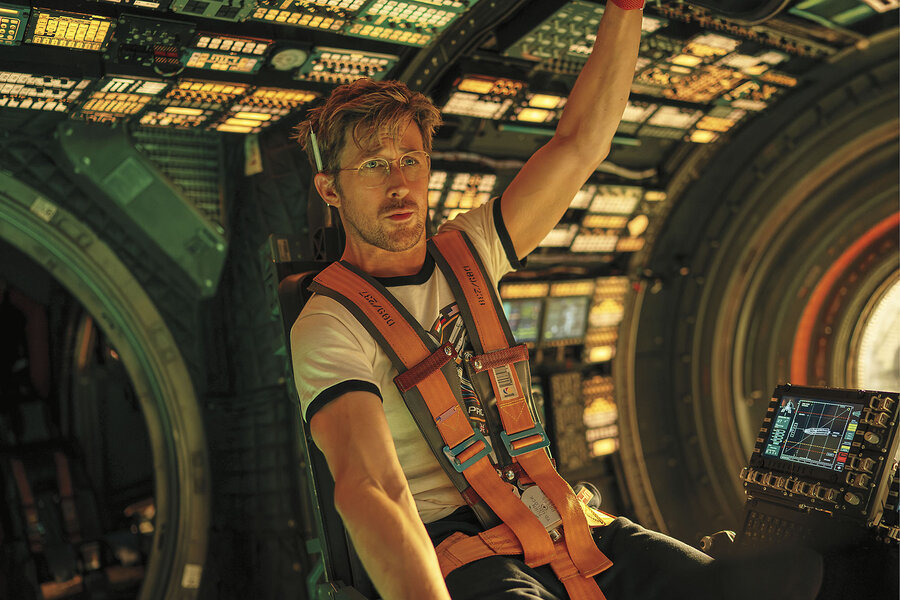
For Mr. Spielberg’s latest close encounter of the cinematic kind, it was great timing. Since then, Mr. Trump has said that he doesn’t think aliens exist. Federal agencies have yet to release new information. But no matter what the files might reveal, extraterrestrials are a subject of fascination in popular culture. Stories such as “Disclosure Day” and the imminent movie adaptation of the sci-fi novel “Project Hail Mary” invite us to reorient how we think about humankind’s place in the universe.
“Movies have definitely opened us up – even more than print science fiction – to the idea that something is out there,” says Fraser Sherman, author of “The Aliens Are Here: Extraterrestrial Visitors in American Cinema and Television.” “There has always been a feedback loop between popular interest in the subject and movies.”
Aliens’ path to pop culture
Extraterrestrials first started showing up in fiction in the late 1800s. Most notably, H.G. Wells’ “War of the Worlds” (1898) imagined technologically advanced invaders from Mars. They had squid-like tentacles and reptilian faces. In an alien beauty pageant, they’d be stiff competition for Jabba the Hutt.
During the early 20th century, science fiction flourished through new mediums. In 1902, the visually lavish movie “Le Voyage dans la Lune” (“A Trip to the Moon”) depicted intelligent, bipedal, insect-like lunar inhabitants. Newsstand pulp publications such as “Planet Stories” featured luridly illustrated sci-fi yarns. Orson Welles’ 1938 radio adaptation of “War of the Worlds” panicked some listeners who thought they’d tuned in to a report of an actual alien invasion. Extraterrestrials had become popularized.
“There were numerous places where people could be influenced by what they saw or heard,” says Michael Stein, editor of “Alien Invasions! The History of Aliens in Pop Culture.”

Those fictional aliens preceded the first widely reported UFO sighting. In 1947, a pilot named Kenneth Arnold told news organizations that he saw nine flying discs. “Flying saucer” entered the popular lexicon. And science fiction. In “The Day the Earth Stood Still” (1951), the alien ship was shaped like a giant disc. The trope persisted in TV series such as “V” in the 1980s and with the 1995 blockbuster film “Independence Day.”
There has been a comparable relationship between fictional depictions of extraterrestrials and the physical descriptions people have given when reporting alien contact. A similar feedback loop extends to alien conspiracy theories – for example, the alleged government cover-up of a 1947 UFO crash near Roswell, New Mexico.
“A lot of the old Roswell mythos and so on, and people’s perceptions of it, are shaped by what they’ve seen on ‘The X Files,’” says Jesse Walker, author of “The United States of Paranoia: A Conspiracy Theory.”
Last year, The Wall Street Journal reported that the Pentagon has spent decades spreading UFO disinformation. It created false documents and fabricated images to cover up secret weapons programs at bases such as Area 51 in the Nevada desert. Even so, many UAPs, including accounts of naval pilots encountering wingless objects capable of astonishing speeds and maneuvers, remain unexplained.
Pondering contact with extraterrestrials
But science fiction works best when it invites us to imagine fantastical elements beyond our immediate experience. In Andy Weir’s bestseller “Project Hail Mary,” for instance (spoiler alert), astronaut Ryland Grace is 11.9 light-years from Earth when he encounters an alien spaceship.
Mr. Weir consciously eschewed tropes of aliens that look like little gray men with egg-shaped heads. His alien resembles a large spider, but with rotating limbs and a stone-like carapace. The species lacks eyes but visualizes objects through sound waves. It lives in a different atmosphere. Ryland nicknames the alien “Rocky.” Turns out that Rocky is on a mission, like Grace, to save his home planet.
The author sought to ground his fiction in science. To that end, he asked himself how that species, known in Mr. Weir’s book as Eridians, could build a spaceship and leave their planet. That led him to explore ideas about the Eridian language, the formation of its civilization, and their capacity for compassion.
“If everybody in your society has that, then when something happens to me, they all come and help me,” says Mr. Weir, whose book has been adapted into a movie starring Ryan Gosling as Grace, and which opens March 20. “Compassion comes from empathy. I find it hard to believe you could have one without the other.”
The optimistic outlook about humans and aliens in “Project Hail Mary” is similar to that found in movies such as “Enemy Mine,” “Arrival,” and “Star Trek VI: The Undiscovered Country.” They aren’t engaged in war. Humans and extraterrestrials realize they share qualities in common. A shared “humanity,” if you like. The “Star Trek” movie playfully gets at that idea when one of the aliens claims, “You’ve not experienced Shakespeare until you’ve read him in the original Klingon.”
In “Project Hail Mary,” Grace and Rocky share the ability to communicate, empathy, and compassion. Those three things provide “all the ingredients you need for friendship,” says Mr. Weir, whose breakout novel, “The Martian,” was also made into a film.
Mr. Weir says that if humans made contact with intelligent aliens in real life, it would be “the most important moment in human history.” The author says that the first thing that a devoutly religious person might ask is whether the aliens have souls. Many have pondered that hypothetical question.
“It will appear as if God had more than one child, so to speak, and I don’t see any problem with that,” says Avi Loeb, author of “Extraterrestrial: The First Sign of Intelligent Life Beyond Earth.” “If you believe in God being capable of creating the universe, definitely creating other siblings in our family would make a lot of sense.”
Mr. Loeb, a Harvard University astronomer, compares such a scenario with the Copernican revolution – the discovery that the Earth revolves around the sun rather than vice versa. We would have to rethink the idea of being at the center of our universe.
In the trailer for Mr. Spielberg’s “Disclosure Day,” a nun expresses a similar thought: “Why would He make such a vast universe, yet save it only for us?”