The eyes of the world are rightly focused on the closure of the Strait of Hormuz in the Persian Gulf, its malign impact on the price of oil and gas and the destructive consequences for both business and consumers.
This fresh economic challenge comes on top of existing – and deep-seated – concerns about persistent inflation, higher interest rates and the very real possibility of a global slump.
Yet away from the current oil shock and the flames engulfing the Middle East is another firestorm which, although largely hidden, could prove as devastating as the great financial crisis (GFC) of 2008 when the world’s banking system had to be rescued by Western governments.
Now, once again, banks and the fund managers looking after our pensions and savings are in a state of panic.
Amid enormous outflows from their funds – as nervous investors seek the safety of cash – the masters of the universe on both sides of the Atlantic are in retreat and slamming the doors on those seeking to escape. The prospect of a banking meltdown is eating away at confidence and causing market values to plunge.
As a financial editor who reported for this paper on the credit crunch of 2007 – which preceded the GFC a year later – the fissures breaking open in the financial system look disturbingly familiar. Rarely have I been so concerned.
Among senior financiers, economists and policy makers across the Western world, there’s a rising sense of fear. We have been here before.
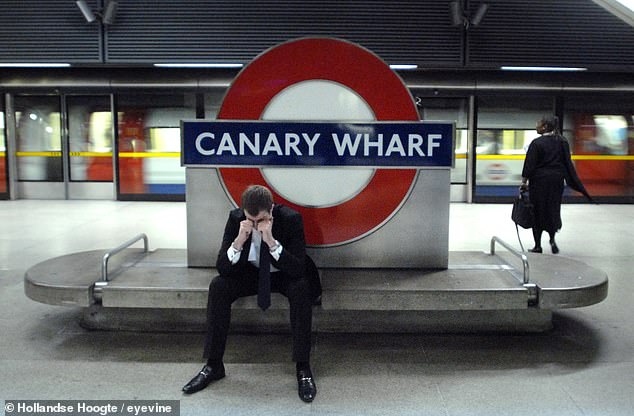
A banker at Canary Wharf station on September 12, 2008 amid the great financial crisis
In the aftermath of the GFC, financial regulators imposed tough new rules on banks requiring them to hold more capital. This was to protect depositors against future blunders and to persuade the banks to be more scrupulous in their lending.
Explosion
The strict discipline led financiers in Mayfair, the City and downtown Manhattan to fill the vacuum – by dipping into unregulated, poorly supervised private markets.
This vast, little-understood backwater of finance – often known as ‘shadow banking’ – operates beyond the reach of central banks, such as the Bank of England, or official enforcers such as Britain’s Financial Conduct Authority.
Side-stepping the visible, regulated financial sector in this way has been an obvious risk, but there was serious money to be made.
There has been an explosion of ‘Wild West’ private equity, private credit and hedge-fund lending. And it is the toxic legacy of this largely hidden activity that is now seeping to the surface and threatening the global economy.
The Washington-based International Monetary Fund (IMF) estimates that commercial banks in America and Europe have a mammoth $4.5trillion (£3.4trillion) exposure to this mountain of shadowy debt.
The IMF had already declared the shadow banking system to be the single biggest threat to world financial stability.
Then, as the Iran crisis erupted over the last three weeks ordinary retail investors, family wealth offices and professional asset managers developed a bad case of the jitters.
With the world in fresh turmoil, billions of pounds have flowed out of funds as investors rushed to protect their money.
And the tremors are already shaking the financial system, major players included.
American giants Morgan Stanley and JP Morgan have expressed alarm. Here in Europe, Barclays and Santander are feeling the aftershocks from the first collapses and closures of funds.
The potential for a financial catastrophe was palpable at a private dinner of senior economists and regulators last week.
The guest speaker, who heads one of Britain’s most respected forecasting groups, highlighted the potential for further collapses within the financial system.
My fellow diners expressed concern that last month’s collapse of London-based mortgage lender Market Financial Solutions (MFS) is a canary in the coalmine – and that Britain should brace itself for something far worse.
Several of those present were veterans of the 2008 GFC and at least one of those expressing alarm had been at the side of former Chancellor Denis Healey during sterling’s plunge in 1976 when the national reserves were drained and Britain had to go, cap in hand, to the IMF for a bail-out.
In 2008, the crash was caused by US mortgage lending to poorer borrowers – sub-prime mortgages – which were then sliced and diced and ended up on the balance sheets of financial groups around the world.
This time around the block, the banks have been lending to private equity and hedge funds – the shadow sector – which have used the loans to finance bids and deals, some of which have gone horribly wrong.
The assets bought have been injected into funds offering super-charged returns.
But the reality for private investors and professional asset managers seeking exceptional returns is that if the rewards look too good to be true they almost certainly are.
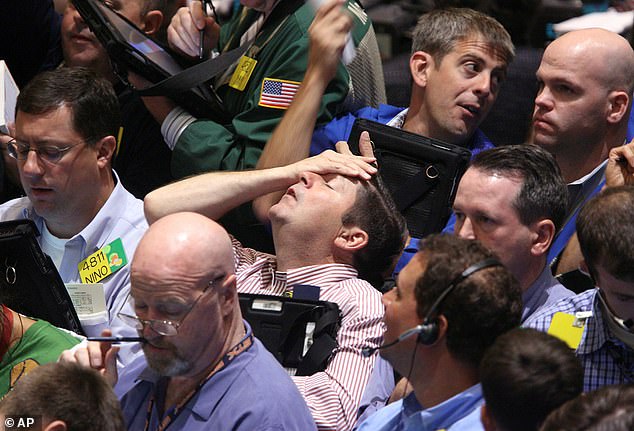
Traders panic during the financial crisis of 2008 at the New York Mercantile Exchange
Last week one of the world’s top investment banks Morgan Stanley limited withdrawals from its $7.6billion North Haven Private Income Fund after experiencing a surge in ‘redemption requests’ (which is to say that investors wanted their money out).
It followed similar moves by the asset manager Blackstone, which looks after the savings of millions of people across the globe.
Shockwaves
Christian Stracke of Pimco (an arm of the giant German insurer Allianz which manages assets of £1.7trillion) said the private equity industry was facing ‘a reckoning. It’s not just a crisis of confidence but of bad underwriting.’
US-based fund manager Blue Owl has been at the heart of the growing catastrophe. It faced a liquidity crisis – a shortage of cash – last month and was forced into a fire sale of $1.4billion of assets causing shockwaves across financial market as its share price tumbled. The failure of London mortgage lender MFS has left Barclays and Santander nursing £1.3billion of losses.
At the time of the Great Financial Crisis the world’s most famous investor Warren Buffett, the Oracle of Omaha, noted sardonically: ‘Only when the tide goes out do you discover who’s been swimming naked.’
It will not be a pretty sight.
Belatedly, the Bank of England is conducting a ‘stress test’ to understand how British financial institutions would be affected by a full-blown earthquake in the private credit markets.
Sadly, however, I have little confidence that this Labour government even begins to understand what it faces.
Pray
The guest speaker at last week’s financial dinner was particularly incensed by Chancellor Rachel Reeves’s appointment of a new financial regulator, Katharine Braddick, to be deputy governor at the Bank of England.
Braddick has been charged with encouraging ‘bolder’ (read riskier!) lending in the same private markets now causing so much well-founded concern.
Reeves has even asked her to oversee a relaxation of mortgage rules – another troubling echo of 2008.
At present, the world’s eyes are diverted by President Trump’s efforts to dislodge the stubborn leaders of Iran.
But if the movement in the tectonic plates seen in the last several weeks turn out to be as deep-seated as many believe, the economic crisis engulfing us will be of a completely different order.
We must pray that is not the case. For if it is, all those of us with pensions, hard-earned savings and other investments face life-changing losses. And the economy itself will lie in ruins.
DIY INVESTING PLATFORMS

AJ Bell
AJ Bell
Easy investing and ready-made portfolios
Hargreaves Lansdown
Hargreaves Lansdown
Free fund dealing and investment ideas

interactive investor
interactive investor
Flat-fee investing from £4.99 per month

Freetrade
Freetrade
Investing Isa now free on basic plan

Trading 212
Trading 212
Free share dealing and no account fee
Affiliate links: If you take out a product This is Money may earn a commission. These deals are chosen by our editorial team, as we think they are worth highlighting. This does not affect our editorial independence.