Of all the recent signs that Western civilization is circling the drain, the most depressing is the apparent decline in IQs.
The so-called Flynn Effect once showed IQs rising steadily. Its reversal suggests we are heading for a steep decline. We may soon look back on this era of TikTok, Love Island and Zack Polanski as an age of dignity and restraint. If we stop reading at the current rate, our children will inherit a brave new world where books are viewed as arcane, even perverse, artifacts of a lost civilisation. They will stare at the Complete Works of Shakespeare much like a chimpanzee stares at an iPhone.
When we started teaching we used to worry about the influence that cigarettes and alcohol, comics and television, were having on teenagers’ brains. Little did we know that those were our salad days, filled with such trifling trinkets of distraction compared to what we are facing now. It is axiomatic to say that attention is fundamental to learning, and strengthened attention can improve cognitive control, but over the last ten years we have seen attention spans weaken, reduced to a narrowness which makes teaching and learning not only increasingly difficult but actively resisted.
Intelligence is inherited, to some extent, but it also depends on our environments. Too many of our children struggle to focus in a way previous generations did not. While the causes are complex, mobile phones and social media are the primary culprits, and many children admit as much. But we may be at a turning point: last week Australia banned under-16s from ten of the world’s biggest social platforms. Watching this sociological stress test play out — particularly its enforcement and impact on education — will be fascinating, but already the downsides seem minimal. We have lived with the “great re-wiring” of adolescent brains for over a decade. The evidence of harm is compelling, as is the depressing data on the mental disorders that Zuckerberg et al have gifted to generations Z and Alpha.
The threat that AI poses to intelligence is existential: it allows children to outsource their thinking entirely
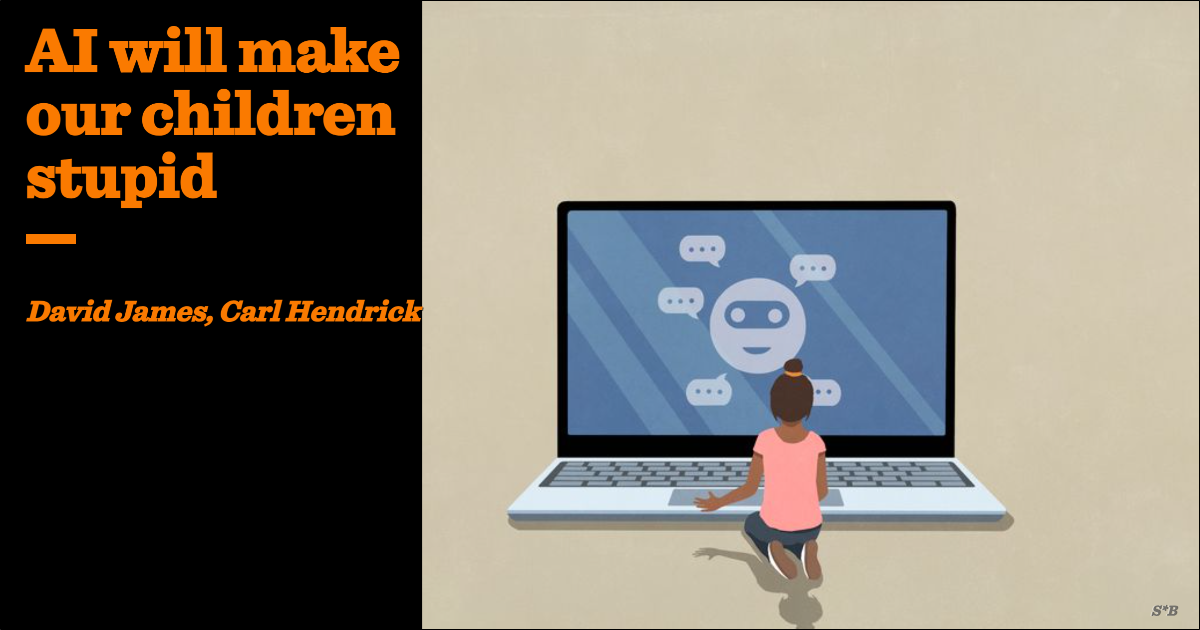
Yet there is a new boss in town. It is just as accessible as the old one, and owned by the same old behemoths (Meta, Google, Microsoft), but it is far more alarming. It arrives precision-designed to destroy whatever vestiges of cognition remain in the hollowed-out ruins of the teenage brain. It is, of course, AI.
The threat that AI poses to intelligence is existential: it allows children to outsource their thinking entirely. Fundamental skills like mental arithmetic, memorising text, or reading a map could soon be obsolete as cognitive offloading becomes a normal way of working. We are fast becoming what educationalist Daisy Christodoulou calls a “stupidogenic” society. We are building a world where the phone isn’t just smarter than the chimpanzee holding it — it’s the only one of the two doing any thinking at all.
As Christodoulou argues, part of the problem is the technology, but it’s also the desire among people in positions of authority and influence, to embrace this Endarkenment. They believe that exams need to be adapted (read: abolished) in order to embrace AI. Of course, the opposite is true, and the fact is that at the very point that we need our brains more than ever — to be able to retain concentration so that we can learn and distinguish between what is real and what is AI slop — comes at the very same time we are voluntarily in the process of re-booting ourselves with a deeply flawed downgrade.
The process of writing is itself constitutive of understanding.Writing is thinking.
The danger here is the separation of process from “product”. In the eyes of the utilitarian tech-evangelist, the essay is simply a product, a sequence of words to be generated as quickly as possible. But the process of writing is itself constitutive of understanding.Writing is thinking. It is the act of retrieving knowledge, wrestling with syntax, and organising logic that forges understanding. When AI produces the final text, the student is the ventriloquist’s dummy, mouthing words that originated elsewhere. They possess the answer but lack the understanding of how it was derived, rendering them incapable of critiquing, adapting, or applying that knowledge in any novel context. We are also witnessing a kind of cognitive laziness which some of our institutions are actively encouraging. When universities tell students to “use AI responsibly” without defining what that actually means, they are licensing the very abdication they should be resisting.
Ultimately, learning requires friction. It requires the uncomfortable sensation of not knowing, the strain of recall, and the cognitive demand that tech companies are seeking to eliminate. By smoothing away these difficulties with AI, we are not making our children smarter, or giving them “21st century skills”; we are turning them into passive consumers of synthetic intelligence, doomed to float on a sea of algorithmic slop they have neither the will nor the wit to navigate.