Thousands of Americans anxious to learn if they’re in for a long winter gathered in Pennsylvania today to hear from meteorological groundhog, Punxsutawney Phil.
After the grueling winter storm that left piles of frozen snow and below-freezing temperatures in its wake, visitors of the Groundhog Day ceremony were hoping the rodent would not see his shadow to signal six more weeks of winter.
But a little after 7am on Monday, it was announced that the groundhog did see his shadow. The news of a longer winter garnered a combination of cheers and boos from the crowd.
Punxsutawney Phil’s handlers held signs on the stage that said ‘Brrrr! More Snow,’ ‘Freezing Rain’ and ‘6 More Weeks of Winter.’
This was the 139th annual Groundhog Day ceremony, held as usual at Gobbler’s Knob in Punxsutawney, which is located about 80 miles northeast of Pittsburgh.
The celebrations began shortly before 6am, with thousands of people gathered at the site and millions more tuning in online.
Immediately after the announcement, The Pennsylvania Polka, a dance hall tune, played to the amusement of the crowd.
Once that ended, the Sonny and Cher hit I Got You Babe played. The song became associated with the ceremony after featuring in the hit movie Groundhog Day starring Bill Murray.
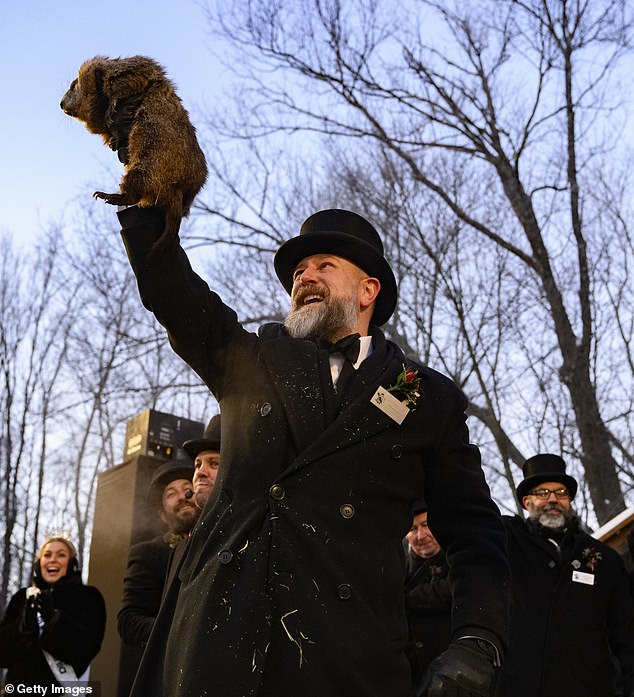
A little after 7am on Monday, it was announced that meteorological groundhog Punxsutawney Phil saw his shadow, signaling six more weeks of winter weather for the United States
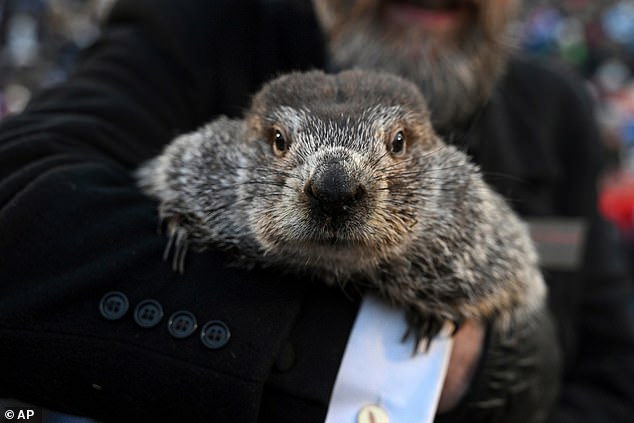
Punxsutawney Phil predicted six more weeks of wintry weather Monday, a forecast sure to disappoint many after what’s already been a long, cold season across much of the US
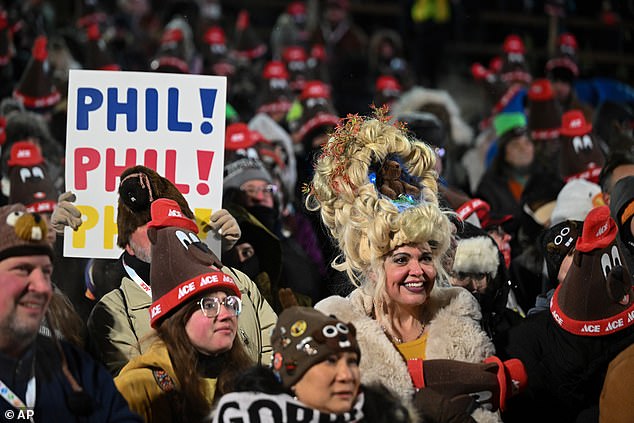
Thousands of people gathered at Gobbler’s Knob in Punxsutawney, Pennsylvania for the announcement, which garnered a combination of cheers and boos from the crowd
In the film, Murray’s character hears the song every morning when the day repeats and his alarm rings at 6am.
It was so cold that Punxsutawney Phil’s handlers were worried about having him outside for too long.
Visitors are usually allowed to come up on stage and take photos with the groundhog, but due to the freezing temperatures, they were instead asked to go up in front of the stage and take selfies.
Visitors from across the country traveled to the small Pennsylvania town for the ceremony.
Californians Melissa and Ryan Launder went to the event as part of their 30th anniversary celebration. ‘It’s cold but it’s fun,’ Melissa Launder told the AP.
Groundhog Day is an old American tradition that traces its roots back centuries. The modern version of the ceremony held in Punxsutawney began in 1887, when members of the town’s Groundhog Club formalized it.
Local legend claims that Punxsutawney Phil is the same groundhog that first emerged from his tree stump to predict the weather 139 years ago, though historians agree that the job has been passed down through many generations of groundhogs.
The tradition goes back even further than the late 19th century. Historians tie it to Candlemas, a Christian holiday marking the halfway point between winter and spring, which takes place on February 2.
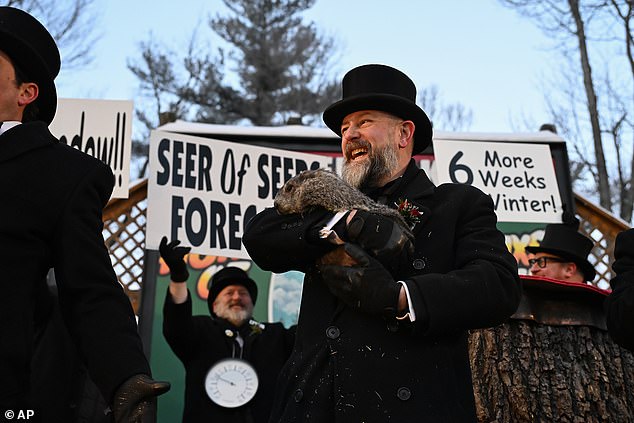
Punxsutawney Phil’s handlers held signs on the stage that said ‘Brrrr! More Snow,’ ‘Freezing Rain’ and ‘6 More Weeks of Winter’
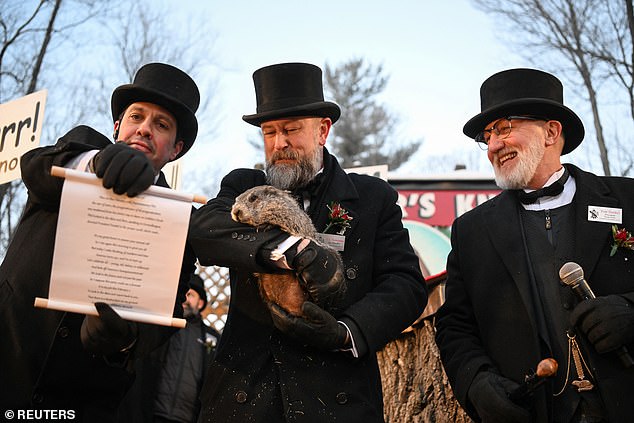
This was the 139th annual Groundhog Day ceremony. Local legend claims that Punxsutawney Phil is the same groundhog that first emerged to predict the weather in 1887
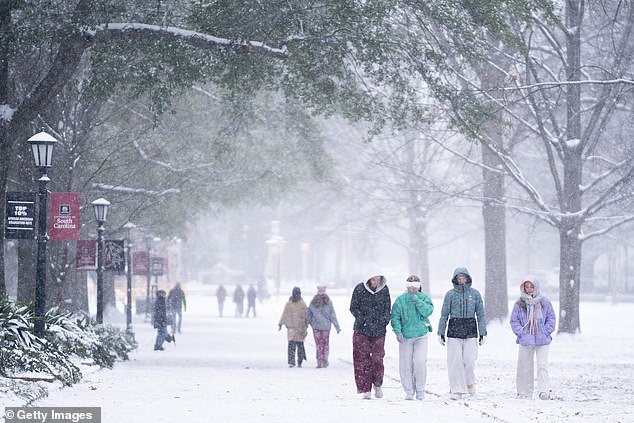
After the grueling winter storm that left piles of frozen snow and below-freezing temperatures in its wake last week, many were hoping that Phil would predict a shorter winter
In 1678, British naturalist John Ray noted the holiday’s predictive power and wrote: ‘If Candlemas day be fair and bright, Winter will have another flight. If on Candlemas day it be shower and rain, Winter is gone and will not come again.’
European settlers in America embraced and adapted the custom, observing wildlife such as badgers or hedgehogs for some indication of how the seasons would change.
German immigrants who settled in Pennsylvania swapped out observing wildlife for observing captive-bred groundhogs.
The tradition remains highly popular despite studies showing that there is no association between groundhogs seeing their shadows and shorter or longer winters.