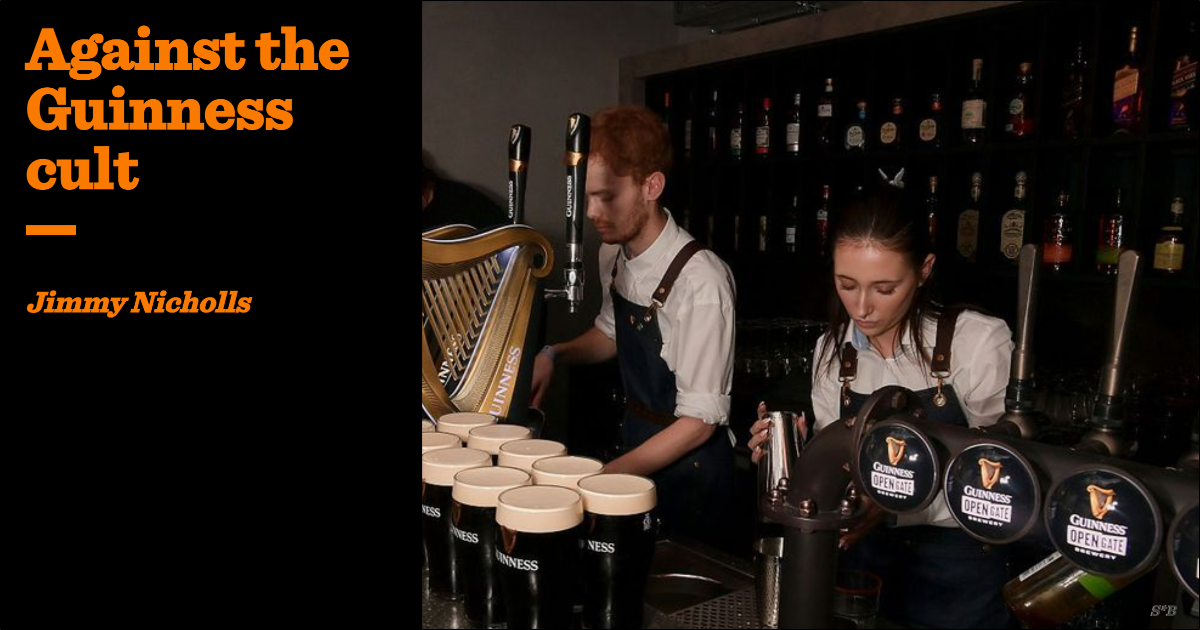
Tilt the glass 45 degrees, keeping the spout out the liquid; pull the handle towards you “with purpose”; gradually straighten it halfway up, cutting the flow at about three-quarters full; wait for a minute, or as long as you can be arsed; and push the handle back to fill the rest of the glass and finesse the head.
That, for the uninitiated, is Guinness’s two step-pour — famous or infamous, depending on how often your pint has been forgotten while another customer is served. As I’m pulling one at the Guinness Open Gate Brewery, a £73m marketing exercise that’s just opened in London, I put it to the instructor that it’s just a gimmick, a hangover from the historic process of topping flat Guinness with a frothier head before the brewer discovered nitrogen.
Guinness is mid — a bland stout
She assures me that the consistency would be off with a single pour, and some scientists reckon she’s right. I am sceptical that it matters by the fourth pint. Actually, I’m sceptical that it matters at all. Guinness’s texture is creamy, the taste pleasant, and the body thin enough that you can sink 10 and be pushing out black stools come morning. But if the best thing on draught is the black stuff, you are in a bad pub. Because Guinness is mid — a bland stout that even a Guinness Open Gate brewer reckons has the body of the specialty lager brewed onsite. This, I’d contend, is not a compliment.
But against my taste, Ireland’s most famous export is having a viral moment. Spurred on by TikTok, and photos of attractive female celebs enjoying a stout or three, Gen Z have been gulping the stuff down, so much so that British pumps ran dry last Christmas, forcing owner Diageo to pinch extra stocks earmarked for the Irish, like 1916 never happened.
Accompanying this is the enthusiasm for “splitting the G”, in which young men neck the first third of every Guinness, hoping that the liquid levels off to cut the capital letter on the stout’s branded glass. Having perhaps started life as an Irish drinking game some years ago, if you believe the depths of Reddit, in recent years it has gone international — the brand denying any involvement, which I suppose is good for its corporate responsibility reporting.
Thus, the opening of the London site could scarcely be better timed. Having refitted an old Combe brewery in Covent Garden, the result is a labyrinth featuring “an intimate 360-degree immersive experience” — that is, a history lesson in a round room — as well as a brewery tour, beer tasting sessions, the aforementioned opportunity to pour your own Guinness, and a selection of restaurants, drinking spots and outlets for branded clobber.
Company men tout the brand synergy of the location, the same city that Arthur Guinness nabbed the idea for his stout while visiting in the 1770s. (I can’t recall the beer having much connection to Baltimore and Chicago, which already host their own Guinness tourist traps.) Drawing in a mix of locals and travellers is the ambition here, with one in seven pints poured in the British capital already accounted for by Guinness.
Undercutting this is the fact that not a drop of the black stuff will be brewed on site. Capacity at the London brewery is limited to 750,000 pints a year, while St James’s Gate in Ireland can shift 3 million every day, the lack of romance in being a global beer mega corporation offset by those economies of scale. The Open Gate Brewery London then is not so much a Guinness brewery as a brewery that serves Guinness.
That doesn’t stop them spamming you with statistics about the beer being brewed across the Irish Sea. There are, a wall tells me, 300 million bubbles in each pint of Guiness, the numbers totted up by Michael Ash, the mathematician responsible for putting nitrogen into the beer and enabling its draught export beyond Ireland.
As for the brewery tour, this is much the same as any man has wandered through on the inexorable approach to middle-age. There are high-vis vests and eye protection, tanks and pipes, and an enthusiastic explanation of the brewing process that I’m destined to forget, despite having brewed my own tolerable IPA during the depths of the winter lockdown.
Compensating for that is the fact that the specialty beers brewed onsite by head brewer Holly Stephenson are all pretty good. Aside from the aforementioned lager, the tasting session featured the Covent Classic IPA, Piazza Pale Ale, Old Brewer’s Yard Porter, Winter Warmer, and Apricot Sour. To my taste, the sour is the best, with the porter pairing well with a Guinness cake.
As you might gather, this is all entertaining enough for £30. I can also recommend the seafood menu at Gilroy’s Loft, though having glanced at the prices I’m glad I wasn’t paying. It is likely the complex will fulfil the ambition to become a fixture of London’s drinking scene, especially with the pies and pints available in the central courtyard.
But it feels a bit much for a pint that has become a bizarre flex for anyone too young to remember when they could be had for as little as £4 in central London. Back in the late noughties, it at least made some sort of sense that asking for a Guinness over the usual fizzy pish would prompt your mates to accuse you of what the Irish call “notions”.
These days, most pubs surrounding the Open Gate Brewery will carry something more interesting than Guinness, even in the craft beer recession. Just to take the stouts, Anspach & Hobday’s London Black is tastier, as indeed is Black Heart from Scotland’s most infamous brewer. Some of us still drink beer for the taste more than the memes.