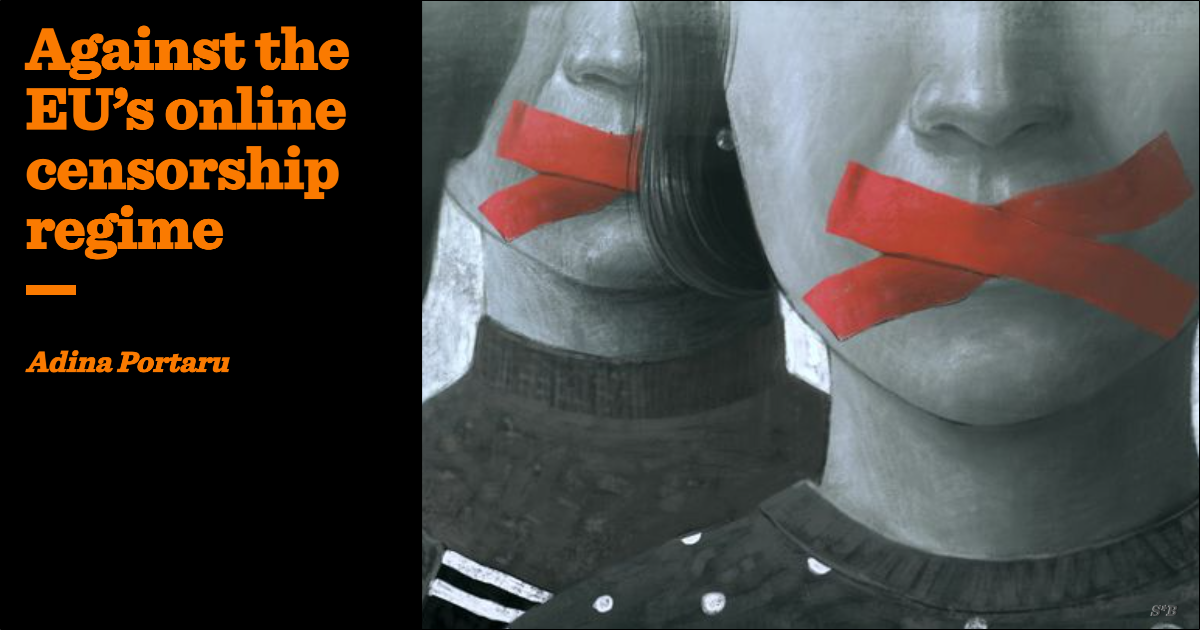
This week, more than 100 free speech experts signed a letter to the European Commission warning that the Digital Services Act (DSA), an EU law, threatens to impose online censorship both in Europe and across the whole world.
Signatories of the letter, coordinated by my organisation ADF International, include a former VP of Yahoo Europe, a former US Senator, cross-party Members of the European Parliament, former President of the American Civil Liberties Union Nadine Strossen, award-winning journalist and author Michael Shellenberger and many other academics, lawyers and experts from around the globe.
In warning about the worldwide impact of the DSA, the experts’ letter reinforces concerns from the US ambassador to the EU Andrew Puzder and Google in recent weeks that the European legislation threatens to impose censorship beyond the EU’s borders.
These significant interventions show there is a growing coalition of high-profile figures who are aware of and increasingly vocal about the deep problems with this legislation.
The European Commission’s response to free speech concerns like these until now has been to deny their validity and claim the DSA merely creates a “safer digital space” for those in the EU. But as this week’s letter reinforces, this position simply does not stand up to scrutiny.
Online platforms, such as X, YouTube and Facebook, must address “hate speech” and “disinformation” under the DSA and its codes of conduct — vague and subjective terms that lack clear legal definitions, and in practice result in the censorship of disfavoured views.
The definition of “illegal content”, which platforms must remove under the DSA, is any content that breaches EU or any member state’s legislation at any given time. This means the most restrictive anti-free speech laws in any individual EU country — of which there are unfortunately many across Europe — will now be applied across the bloc, introducing a lowest common denominator of censorship across the EU.
Platforms risk crippling fines of up to 6 per cent of global annual turnover for non-compliance with the DSA but, crucially, face no penalties if they censor too much content. This creates a worrying incentive for tech companies to err on the side of caution by adopting an “if in doubt, censor” approach.
And these risks of online censorship are not confined to the EU. There is precedent from the Court of Justice of the EU which opens the door to worldwide takedown orders for content deemed illegal in the EU.
Adding to these concerns, French MEP Virginie Joron, a signatory of this week’s letter to the Commission, said: “The French digital regulator ARCOM told me they believe the DSA allows them to censor any post anywhere in the world using the DSA. That means even an American citizen posting in Alabama could potentially have their online post taken down, even if the publication would be legal in the US.”
An additional threat from the DSA mentioned in the free speech experts’ letter is the exporting of European speech standards across the world through the content moderation policies of online platforms. Platforms generally have one global policy for content moderation, which could now be made to comply with the DSA’s restrictive approach.
So far, the European Commission’s formal review into the DSA, which must occur by 17 November, as mandated by Article 91 of the act, has unfortunately been opaque and based on undisclosed surveys sent to unnamed stakeholders. The EU claims transparency is one of its key principles but this is often not the case in practice.
In light of the significant threats to free speech posed by the DSA, the signatories of this week’s letter call on the Commission to, firstly, conduct a comprehensive and inclusive consultation with independent experts in freedom of expression, constitutional law, and digital rights, as part of the formal review, and to invite public comments.
Secondly, to publicly disclose the list of NGOs, civil society actors, and partner entities engaged in the review process, and to reveal the criteria and methodology used for their selection.
And lastly, to ensure that the review includes a rigorous legal analysis of the DSA’s compatibility with fundamental rights protections, especially under Article 11 of the Charter of Fundamental Rights of the EU, Article 10 of the ECHR, and Article 19 of the ICCPR, which guarantee freedom of expression.
With such a broad and global coalition now formed against the DSA, the Commission can no longer afford to ignore well-founded concerns. Steps must be taken immediately to ensure the DSA does not result in an ideologically driven censorship regime across the internet.