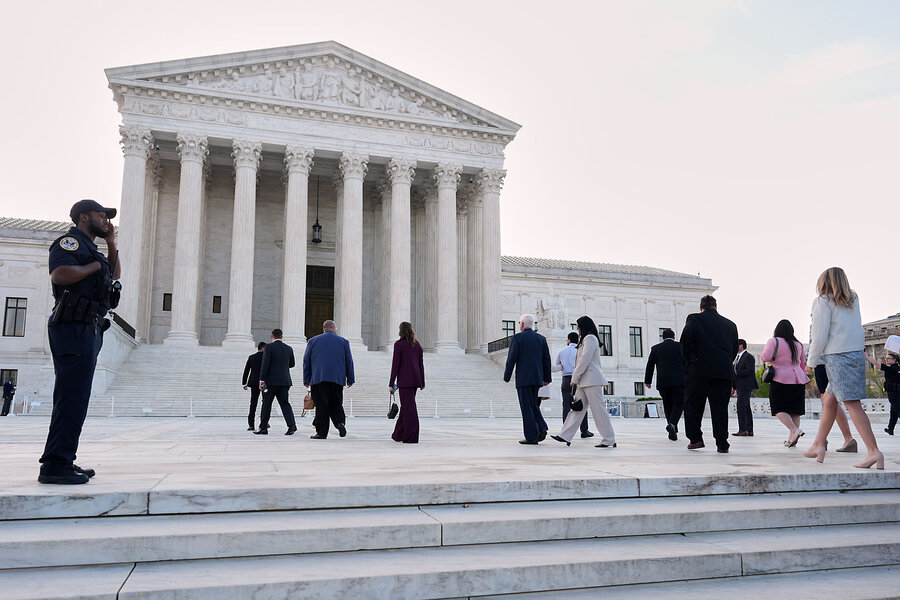
A presidential order reinterpreting how the Constitution defines U.S. citizenship faced a skeptical Supreme Court on Wednesday.
The case, Trump v. Barbara, is one of the most important the justices will decide this term. The oral argument, in fact, made history as the first to be attended by a sitting president. President Donald Trump left about halfway through the proceedings, according to reports.
The case stems from an executive order Mr. Trump issued hours into his first day back in office. It attempted to redefine the citizenship clause of the 14th Amendment and the 1952 Immigration and Nationality Act, which codified the clause into federal law. The clause provides automatic U.S. citizenship to “all persons born or naturalized in the United States, and subject to the jurisdiction thereof.” Mr. Trump’s order would make the children of parents in the country illegally – or temporarily, such as on a student visa – ineligible for citizenship because they are not “subject to the jurisdiction” of the U.S. government. The order would apply only to future births.

Why We Wrote This
In one of the biggest cases of the year, Supreme Court justices sounded wary of the government’s argument that the Constitution does not guarantee birthright citizenship. In a first, the president of the United States attended the oral argument.
The challengers claim that upholding the order would violate the Constitution and upend centuries of settled law. The American Civil Liberties Union led the class action lawsuit on behalf of families whose children’s citizenship could be brought into question.
The Trump administration, meanwhile, argues that the order is both legal and necessary to crack down on illegal immigration and “birth tourism,” in which a woman enters the United States for the sole purpose of securing American citizenship for her newborn.
Many of the justices sounded skeptical of the government’s arguments, however.
The current interpretation of birthright citizenship “certainly wasn’t a problem in the 19th century,” said Chief Justice John Roberts at one point.
Solicitor General John Sauer, arguing on behalf of the administration, pushed back, arguing that modern times require a reinterpretation. Unlike the 1800s, he said, foreign visitors are now only an eight-hour flight away. “We’re in a new world,” he added.
“Well, it’s a new world. It’s the same Constitution,” replied Chief Justice Roberts.
After he left the Supreme Court, Mr. Trump posted on social media that “We are the only Country in the World STUPID enough to allow ‘Birthright’ Citizenship!” In actuality, about three dozen countries provide for unrestricted citizenship at birth. Some countries around the world have chosen in recent decades to tighten, or get rid of, their birthright citizenship policies.
Lower courts have consistently ruled against the White House’s interpretation of birthright citizenship. If the justices rule in the government’s favor, there could be as many as 6.4 million U.S.-born children without legal status by 2050, according to a recent study by researchers at Penn State University.
A “domicile” debate
Much of the oral argument on Wednesday focused on a different Supreme Court case. The 1898 decision in United States v. Wong Kim Ark held that a child born in California to Chinese citizen parents was a U.S. citizen under the 14th Amendment.
The Civil Rights Act of 1866 granted automatic citizenship to persons born in the U.S. and not “subject to a foreign power.” But when Congress codified the citizenship clause in the Immigration and Nationality Act, it used the 14th Amendment’s “subject to the jurisdiction thereof” language.
“One might have expected Congress to use a different phrase if it wanted to try to disagree with Wong Kim Ark on what the scope of birthright citizenship … should be,” said Justice Brett Kavanaugh during the oral argument.

But, Mr. Sauer told the justices repeatedly, they could uphold Mr. Trump’s order without overturning Wong Kim Ark. What the court should do, he argued, is acknowledge the importance of the Wong court’s use of the term “domicile” in that decision. The word appears nearly 20 times in the decision, and Mr. Sauer said it refers only to people “who are lawfully present and have an intent to remain permanently” in the U.S.
The word “jurisdiction” in “subject to the jurisdiction thereof,” he added, “means allegiance.” He continued: “The allegiance of an alien present in another country is determined by domicile.”
With that argument, the Trump administration is “trying to characterize that [Wong] decision as more narrow than it was,” says Rachel Rosenbloom, a professor at Northeastern University School of Law.
Instead, she says, the Wong decision “establishes a very broad rule of birthright citizenship.”
The Trump administration, meanwhile, is arguing that “unless you’re here lawfully, and unless you’re domiciled here in the United States, the birthright clause in the 14th Amendment doesn’t apply to you,” says Andrew Arthur, the resident fellow in law and policy at the Center for Immigration Studies, which advocates lower immigration rates.
The Wong court “relied upon English common law and … feudal principles; but they all flow from the idea that you are a subject to the liege or the king,” he adds. “What Sauer is getting at is that [interpretation] is not a good fit and [Wong] is not a proper precedent for a republic like ours to follow.”
The administration’s domicile theory preoccupied the justices even during their questions to Cecillia Wang, the national legal director at the American Civil Liberties Union, who represented the challengers.
“Isn’t it at least something to be concerned about … since it’s discussed 20 different times?” Chief Justice John Roberts asked her.
Big case, big (potential) consequences
The practical implications of the Supreme Court upholding Mr. Trump’s executive order are noteworthy. Narrowing birthright citizenship in that way would increase the country’s “unauthorized” population by 2.5 million in one decade, according to a recent study. By contrast, the number of “birthright tourism” cases is much smaller, according to the latest figures from the Center for Immigration Studies. In 2020, they found that between 20,000 and 26,000 babies a year are born to a parent flying to the U.S. to give birth.
Enforcement could also be a challenge, particularly for parents with certain temporary statuses. Those include asylum-seekers and people living under Temporary Protected Status, which grants legal status to citizens of countries deemed unsafe to return to because of catastrophes such as natural disasters or war.
“It’s not as simple as documented immigrant versus temporary visa,” says Ming Chen, a professor at the University of California College of the Law in San Francisco.
“Temporary visas are all very different,” she adds. “Parent status shifts a lot.”
Those potential practical implications didn’t get much attention from the justices. Instead, their hours of questions about how to interpret the citizenship clause, the Wong decision, and various associated statutes illustrate how the debates between them will likely focus on the more technical aspects of the case.
Those more arcane questions can be boiled down further, says Mr. Arthur.
“Is the [citizenship] clause of the 14th Amendment vague or not?” he asks. “And if it is vague, how do you interpret it, and who can properly interpret it for legal purposes?”
A decision in the case is expected by late June or early July.