A politician named after Adolf Hitler has secured a fifth term in office.
Adolf Hitler Uunona went viral during Namibia’s local elections in 2020 where he won by a landslide. And he retained his seat this week with another huge majority.
Mr Uunona, 59, ran for the role of district administrator in the Ompundja region.
The politician, who has been in power since 2004, said: ‘My father named me after this man. He probably didn’t understand what Adolf Hitler stood for.’
As a child I saw it as a totally normal name. Only as I grew up did I understand that this man wanted to conquer the whole world.’
Mr Uunona said his wife called him Adolf, adding that he usually goes by Adolf Uunona.
His name was abbreviated to ‘Adolf H’ in a list of candidates printed in a government gazette.
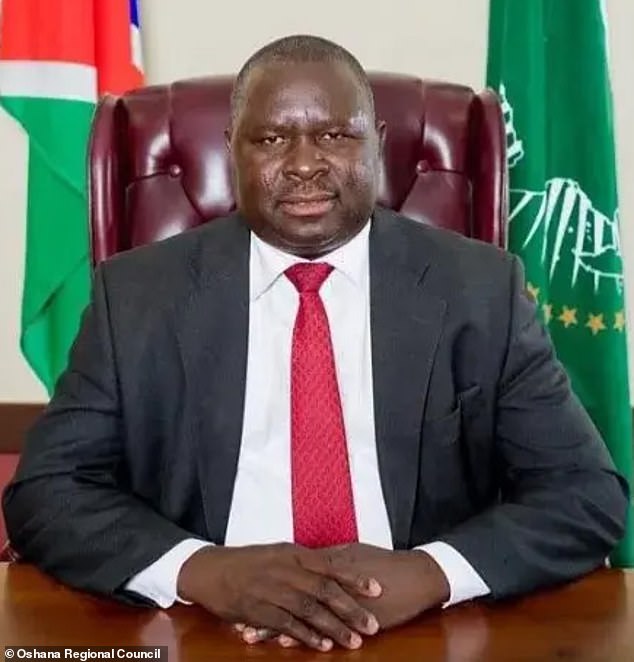
Adolf Hitler Uunona, 59, has been district administrator in the Ompundja region on Namibia since 2004
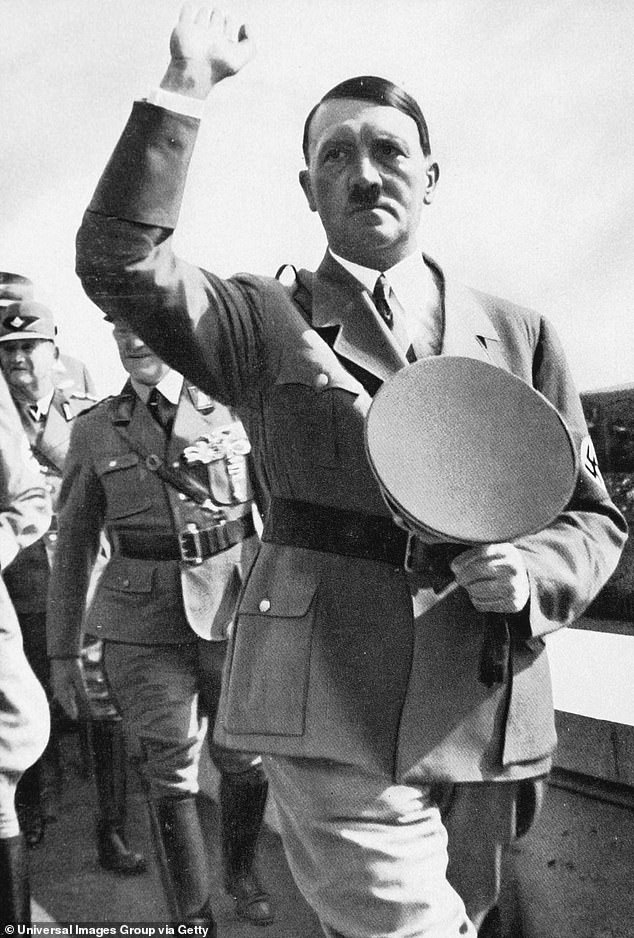
Adolf Hitler, who the politician shares a name with, of the Nazi party is seen in Germany in 1935
‘The fact I have this name does not mean I want to conquer Oshana,’ he said, referring to the region where he won the election in 2020.
‘It doesn’t mean I’m striving for world domination.’
But following his latest election win, Mr Uunona said he has officially changed his name due to the unwanted attention.
He said: ‘My name is not Adolf Hitler, I am Adolf Uunona.
‘I have seen in the past people calling me Adolf Hitler and trying to associate me with someone I do not even know.’
Once known as German South West Africa, Namibia was a German colony from 1884 until the empire was stripped of its possessions following the First World War .
Namibia is still home to a small German-speaking community and some people still have German names.
The 20th century’s first genocide: German massacres in Namibia
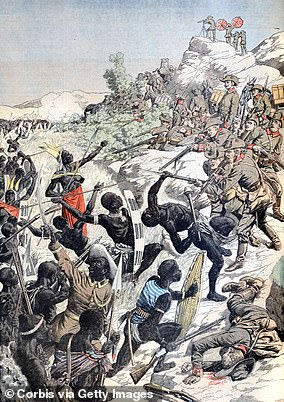
A depiction of the conflict between Herero fighters and German colonialists in 1904
German soldiers killed tens of thousands of indigenous Herero and Nama people in colonial Namibia between 1904 and 1908 in what has been labelled the first genocide of the 20th century.
Namibia, then known as German South West Africa, was one of the few German possessions overseas – after its 1871 unification meant it arrived too late to capture much of the colonial spoils.
The German occupiers forced native tribespeople off their land and recruited them for forced labour, leading to an uprising in which Herero people killed 123 German settlers.
The German Reich sent reinforcements in response, and its soldiers carried out a brutal four-year campaign of slaughter in which 65,000 Herero and 10,000 Nama people are thought to have been killed.
In addition to the slaughter, thousands of Hereros were driven into the desert and died of thirst and starvation, and the rest were sent to prison camps.
In the Battle of Waterberg in August 1904, around 80,000 Herero fled including women and children.
Germany recently handed over a cache of skulls and other remains of massacred tribespeople, which were used for experiments to push long-debunked claims of European racial superiority.
The German colonial empire was disbanded after World War I when the country was stripped of its possessions, and the colonial past has since become largely overshadowed by the horrors of Hitler’s rule.
Namibia was later handed to South Africa by the League of Nations and finally achieved independence from the apartheid state in 1990.