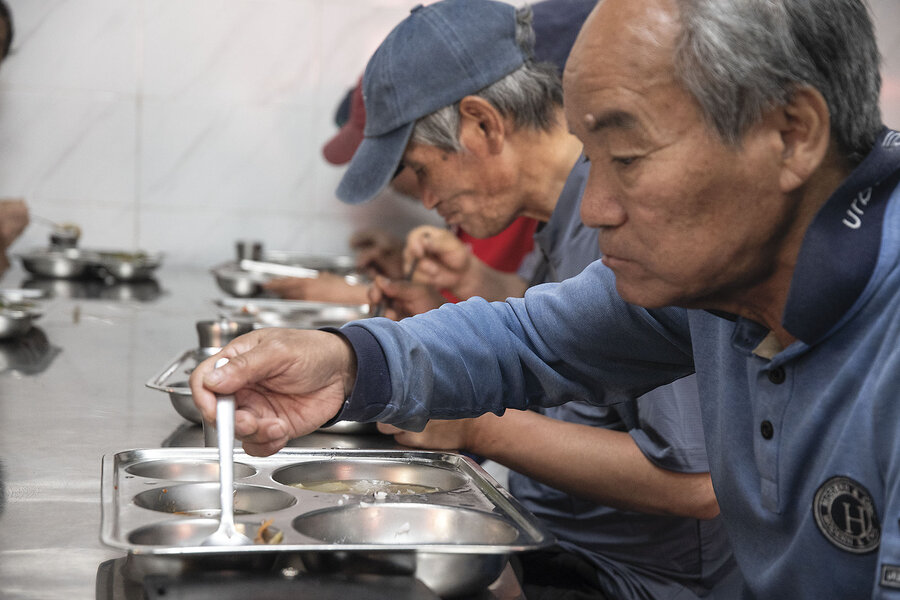
They wait quietly in a long line that snakes down an alley and disappears around a corner. Some lean on canes. Many wear masks, and hats to shield themselves from the noonday sun. All are hungry for a hot lunch, and perhaps a little company.
At 11 a.m. sharp, the doors of the Thomas House soup kitchen swing open. One by one, the visitors – most of them older adults – hold out their hands for a volunteer in a blue apron to stamp with ink. Taking a plate, they step eagerly to a kitchen counter for heaping ladles of spiced meat, kimchi, broth, and rice.
“I come here for every lunch,” says Choi Guemsun, sipping soup between bites of rice. Ms. Choi lives nearby in a backstreet slum area behind a subway station and survives on a government pension of about $215 per month.
Why We Wrote This
Many destitute older adults in South Korea are also lonely. One Seoul soup kitchen has been a reliable source of food, warmth, and company for more than three decades.
Surrounded by gleaming skyscrapers, boutique coffee shops, and posh department stores in Seoul’s Yeongdeungpo District, the cramped eatery with plastic stools and a growing clientele reveals a pressing need in South Korea, Asia’s fourth-largest economy. Despite its high level of development, South Korea is seeing more of its vast population of older adults become impoverished.
Nearly 40% of South Koreans ages 65 and over live below the poverty line – defined as 50% of the median income. This share is about triple the average for other countries in the Organization for Economic Cooperation and Development. As South Korea’s population rapidly ages, studies show that its pension system has not kept pace, with significant coverage gaps and with relatively low benefits compared with other developed countries.

Ann Scott Tyson/The Christian Science Monitor
Many destitute older adults in South Korea are also lonely, leading to a crisis known as “lonely deaths,” a euphemism for suicide. South Korea had the highest suicide rate of Asian countries and the 10th-highest rate in the world in 2021, according to World Health Organization data. Last year, Seoul launched South Korea’s first comprehensive program to combat loneliness, a 451.3 billion won ($327 million) effort. It offers 24-hour counseling hotlines, home visits, social outings, and places to meet for a bowl of noodles.
“Loneliness is one of the worst sources of all kinds of mental problems” for South Korea’s older urban population, says Park Sang-chul, a biochemist and longevity researcher at the Advanced Institute of Aging Science at Chonnam National University in Gwangju. “We need to activate them to come out and to make a connection.”
Thomas House – a reliable source of food, warmth, and community for more than three decades – does just that. About 400 people eat here every day except Sunday and Thursday, rotating through the 34 seats.
“Thomas House is very helpful to me,” says Kwan Youngphil, an octogenarian who says he failed in business and now makes ends meet, in part, by collecting paper and empty plastic bottles to recycle.
“I live alone and don’t have time to cook,” he explains as he finishes lunch and picks up a free tangerine and a package of instant noodles for dinner.
Apart from sharing hot meals with other older adults, Mr. Kwan says he enjoys stopping by to spruce himself up one Saturday morning a month. “I come here at 10 a.m. and get a haircut,” he says with a smile.
Startup challenges
Catholic priest Kim Jong-kook was ministering to inmates a few miles away in 1992, when he was first summoned to care for homeless people in Yeongdeungpo. Missionaries who tried to distribute food had faced resentment from the people, who beat them and drove them away.

Ann Scott Tyson/The Christian Science Monitor
“For the first time, I was afraid,” recalls the Rev. Kim, also known as Thomas Aquinas, as he places his hand on his heart.
After much prayer, he adds, he made his first foray into the neighborhood, saying little as he used a cart to pick up trash. In time, he rented a small space, bought a frying pan and stove, and launched the soup kitchen.
“I had nothing to start with, not even a spoon or chopsticks,” he recalls. “I started to buy all these things myself.”
Seeing his kindness and generosity, the people accepted him.
Still, challenges abounded.
“People spat everywhere and tossed down trash,” he says. In response, the Rev. Kim began addressing visitors using a special Korean word for “we” that stresses community and belonging. “Their behavior improved a lot,” he notes.
“Most of the people have met with failures in life. … Some don’t reveal their history,” he says. “But coming to Thomas House is itself a kind of communication. Without Thomas House, they would stay inside all day, but here the volunteers welcome them.”
“It gives me joy”
A stay-at-home mother from a wealthy Seoul household, Park Kyung-ok was inspired by a prayer meeting 30 years ago to help feed impoverished people, and has led the kitchen’s roughly two dozen volunteers ever since. Donations and the number of helping hands ebb and flow, but whenever needs arise – whether for rice or a new dishwasher – so does a source of supply, Ms. Park says. The wall in her pantry bears her favorite Bible verse in Korean: “I can do all things through Christ which strengtheneth me.”

Ann Scott Tyson/The Christian Science Monitor
She recalls her surprise one day when a man arrived at the soup kitchen with boxes full of yogurt on his back. “He said: ‘I ate here every day. Now I work and I’m getting better, so I want to help,’” she says.
Volunteers cook all the meals, including special dishes such as chicken soup with ginseng on holidays.
Chun Byung-moo, a retired accountant, has volunteered at Thomas House for eight years.
“I have plenty of time since retiring,” he says, wearing a straw fedora. “I am very proud of helping others. It gives me joy.”
Park Chung-bae, a retired soldier and octogenarian whose family emigrated from North Korea during the Korean War, says visiting the kitchen is a highlight of his day. Weekdays, Mr. Park rides the train an hour each way to join the bustling lunch at Thomas House. On Sundays, he goes to church.
“They do a lot of good humanitarian work here,” he says, adding that “It’s hard living alone.”
Along with attending church, he explains, “This calms me down.”