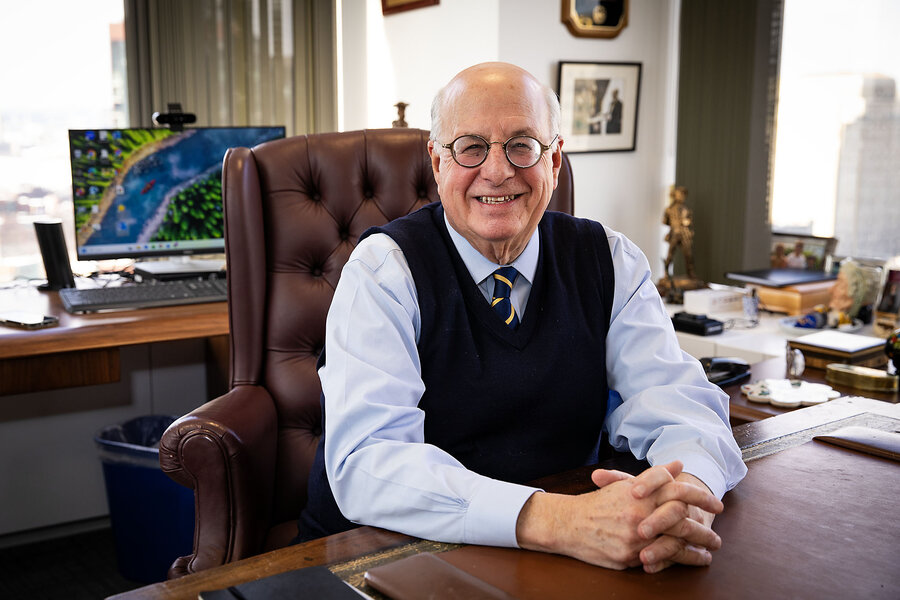
President Ronald Reagan appointed Mark Wolf to be a U.S. district judge in 1985. Four decades later, he announced his resignation from the bench in an article in the Atlantic.
Federal judges adhere to strict rules regarding what they can say in public. To avoid an appearance of bias, they rarely speak publicly at all – and refrain from commenting on politics and political leaders. Instead, they speak through their written opinions on matters of fact and law.
But in the face of what he calls the Trump administration’s “assault on the rule of law,” Mr. Wolf wrote that he could “no longer … bear to be restrained by what judges can say publicly or do outside the courtroom.”
Why We Wrote This
It’s rare for a federal judge to resign over the actions of a president. Mark Wolf, a district court judge in Massachusetts appointed by President Ronald Reagan, made that choice.
His decision has faced some criticism. Mr. Wolf “is a disgrace to the federal judiciary,” wrote Mike Davis, founder of the Article III Project, a group that advocates confirming conservative judges to the federal courts, in a Fox News commentary.
Mr. Wolf, who served as a district court judge in Massachusetts and is now a lawyer at Todd & Weld in Boston, spoke with the Monitor recently. He discussed his decision to resign from the bench, why he believes President Donald Trump is a threat to the rule of law, and how he thinks the job of a judge is often misunderstood. The interview has been edited for length and clarity.
What have you been up to since you left the bench a few months ago?
I’m trying to reach the American people, at least some of them, because I have a profound concern that the president feels he can – and maybe he can – ignore court orders with impunity.
In [July 1974], about a month or two after I joined the Justice Department, the Supreme Court ordered President [Richard] Nixon to turn over the [Watergate] tapes. … He could have refused, he could have destroyed the tapes, but he knew the American people at that time wouldn’t tolerate disobedience and he would be impeached and removed from office. So, he turned over the tapes and resigned. I’m not sure where the American people are today, but when district judges, particularly, rule against the president and explain it in their decisions, he has the ultimate bully pulpit. He’s the president of the United States, he’s got social media. He says those judges are crooked and they should be impeached.
If the American people don’t have confidence in the impartiality, the integrity of judicial decisions, and don’t insist that the president obey court orders, then there are no limits on the president. Courts [and] judges don’t have the power to really enforce their orders themselves. So, one of the things I want to do is take advantage of the opportunities that have been offered to me to advocate for the judges and try to encourage people to insist that the president obey court orders. He says he’s obeying all of the orders, [but] I think close studies by the Washington Post said that he or his administration were not obeying, or properly obeying, about a third of the court orders against them, and that’s a very problematic thing.
I want to talk to people across the political spectrum, but also listen to them. … I would like to try to find some way to have civil discussion among people who are not inclined to agree.
Before you became a judge you worked at the Department of Justice, and you joined near the end of the Watergate scandal. Can you talk about that time in your career?
Everybody counseled me not to go to the Department of Justice. They said, ‘You’re going to be stigmatized for the rest of your life’ for having worked in this disreputable Department of Justice. I thought, ‘I’m 27 years old, they needed more honest lawyers, I would go and straighten out the president.’
[Nixon] resigned in early August. As a result, I was in the Justice Department when Gerald Ford became president, and he recruited Edward Levi, the president of the University of Chicago to be attorney general in an effort to restore confidence in the department.
[Levi] had me on his personal staff. And so, for those next two years, I worked for a person who personified what he said in his induction remarks. He said: ‘Nothing can more weaken the quality of life or more imperil the realization of the goals we all hold dear than our failure to make clear by word and deed that our law is not an instrument of partisan purpose.’
I saw him make some difficult decisions. And that had a very profound effect on me.
Can you share an example?
There was an investigation of whether President Ford took illegal campaign contributions when he was in the House of Representatives.
Attorney General Levi was very skeptical about whether those charges would prove to be meritorious. And this was in 1976, so an election was coming up in November, and Watergate was barely history. So, while he was skeptical about whether these allegations would prove to be meritorious, he felt that because there was so much public skepticism about whether the Department of Justice could be trusted to investigate the president, he needed to appoint a special prosecutor to reassure the American people. [The special prosecutor] found that there was essentially no evidence to support these allegations.
But it was an issue in the election, and Ford lost. And there were Republicans who blamed Levi for costing Ford the election. That was an example of doing something that would foreseeably be adverse to the president’s political interests, but he felt that was his duty.
How did your time at DOJ then prepare you for being a judge?
There was an intermediate step. When Jimmy Carter won the [1976] election, I lost my [Justice Department] job. So, I came back to Boston to practice law. Years later, a state commission found that corruption was a way of life in public contracting at the state level in Massachusetts, in Democratic and Republican administrations, And there were also lots of allegations of corruption in the administration of the long-serving mayor of Boston. So, after Ronald Reagan was elected, there were calls for a nonpolitical U.S. attorney for Massachusetts.
What do you think ‘non-political U.S. attorney’ meant at that time?
I was hired as the deputy U.S. attorney. And we were the only one of the 94 U.S. attorney’s offices to have corruption as our highest priority. And I said, the hiring will be nonpartisan, and will be based on merit. Doing that, we built a terrific office.
I made a distinction between politics and partisanship. The president gets elected, and he’s got a right to say to the attorney general: ‘I want you to devote more resources, say, to drug enforcement or immigration enforcement and less to civil rights.’ That’s setting policy. That’s legitimate.
But you have to have established standards and procedures that are applied neutrally, uniformly, without fear or favor, without respect to the identity of who is the subject of the investigation or prosecution. You can’t make decisions based on partisan considerations – ‘This one’s a Republican, so we won’t prosecute him’ – or personal considerations – ‘Oh, this is somebody who’s donated a lot of money to my campaign, or maybe bought a lot of my cryptocurrency.’
That’s what nonpartisanship in the administration of justice is, and it’s exactly what we don’t have now.
Are those qualities you made sure to apply over those decades on the bench?
That’s the oath you take as a district judge, to administer justice impartially. It’s the fundamental principle. And, in fact, the goal isn’t to have an independent judiciary – an independent judiciary could be an unaccountable judiciary. It’s to have an impartial judiciary. I had life tenure because it would permit me to make unpopular decisions without risking my job. It’s instrumental. You decide the case based on the facts that are derived from the evidence, and based on law.
I’ve worked with embattled judges all over the world, judges who were in prison because they were striving to make their judiciaries, their judges, more expert, more independent, more impartial. I always came back from those trips with a heightened appreciation for the opportunity to be an impartial judge in the United States and a heightened sense of responsibility to do the job right, because these people were taking enormous risks.
These days, whenever we hear about a judge we also hear the name of the president who nominated them. Did being a Reagan appointee mean anything at the time?
That wasn’t the case when I was appointed [and] maybe for the first 15 years, maybe until Bush v. Gore in 2000. For a number of years, if I made a decision they would say, ‘Judge Mark Wolf decided this.’ And then at some point it became, ‘Judge Mark Wolf, appointed by Ronald Reagan.’ Sometimes, now, I’m characterized as a conservative judge. I’ve been criticized for not being a conservative. And I don’t think it’s accurate to consider me a conservative or a liberal judge, a Republican judge or a Democratic judge. I was an impartial judge. And I believe that if you’re an impartial judge, the same party’s not going to win every time.
Is there a way you think judges can better communicate that to the public?
The code of conduct for judges says that judges should not write or say anything or do anything that would cause a reasonable person to question their impartiality. That doesn’t mean you can’t say or write anything, and I think actually many judges may be too restrained in feeling they can’t publish an opinion piece or something like that.
Right now, it’s understandable that they would be [more] restrained, because you get attacked. It’s just very risky. It’s not wise. So it’s hard to communicate that way.
What has been my experience – but I’m concerned that it won’t continue to be judges’ experience – is that the organized bar would advocate for judges. The American Bar Association, the Federal Bar Association, the local chapters of the Federal Bar Association, lawyers [there] would advocate for judges on principled issues.
How would you compare the DOJ today with the DOJ you worked in?
They couldn’t be more different. It’s essentially why I resigned. Attorney General Levi administered, and helped establish – I think for a long time – a Department of Justice which did not operate as an instrument of partisan purpose. The [partisan] things that Richard Nixon did with regard to the Department of Justice, periodically and secretly – because he knew they were illegal or improper – President Trump does repeatedly, and overtly.
Threats against judges have increased sharply in recent years. Is there more that could be being done to protect judges?
The officials responsible for protecting judges are the United States marshals. They’re in the Department of Justice, they’re not in the judiciary.
But there’s not enough marshals to provide protection given there’s a higher number of threats than there have ever been, death threats than there have ever been. And given the fact that the Department of Justice [has] sometimes reiterated or amplified the president’s criticism of judges. … You know that the Department of Justice won’t be dedicated to protecting those judges. It’s a real problem.