This article is taken from the April 2026 issue of The Critic. To get the full magazine why not subscribe? Get five issues for just £5.
It’s the edge of the world and all of Western civilisation,” Anthony Kiedis sang on the Red Hot Chili Peppers’ “Californication” in 1999. “The sun may rise in the East, at least it settled in a final location.” Thomas Jefferson never appeared on stage wearing nothing but a single sock over his shortcomings as the Chili Peppers did, but Jefferson also imagined the American republic as an edge case: the “last hope of human liberty in the world”. In 1862, twelve years after California entered the Union, Abraham Lincoln refined this to the “last, best hope on earth”.
Busy manifesting their destiny, most Americans understand “the West” to mean the inland empire that begins on the western edges of the Dakotas, Nebraska, Colorado and Texas, crosses the Great Plains and the Rockies, and ends on the Left Coast and the Pacific Ocean. If they are thinking historically, they might mean the frontier that closed in the 1890s. The idea of “the West” as a political alliance appears only in times of conflict or crisis, and mostly in the strategic sense (the “Western alliance”). If Americans speak of “Western civilisation”, then they either need a rhyme as Anthony Keidis did, or the pressure really is on.
“We are part of one civilisation — Western civilisation”, Secretary of State Marco Rubio told the Munich Security Conference in February this year. “We are bound to one another by the deepest bonds that nations could share, forged by centuries of shared history, Christian faith, culture, heritage, language, ancestry, and the sacrifices our forefathers made together for the common civilisation to which we have fallen heir.”
This civilisational understanding is not a novelty in American history. It recurs when a changing world changes Americans’ perceptions of their national interest and national identity. Both are in flux at present. Our age is not that of superpowers or even hyperpowers. It is the Age of the Civilisationists.
★
When the Founders extracted a nation from an empire, they spoke of building a “republic” and a “society” with “civic” values. But “civilisation” in the current sense was not in their vocabulary. To Edward Gibbon, who published the first volume of Decline and Fall in 1776, to be “civilised” was to be brought out of barbarism by the law.
One of the first significant uses of “civilisation” to mean a historical legacy rather than a legal condition was Jacob Burckhardt’s The Civilisation of the Renaissance in Italy (1860). Since the late 1800s, the rhetoric of American statesmen has used this sense of “civilisation” in two ways: an end-of-history aspiration to cast off and create a new civilisation, and a recurring desire to stay tethered to the Old World.
The first of these moods resounds through George Washington’s rejection of “foreign entanglements” in Europe. When President Monroe announced another set of entanglements with his Doctrine in 1823, he too defined American interests against those of Europe: the Western Hemisphere belonged to America only. The other doctrine of the Jacksonian age, Manifest Destiny, also assumed a unique American future; the phrase first appeared in an 1845 essay advocating the annexation of Texas. The growth of a global economy, and America’s growing part in it, forced America’s leaders to consider the second mood.
The new sense of “civilisation” was a product of the European empires: broader contacts with Asia required deeper concepts. It entered American parlance by becoming a rubric for the first age of globalisation (1870–1914). Again, the concept came from Europe. In 1866 and 1867, the Liberal MP Charles Dilke travelled through the British Isles, post-Civil War America and India. In his resulting book, Greater Britain (1868), Dilke identified a common English-speaking civilisation that carried a core of “Saxon” values across borders and oceans. This is the origin of Winston Churchill’s “English-speaking peoples” and, more recently, James C. Bennett’s “Anglosphere”.
The first notable American proponent of this view, Theodore Roosevelt, was also the first notable American imperialist. The second, Woodrow Wilson, was the first American imperialist not to realise it.
The older sense of “civilisation” endured. Woodrow Wilson used it when, persuading Congress of the need to enter a European war in 1917, he warned of “civilisation itself seeming to be in the balance”. Wilson had no doubt, though, that his America — Progressive, Protestant and white — was now the world’s leading civilisation.
Oscar Wilde did not say after his American tour of 1882 that America was “the only country that went from barbarism to decadence without civilisation in between”. This first appeared in a French newspaper, La Liberté, in 1932, though it is sometimes attributed to Georges Clemenceau.
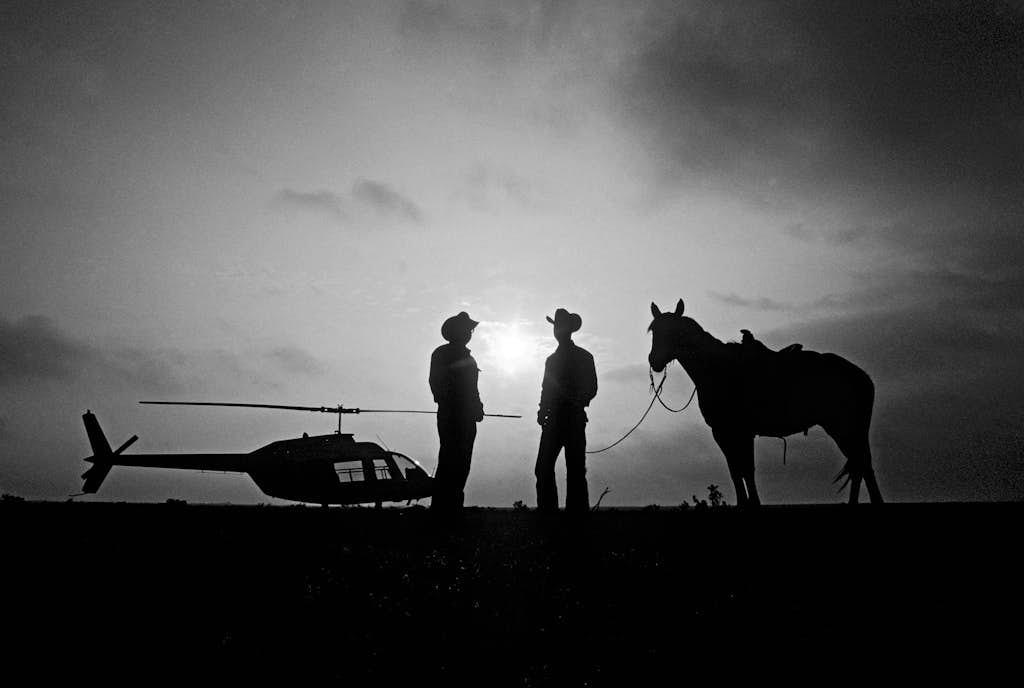
What Wilde did say in 1887 was that “English people are far more interested in American barbarism than they are American civilisation.” The English, Wilde wrote, preferred “buffaloes to Boston” and the other “inexpressibly tedious” cities. “Better the Far West with its grizzly bears and its untamed cowboys, its free open-air life and its free open-air manners, its boundless prairies and its boundless mendacity!”
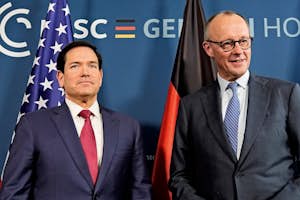
The wit and raconteur Marco Rubio differs. English settlers built the first colonies, Rubio said at the 2026 Munich Security Conference. Scots-Irish roughnecks and French fur trappers expanded the frontiers. German farmers made the Midwest. As for the American West, the “entire romance of the cowboy archetype” was “born in Spain”. Henry James would have recognised this view of America the civilising, and America as a civilisational extension of Europe. As the second Trump feels the turn of the geopolitical screw, it is refurbishing this old self-image.
★
The world wars reversed the great-power polarity between Europe and America — and turned America into Europe’s custodian. Whilst American leaders invoked “Western civilisation” to stiffen European spines in the Cold War, the “Plato to NATO” syllabus of “Great Books” and political philosophy inculcated Americans’ self-understanding and self-interest. This presented the Atlanticism of the Cold War not as a novelty — a permanent American return to the Old World — but a variation of an old story. This view peaked with the popularity of Samuel Huntington’s “clash of civilisations” theory after the 9/11 attacks, then declined as the War on Terror went off track.
The “civilisation” idea first spread in America in the first age of globalisation. Its revival follows the close of the second age of globalisation (1990–2016). The first anglophone use of “civilisationism” might be in a 2018 article by Daniel Pipes on Europe’s new nationalist parties. These rough-hewn civilisationists, Pipes argued, “have something to teach the elites, possessing as they do realistic insights about sustaining traditional ways and maintaining Western civilization”.
Instead of a “rules-based order”, liberal states see a new geography of power. The old peoples are domesticating the nation state, a European export, as the civilisation state. The major Asian powers are the revived civilisations of Russia, China and India. The pivot states are also civilisational revivals: Israel, Iran, Turkey and Japan. The would-be pivot states of the Gulf monarchies are a novelty, but as Mohammed Soliman notes in West Asia: A New Grand Strategy in the Middle East (2026), the Gulf’s bonds with India and the Eastern Mediterranean revive links that pre-dated European imperialism.
America, the new civilisation state, is on the edge of this old-new Asian world. It needs Europe as a platform, and it sees Europe as needing American support if it is to function as one. Hence Vice President J.D. Vance’s bad-cop turn at the Munich conference of 2025. Europe’s leaders, Vance said, were undermining a “shared civilisation” by suppressing speech with “ugly, Soviet-era” concepts such as “disinformation”, opening “the floodgates to millions of unvetted immigrants”, and treating their citizens as “interchangeable cogs of a global economy”.
The post-2016 New Right says the same of America in the Obama and Biden years — and rightly so. Their image of Europe is in many ways a reflection of domestic uncertainties in an America whose common culture has dissolved. They feel closer to Europe in kinship, Christianity and legal culture than elite Europeans feel to America. Like Kenneth Clark, Vance and Rubio say they “recognise civilisation when I see it”. They don’t recognise Western Europe today.
They do, however, recognise their idea of Old Europe in the “New Europe” that, like them, is frequently at odds with Brussels, Paris, Berlin — and now London too. But then, as T.S. Eliot wrote, the West is “a subject about which everyone thinks he has something to say”.