Many nations that have emerged from internal conflict – Rwanda, Colombia, Indonesia, to name a few – have anchored their national reconciliations in acts of mercy. In its own peculiar way, Venezuela might now join this group, nearly three months after the United States removed its dictator, Nicolás Maduro, by force and charged him with narcoterrorism and drug trafficking.
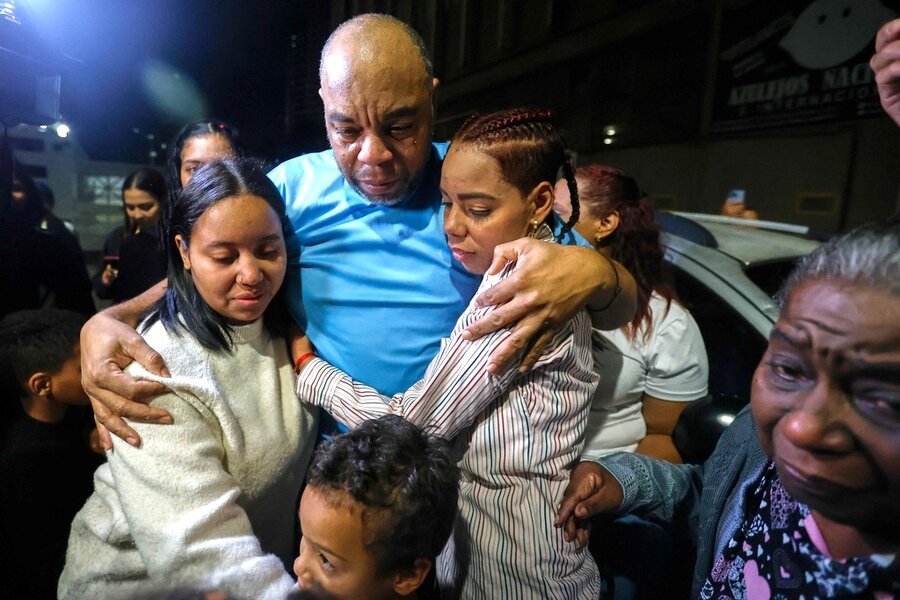
Most of Mr. Maduro’s colleagues remain in power in a deal made with U.S. President Donald Trump in the name of stability and a sharing of oil wealth. Yet the regime has also begun releasing political prisoners – just how many is in dispute. And in late February, Venezuela’s National Assembly passed an amnesty law that, for all its serious flaws, covers hundreds of detainees over decades.
These acts of mercy might seem useless. Many of the political prisoners violated no law, or at least none based on democratic rights. And the proceedings for their release from prison are conducted in front of judges tied closely to the regime. In addition, many Venezuelans are still being arrested for speaking out.
Yet the mere prospect of a general amnesty has begun to erode the regime’s legitimacy and has raised hopes for justice. More crucially, it opens a window to a full transition to democracy, one based on truth about the dictatorship’s worst abuses but that might include forgiveness for lesser crimes.
“Amnesty does not defeat the regime on its own, but it does take away its capacity for coercion, breaks the logic of political hostages, and renders terror ineffective as a tool of social control,” wrote Orlando Viera-Blanco, a Venezuelan human rights activist, in Analitica.com, a digital media outlet. “Thus, amnesty is not capitulation, it is the containment of oppression.”
The U.S. has laid out a plan that calls for both an election and a reconciliation process, often called transitional justice. That, combined with the limited amnesty, has emboldened Venezuelans to assert civil liberties. Public workers have gone on strike, activists have held vigils for detained political prisoners, and university students have organized protests.
The amnesty law itself speaks of creating “political pluralism” and reintegrating former political prisoners into public life. Still missing are steps toward truth, accountability, and reparations. The law might be only a tactical sacrifice by the regime simply to retain power. But with each release of a political prisoner, the regime “limits its narrative of internal enemies,” as Mr. Viera-Blanco contended, “and weakens its monopoly on fear.”