This article is taken from the February 2026 issue of The Critic. To get the full magazine why not subscribe? Get five issues for just £25.
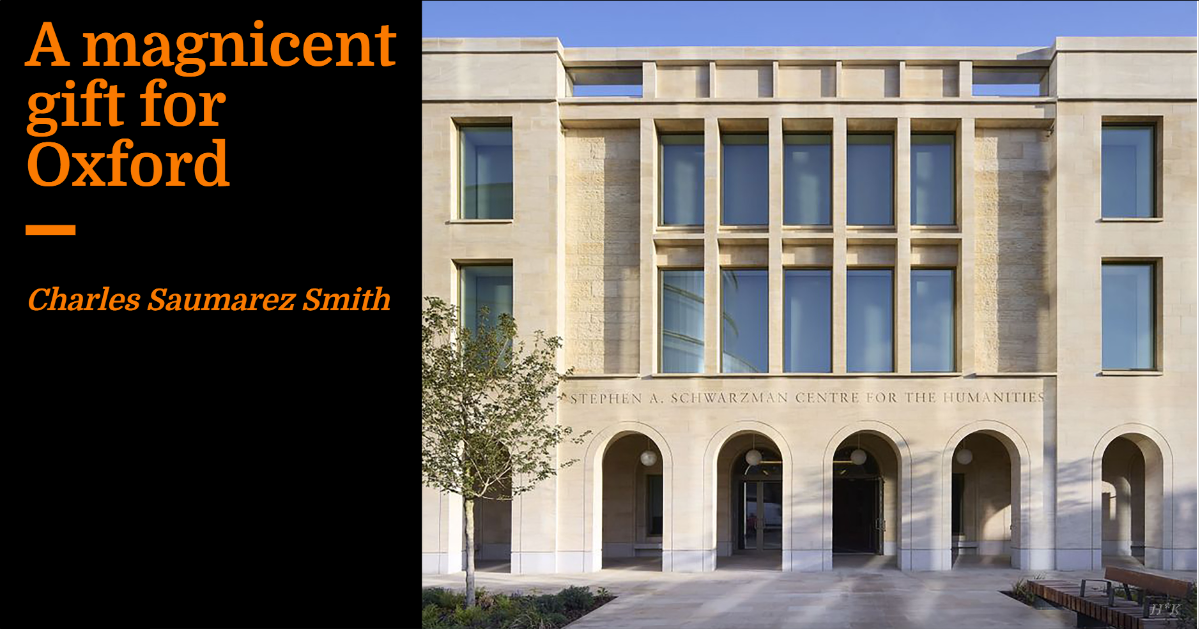
If anyone feels anxiety about the extreme concentration of wealth and privilege in Britain’s ancient universities, then I don’t recommend a visit to the new Stephen A. Schwarzman Centre for the Humanities in Oxford. The building opened not just to members of the University, but to the city as a whole at the end of September 2025.
It has long been an ambition of the university’s administrators and, I suspect, some, but probably not all academics (Oxford is a very conservative place), to centralise its humanities departments in order to provide more cross-fertilisation of ideas and no doubt release valuable real estate previously occupied by the departments in the centre of the city — including, for example, the history faculty which previously occupied T.G. Jackson’s High School for Boys in George Street, much closer to the colleges and Cornmarket.
William Holford drew up a plan for the future development of the university, published in May 1963, which identified the 10-acre site of the Radcliffe Infirmary just north of Somerville College between the Woodstock Road and Walton Street as the only possible potential site for growth. In the early 1970s, newly appointed academics were apparently promised new accommodation. In 1997, a working group on university sites concluded that “the strategic value of this large central site is self-evident”.
The NHS sold the site to the university in 2003. Early proposals included a beaux arts project by a firm of American architects, SLAM Collaborative. In 2005, Rafael Viñoly was commissioned to draw up a masterplan, but Niall McLaughlin (who designed two long thin accommodation blocks for Somerville College immediately to the south of the site) was asked to act as project guardian. His adjustments to the plan led Viñoly to complain that “the current iteration is not one that RVA recognises as its own”. Meanwhile, Viñoly was commissioned to design the Andrew Wiles Building to house the Mathematical Institute.
In 2015, the Blavatnik Building opened. It houses a new School of Government in three overlapping flying saucers, a building of aggressive super-modernity, as if flown in from another universe.
Then, in 2018, Oxford announced a gift of £150 million from Stephen Schwarzman, the founder of Blackstone, who had visited Oxford as a 15-year old on his first tour abroad. He had been impressed.
The Schwarzman gift has enabled the university to relocate nearly all its humanities faculties (apart from the Ruskin School of Art) in one gigantic building at the heart of the Radcliffe Infirmary site. A limited competition was held in 2019 and Hopkins Architects were selected — a shrewd choice.

The architectural practice established by Michael and Patty Hopkins in 1976 grew out of the high-tech practice of Norman Foster, where Michael worked for eight years. But from the beginning they were a bit more conservative than Foster, more interested in the materials of building.
Michael Hopkins’s father was a building contractor in Poole. In their twenties, they renovated an old timber-frame house in mid-Suffolk which Hopkins dismantled to understand how it had been constructed.
They made their reputation with the design of Glyndebourne Opera House which opened in 1994 and has forever endeared them to the world’s elite, who are able to enjoy its reticent brick exterior whilst eating dinner in the Sussex countryside.
Michael and Patty Hopkins handed their practice over to four long-standing principals some time before Michael’s death in 2023. The Schwarzman building has been designed and overseen by Andy Barnett, who was hired by the Hopkinses straight out of college (Cambridge and Harvard). He worked on Glyndebourne and Portcullis House, and he has been responsible for big projects, including a number of university buildings, on both sides of the Atlantic.
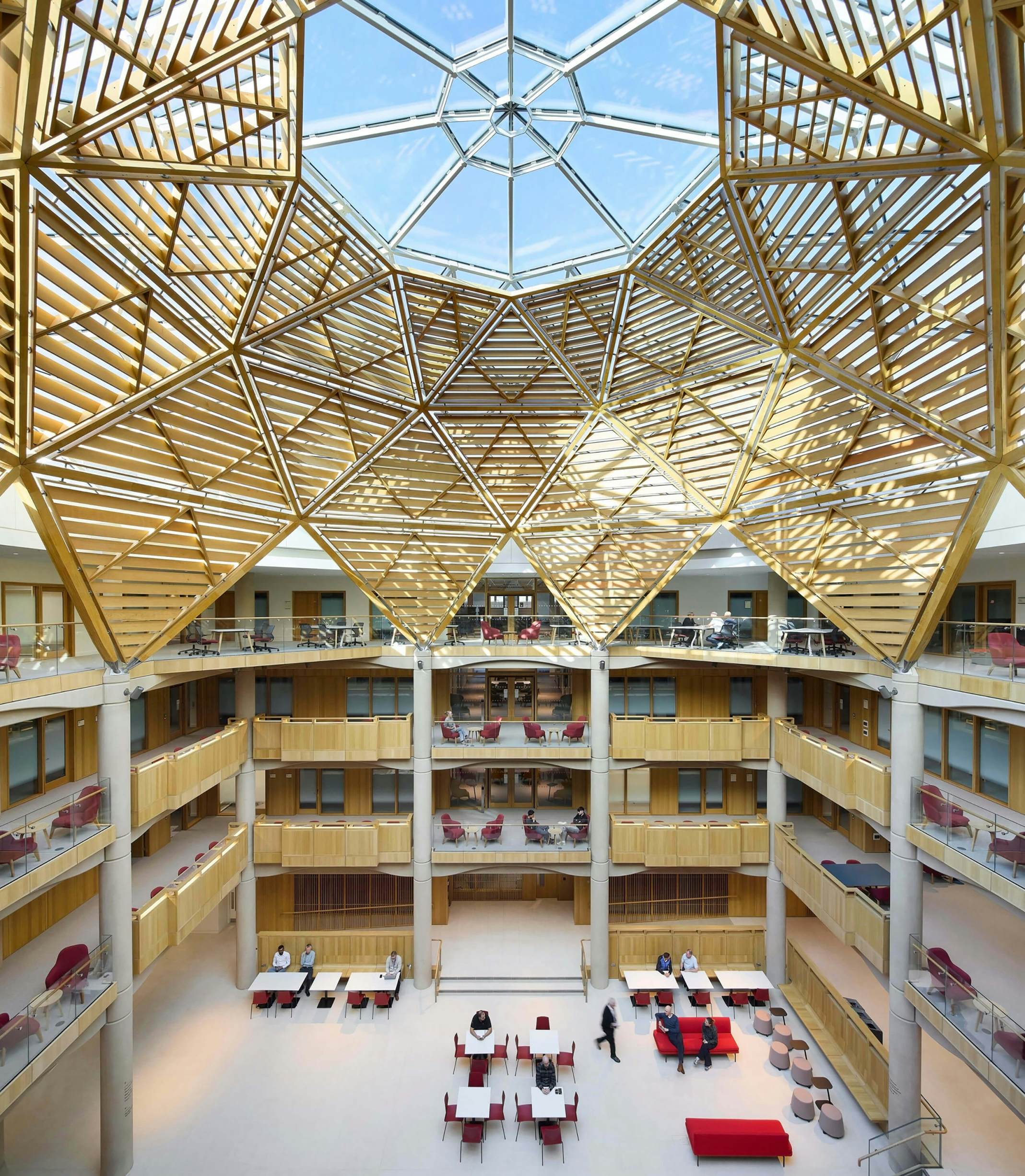
What he proposed was well judged. Outside, it is a carefully considered stone building, slightly 1930s in feel and deliberately collegiate. Inside, you can walk through the entire building from north to south and into its magnificent, central domed space, off which the faculties are housed on three upper stories inaccessible to the public.
It is a clever balancing act between the idea of opening access to the building to a wider public whilst preserving, so far as possible, the integrity of the individual faculties. I was amazed by the speed with which these spaces had been colonised when I visited two days after they had opened and before the beginning of the new term. Indeed, my only reservation about the project is that it may drain even more life out of the historic town centre, already full of empty shops and disconsolate tourists.
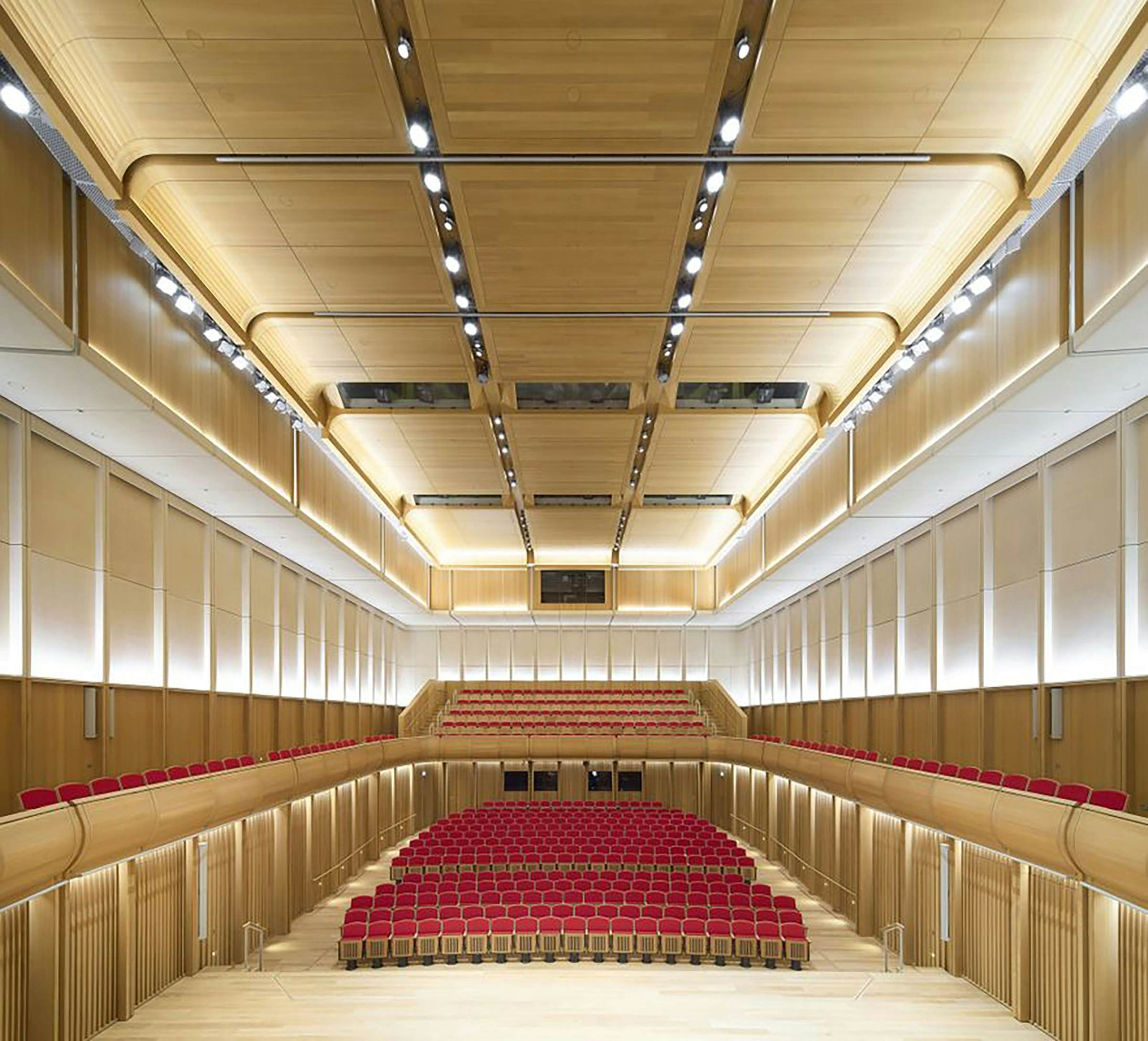
In the basement are a big, beautifully designed 500-seat concert hall, a 250-seat small theatre for daytime lectures and student drama, and a 100-seat experimental black box laboratory.
It was at this point that I felt the overwhelming sense of Oxford privilege. Just when most British universities are closing humanities departments and axeing staff, Oxford, thanks to a single American donor, is able to open a magnificent, spectacularly stately new facility for all its humanities departments, including a branch of the Bodleian Library, a new Institute of Ethics in AI, and a publicly accessible exhibition space for the Bate Collection of Musical Instruments, previously housed in a basement under the music faculty.
Cambridge will find this impossible to match.