The proposed “National Day for Victims and Survivors of Terrorism” is disingenuous and disrespectful
Sir Edward Lutyens’s Cenotaph in Whitehall was only supposed to be a temporary structure. Unveiled in July 1919 ahead of the London Victory Parade celebrating the end of the Great War, more than a million people visited the site within a week to pay their respects to those slain in the foreign fields of Gallipoli, Verdun and the Somme. Before long, calls were flooding in from the public to make the wooden construction permanent. David Lloyd George’s Liberal government had to debate the idea and had to find the money, but with public feeling so strong, it was a foregone conclusion. Construction began the following year. King George V unveiled the stone memorial on 11 November 1920, and the solemn public remembrance tradition it inaugurated has continued every year since, including during the war that followed.
The historian Robert Tombs has observed that no other European country accords such importance to the First World War as Britain, where it is remembered as “a uniquely poignant and traumatic tragedy, bearing many meanings”. More than 100 years on, even with its veterans having long since delivered their last salute, the yearly commemoration begun by seven miles of wreath-laying mourners remains a display of deep and genuine national feeling.
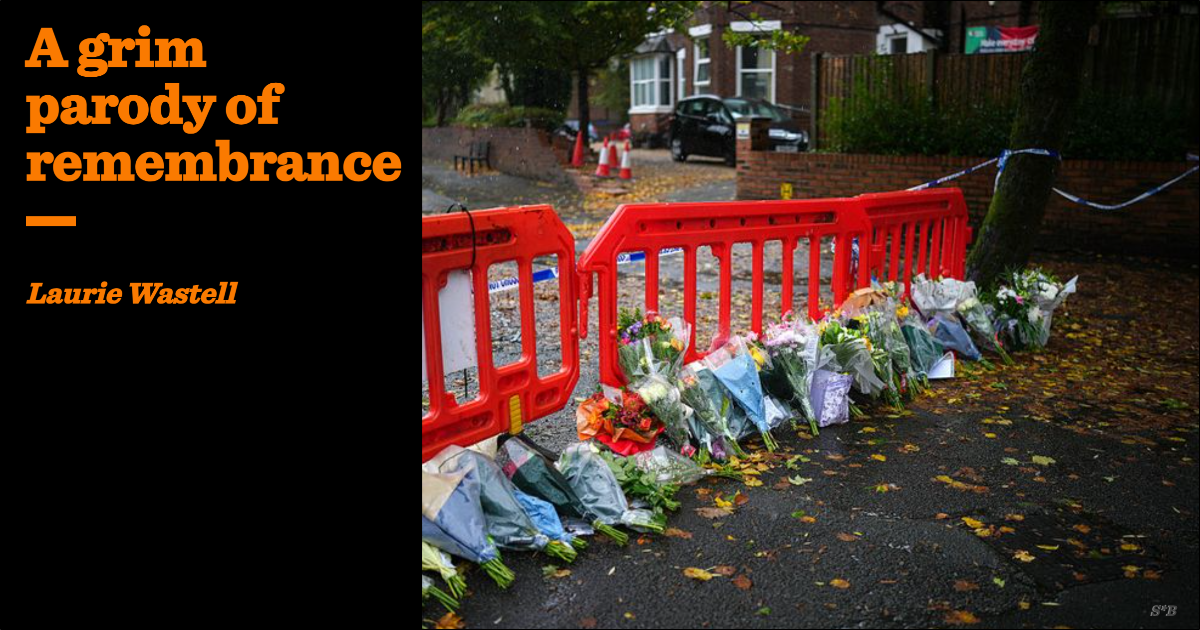
Now, the government has announced there is to be a new day to commemorate dead Britons. 21 August 2026 will mark the first annual National Day for Victims and Survivors of Terrorism, the Home Office announced last month. “The day will focus on remembering and recognising those impacted by terrorism, encouraging victims and survivors to access specialist support”, explains a press release, as well as “educating the public, and amplifying victims’ and survivors’ stories”.
If Remembrance Day and its traditions grew up organically, this initiative feels decidedly top-down. It follows a consultation which ran earlier this year which received just 351 responses, mostly from survivors and victims’ families. Like all such consultations, it seems designed to attract the kind of responses its drafters wanted. On the crucial question of what its focus should be — say, why the government is failing to stop terror attacks and why British-born Muslims keep killing members of the public — its five suggested answers are all decidedly within the comfortably apolitical territory of “raising awareness”, “educating the public” and telling victims’ stories (if respondents really want to go extra trouble, they can write one in). After this cursory exercise in boxing-ticking which next to nobody in the wider society can have even been aware of, some nameless official now tells us imperiously that next year, “The nation will come together to honour and remember victims and survivors of terrorism”.
Perhaps that is why parts of it feel rather misjudged. That we will be expected to “honour” these victims, for instance, seems rather jarring. In 1981, when imprisoned members of the IRA went on hunger strike to pressure the British government to grant them political status, prime minister Margaret Thatcher implacably refused to dignify their campaign of terror with such a concession. “Crime is crime is crime”, she insisted, “it is not political, it is crime, and there can be no question of granting political status”. Today, calls to “honour” the victims of these crimes risk attaching to them a political meaning which Mrs Thatcher would have abhorred and which in their nihilistic cruelty, they surely lack. In the Great War, the flower of our youth willingly laid down their lives to defend their comrades and their country. Today’s victims are being press-ganged in death into a national crusade they never signed up for in life. It is rather like the ghoulish spectacle, noted recently by Fleur Power in the Critic, of bestowing medals for “gallantry” on British members of the public who fought back against mindless violence that had been enabled by the state. This is all cold comfort when as civilians, they should never have been in danger in the first place.
The gap between the unruly, angry masses and the elites who presume to rule them has never been larger
It is certainly hard to see the public buying into this new calendar fixture in any meaningful way. The political theorist Gaetano Mosca held that the stability of any political system depends on a certain level of ideological unity between the elites and the masses. Ideally, this means the masses’ loyalty to the political order they live under is organic and spontaneous; while the elite is sensible enough to work with the grain of the public’s basic sentiments. In Britain, one mark of this unity at the time of the First World War was the number of mourners when it ended; another was the astonishing number of volunteers when it began and the fact that they were drawn from such a representative array of social classes.
Today, though, after decades of woeful political choices, most notably on immigration, the gap between the unruly, angry masses and the elites who presume to rule them has never been larger. A majority of British people hate the multicultural mess successive governments have made of their country; meanwhile their leaders’ deepest desire is to maintain the façade that diversity is our strength.
So it was that after the Southport atrocity (which by any reasonable definition ought to have counted as terrorism), public sentiment was first ignored, then demonised. “How many more children are going to die on our streets, Prime Minister?”, a Southport local memorably heckled as Keir Starmer robotically lay flowers in the town before being rapidly whisked away. Later that day, the Labour Liverpool Mayor, Steve Rotheram, chided grieving residents that it wasn’t “appropriate for people to have used this occasion to put forward some of their nefarious theories about what happened”. When many across the country then demonstrated against the awful killings — along with long-standing wider grievances — the government launched a draconian crackdown to punish not just criminal deeds but also furious words.
Today’s regime, far from being led by public sentiment, maintains several state agencies and programmes whose remit is to smother rightful outrage when such atrocities happen and instead manipulate public sentiment toward the politically anodyne. Did any ordinary person seriously look at the 22 innocent victims of the Manchester Arena bombing and spontaneously think, “don’t look back in anger”? The truth is if a national day were to organically express the feelings of the public towards these terror attacks, those who commit them, and the regime that has enabled them, the result would be so threatening to the current dispensation that no Labour government would ever dream of countenancing it. That’s why instead, all we can expect is a carefully stage-managed lie.