In Fyodor Dostoevsky’s novel The Brothers Karamazov, Dimitri Karamazov, who is said to be a “parricide and a monster”, reveals to pious younger brother Alyosha that he is “tormented by the question of God. That alone torments me [….] How will [man] be virtuous without God? That is the question. I think about it all the time.”
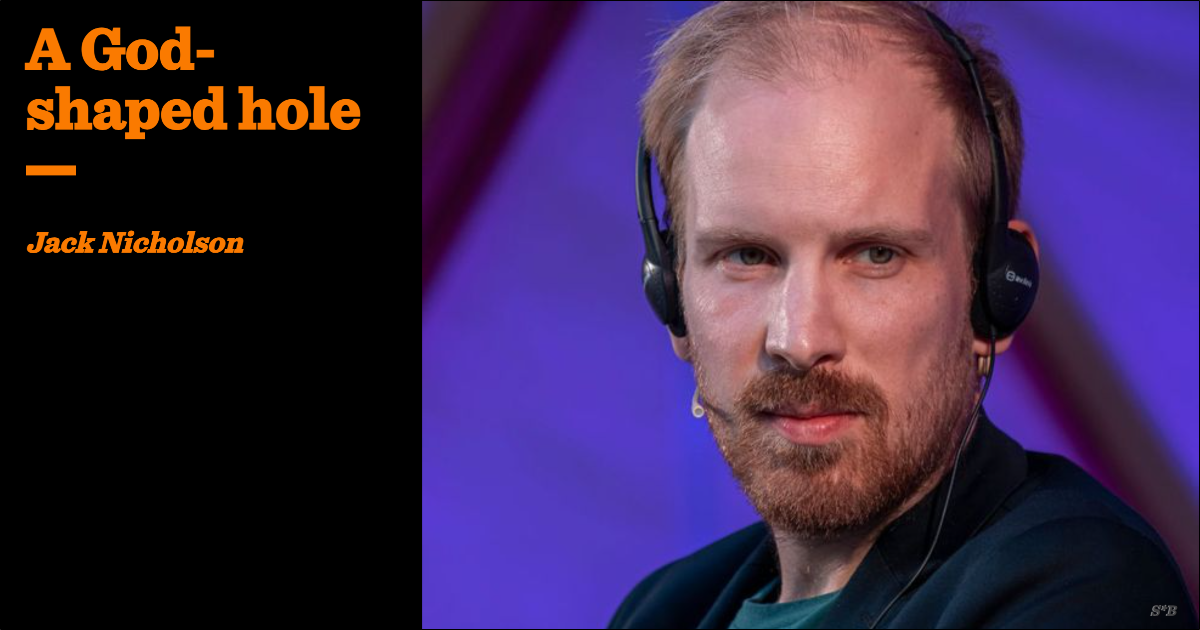
The first of Rutger Bregman’s Reith Lectures (25 November 2025) was called “A Time of Monsters”, after the Italian Marxist philosopher and political theorist Antonio Gramsci’s note from prison in 1926: “The old world is dying, and the new world struggles to be born: Now is the time of monsters.”
In his four lectures on “Moral Revolution”, Rutger Bregman, the Dutch historian and author who, in late 2023, co-founded the so-called “School for Moral Ambition”, defended to audiences in London, Liverpool, Edinburgh, and Stanford University in the United States, his belief that “small groups of thoughtful, committed citizens can change the world”.
This is especially true, said Bregman, in an environment in which elites lack virtue. “Decay is everywhere. The moral rot runs deep.”
Readers of this magazine will note his quotation of the former U. S. President Theodore Roosevelt (as much as the ignominious way in which the BBC removed his reference to Donald Trump as “the most corrupt” holder of that office from the broadcast). Roosevelt said, “It is not the critic who counts. History isn’t changed by those without skin in the game.”
However, the Reith Lectures felt rather lacklustre, chiefly, in their failure to adequately engage with the “question of God”.
In his second lecture, “How to start a moral revolution” (2 December), Bregman used the anti-slave trade campaigners of the late eighteenth and early nineteenth centuries as moral exemplars. They were all motivated by their faith in God. Thomas Clarkson was training to be a priest at the University of Cambridge when he decided to devote his life to abolitionism on the road to Wadesmill, Hertfordshire, in June 1785.
When prompted by presenter Anita Anand on this matter, Bregman conceded that “we human beings always have a God-shaped hole in our hearts. People are always looking for answers to the bigger questions.” He went on to say that moral revolution “probably [has] a spiritual dimension”. And that was it. Bregman failed to adequately address the origin of morality, if not in the heavens.
However, so many of the ingredients of “a moral revolution” he recounted are relational and require defending as such. In his third lecture, “A Conspiracy of Decency” (9 December), Bregman argued that moral revolution entails people coming together in the same room. He exhorted listeners to “find your small group of really committed people who are morally serious.” Then, you will change the world.
“Fighting for Humanity in the Age of the Machine” was the title of Bregman’s fourth and final lecture (16 December). However, fighting for humanity surely requires a theological framework in which to understand why it is “sacred”. Bregman, himself the son of a pastor, seems disingenuous in by-passing this as a requisite for any moral revolution.
Another child of a man of the cloth, the former prime minister Theresa May, spoke to Bloomberg about “Power and Populism” in the same week that Bregman finished up. She said that social media devalues virtue in public life by failing to bring people together and entrenching outlandish worldviews. “Compromise becomes a dirty word.”
Her predecessor Gordon Brown, likewise, the son of a pastor, once countered the perception “that politics cannot make a difference” in a speech to Citizen’s UK (May 2010). He was moved by a video for the Make Poverty History Campaign, which zoomed in on crowds behind charismatic speakers like William Wilberforce throughout history. “They were the people who made history, by being there and demanding change.”
The question remains; how will man be virtuous without God?
Dimitri Karamazov was not in fact “a parricide and a monster”. Wrongly accused of his father’s murder, he nevertheless tells Alyosha, “I love Russia […] I love the Russian God, though I am a scoundrel.” “I shall condemn myself, and I will pray for my sin forever.” The story reminds us that today’s “monsters” could well be in the eye of the beholder, misjudged rather than malevolent.
People are not coming together
Bregman identified so many features of our age in his Reith Lectures, including, “the toxicity of social media”, “isolation and outrage” online, and the presence of “ever smaller moral circles” where compromise is not an option. He also conceded that the loss of his faith felt like the loss of a common story, and that no-one was coming forward with a replacement. People are not coming together.
As to the antidote, further reflection on “the question of God” should help.
I suspect that many of us are, in a sense, pastors’ sons and daughters, struggling either with unbelief or the question of how to make a difference. Bregman was unable to address either of these things over four lectures. He did not strike me as a revolutionary, although he diagnosed a problem.
The old world is dying, and the new world struggles to be born. For all our sakes, let us hope that moral revolution will indeed result.