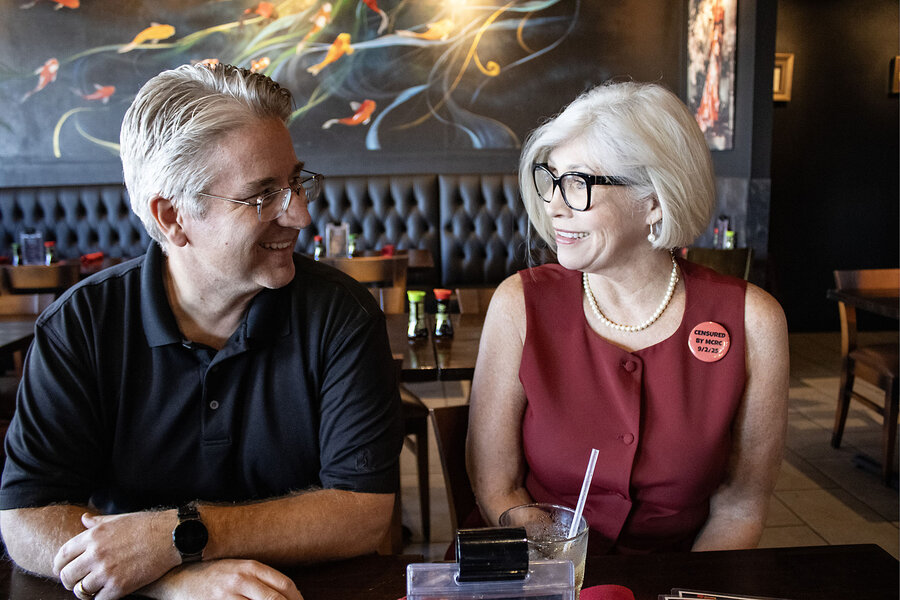
Brent Peak and Lisa Everett typically fall on different sides of political issues. He leads a local chapter of a progressive advocacy group. She’s a GOP district chair. Yet when the two met this past spring on the sidelines of dueling protests, their willingness to talk with one another led to finding some common ground – on the white-hot topic of immigration.
That day, Mr. Peak’s group gathered outside the local offices of the U.S. representative for Arizona’s 8th Congressional District. Several carried signs protesting cuts by the Department of Government Efficiency. Ms. Everett joined a counterprotest, sporting a Trump T-shirt. The two met through a conversation about keeping their demonstrations peaceful. They kept up the discussion over breakfast.
The Democrat and Republican have since aimed their activism in the same direction, agreeing about one community member’s immigration case. They’ve both called for the release of Kelly Yu, a Chinese unauthorized immigrant, business owner, and family member to U.S. citizens, and who has lived in Arizona for more than two decades. The activists and other supportive community members say Ms. Yu isn’t one of what the Trump administration calls the “worst of the worst,” needing priority deportation.
Why We Wrote This
For political opponents to find common ground on immigration matters seems rare. Yet, in Arizona, a progressive activist and a Republican district party chair are uniting around a detained woman who has been a positive force in her community.
The pair visited Ms. Yu in detention during the summer. “She’s everything we want in an American,” says Ms. Everett. “She’s the exact opposite of a drain on our system. She is employing Americans.”
Mr. Peak points out that the family-supported business owner, who fled communist China, “checks a lot of boxes that you would think more Republicans would be in favor of.”
The rare bipartisan support has surprised Ms. Yu, who says in a phone call from Arizona’s Eloy Detention Center that she feels “lots of love.” But that solidarity hasn’t yet won her release, after more than half a year detained by Immigration and Customs Enforcement.
Meanwhile, her U.S. citizen husband, Aldo Urquiza, misses his outgoing wife, who likes her restaurant’s pot stickers.
“You can hear her laugh from miles away,” he says.
From crossing the border to opening restaurants
Ms. Yu’s experience in the United States has spanned four presidents and their varying immigration policies, though no significant congressional reform of immigration laws has occurred during her time here. Her journey highlights how the U.S. immigration system can result in years-long adjudication, and underscores that having U.S. family members doesn’t necessarily lead to easy pathways to citizenship.
In 2004, the Border Patrol arrested Ms. Yu, also known as Lai Kuen Yu, as she illegally crossed from Mexico into Arizona, according to the Department of Homeland Security. The government says that the George W. Bush administration released her two days later. Ms. Yu, who was pregnant at the time of her entry, says she left China to give her daughter “a better life and education, more freedom.”
Ms. Yu applied for asylum, which the government denied. An immigration judge gave her a deportation order in 2005. Her attempts to appeal that order ultimately failed, and she was later detained during the Biden administration. She and Mr. Urquiza, who met through a dating app, married in January while she was in ICE detention in Texas. She was later released, then arrested again this past May.
“They’re playing release and catch, release and catch,” says Mr. Urquiza. He recalls telling his wife: “You’re not an animal.”

Sarah Matusek/The Christian Science Monitor
According to DHS, the Board of Immigration Appeals in June granted Ms. Yu a temporary stay of removal while the appellate board considered her motion to reopen her case. Yet Ms. Yu has not yet been released.
“For operational security and to ensure the safety of our personnel, ICE does not publicize when an alien will be removed,” says a DHS spokesperson. ICE has not responded to additional questions about Ms. Yu, including her detention history.
Several aspects of Ms. Yu’s case remain unclear, such as why she was released then detained again. The Monitor wasn’t able to speak with a lawyer representing her. Generally, though, it is possible for unauthorized immigrants to adjust their legal status through their U.S. citizen spouse or U.S. citizen child who’s at least 21 years old.
But there’s a major catch. If the immigrant entered illegally, they must first leave the country to pursue their status change through a consular process abroad. And that exit, whether voluntary or through a deportation order, triggers a 10-year reentry ban that requires other paperwork to seek lawful status. The bottom line: For people like Ms. Yu, it can be extraordinarily hard to gain a lawful status from within the United States.
Living here without authorization didn’t stop Ms. Yu from launching two Asian eateries in Maricopa County. She had planned to open a third. Through Kawaii Sushi and Asian Cuisine, Ms. Yu became a community fixture, donating to local causes such as baseball teams and helping fundraise for a police department’s K-9 unit. (Opening a business in Arizona does not hinge on immigration status.)
Most U.S. adults support offering unauthorized immigrants a path to citizenship, polling suggests. But there are nuances to Americans’ views on immigration, which include support for border security.
Roughly a quarter of the foreign-born population in the U.S. lives in the country without legal permission. An estimated 13.7 million unauthorized immigrants lived in the U.S. as of mid-2023, according to the nonpartisan Migration Policy Institute, whose estimate includes a few million foreigners with temporary permission to stay. Those researchers found that 45% of the unauthorized population resemble Ms. Yu: residing here for 20 years or more.
Ms. Yu felt like a bird flying through the sky without a nest.
That’s how she described the past 21 years living in the United States without authorization, on a call with the Monitor from Eloy Detention Center. Inside, “life here is just waiting and waiting,” she says.
Ms. Yu believes that once immigration authorities secure her travel documents, they will probably deport her to China. She could face a yearslong bar on reentering the U.S., and says she’s anxious about returning to Asia after so long. “Everything is going to be new to me.”
About 90 miles northwest of the ICE facility where she’s held, a row of red lanterns hangs in her Peoria, Arizona, restaurant. When Mr. Peak and Ms. Everett met there this fall, the Republican displayed a pink pin on her shirt. It noted the date of Ms. Everett’s censure this September by her local party for supporting Ms. Yu and working with a Democrat.
“Literal badge of honor,” chuckles Mr. Peak, who is co-chair of Northwest Valley Indivisible. Ms. Everett says she doesn’t care about the politics of what she says amounts to a “slap on the wrist.”
Anticipating his wife’s deportation, Mr. Urquiza says, at this point, it’s something only the president could stop. Like the majority of Maricopa County voters, he says he cast his ballot for Mr. Trump last year.
What comes next
Six months have passed since Ms. Yu entered the detention center. Her daughter attends college and helps out at the family business alongside Mr. Urquiza.
Customers ask about his wife and what they can do to help. Local news has followed her story for months. Mr. Urquiza knows the questions come from kindness, but the outreach can be “overwhelming,” he says. At the Peoria eatery, reminders of her are everywhere. A photo of Ms. Yu, smiling wide, greets guests at the door.
“She started this, and I’m not going to let it die,” Mr. Urquiza says.
Smoked salmon sushi has become Mr. Peak’s regular order. “We are thrilled to have motivated other people to lend their voices to this issue,” says Mr. Peak. “But it is depressing to see just how ineffective our voices really seem to be.”
The Republican and Democrat are advocating for Ms. Yu “individually, but also systemically,” says Mr. Peak. “We want to see a strong border policy with a compassionate immigration policy.”
The unlikely allies plan to collaborate on other issues for which they share common ground, such as funding for local school districts. “We want to work together any time we can,” says Ms. Everett.
If and when the government deports Ms. Yu, her husband says, the couple hopes to reunite eventually in Mexico. Maybe open a sushi joint there. From detention, though, Ms. Yu says she’s unsure how much freedom of mobility she’ll receive from whichever country receives her first.
The wait has drained the family, and Mr. Urquiza has come to accept her departure.
“I’ll celebrate as soon as she doesn’t call me,” from detention, he says. “Because I know she’s going to be free.”