In the week since the Supreme Court barred gerrymandering of districts intentionally based on race, many state legislatures have been busy debating how to redraw electoral maps. Some lawmakers have offered non-race-based ideas – including proportional representation – to ensure all disadvantaged voters have a voice. Such ideas, however, might first entail a dialogue, both across the aisle and across races.
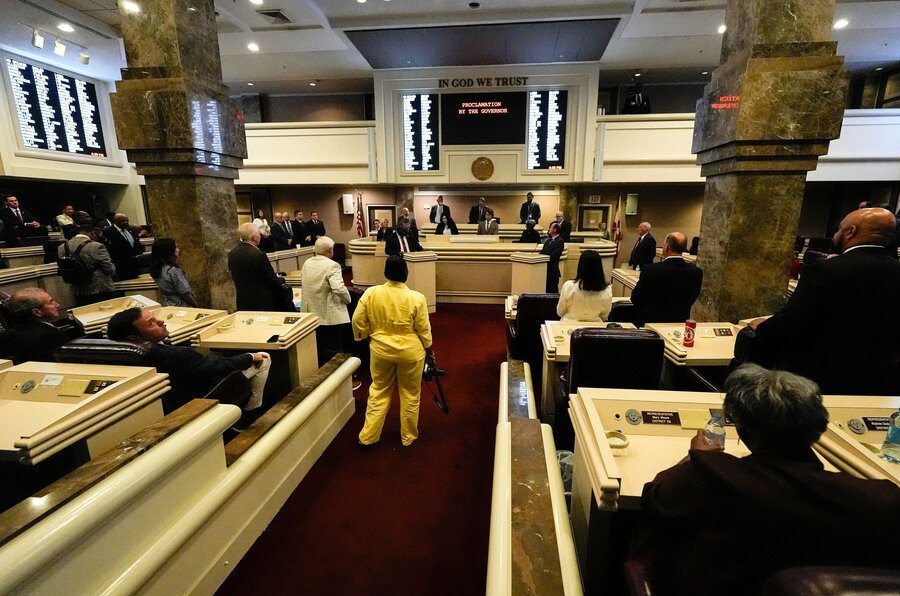
In Alabama, one legislator, Rep. Curtis Travis, offered a different kind of dialogue Monday. In an opening prayer at a State House session on redistricting, he asked “Eternal God” for His wisdom. Here is part of that prayer:
As this House considers matters that shape representation and influence the future of communities across our state, we ask for Your steadying hand.
Today, as lines are considered and decisions are weighed, grant wisdom that is not partisan, but principled.
Grant all of us clarity of mind, humility of spirit, and a commitment to fairness that rises above pressure, preference, or partisanship.
Grant courage that is not self-serving, but just.
Grant discernment that sees every citizen not as a number on a map, but as a soul created in Your image, worthy of dignity and fair representation.
He then asked this for his fellow lawmakers of all parties:
Bless each representative with courage, patience, and discernment for the work ahead.
In the United States, over its 250 years, prayers like that have often helped defuse tensions in race relations. In many statehouses now, however, the discourse is largely defensive and retaliatory, seeking partisan electoral advantage. Yet many Americans might be looking for what inter-race facilitators call “bridging.”
In their 2024 book “Belonging Without Othering,” john a. powell and Stephen Menendian of the University of California, Berkeley wrote that ways to link people across racial or religious divides “can be as simple as an interfaith dinner or a multicultural concert.”
“Active and empathetic listening is perceived and felt as a form of caring and regard, and it builds trust,” the authors wrote. “Remarkably, it may have a greater tendency to induce change or shift opinion than listening for purpose of persuasion, to change a person’s opinion.” Such mutual recognition, they add, can help reduce the kind of zero-sum competition found in neighborhoods, schools, workplaces, and politics.
In his prayer, Representative Travis conveyed a similar note:
Where there is division, bring clarity.
Where there is pressure, bring integrity.
Where there is uncertainty, bring reverence for what is right.
Taking a moment for prayer in the Alabama State House, he later wrote on Facebook, is a reminder that leadership carries weight “grounded in reflection, humility, and a sense of service to something greater than ourselves.”