Brits out enjoying the warm weather will be in for a spectacular treat this evening – and you won’t want to miss it.
A full Flower Moon will bloom in the night sky tonight, marking the first of two full moons this month.
The name ‘Flower Moon’ is thought to come from the abundant flowers that bloom at the start of May as spring gets well and truly underway.
And with temperatures soaring to 24°C in some parts of the country, there couldn’t be a better time to catch a glimpse of our lunar satellite.
Tonight’s full moon will also be special because it is a ‘micromoon’ – a rare phenomenon that occurs when the moon is at the most distant point from Earth in its orbit, making it seem slightly smaller and a little less bright.
But don’t let that put you off, as experts say the size difference should be barely noticeable to the naked eye.
Dr Edward Bloomer, senior astronomer at the Royal Observatory Greenwich, told the Daily Mail: ‘The Moon will be rising towards the southeast just before 9pm, and will continue to climb and head southwards – it’ll hit its greatest elevation around 1am, and thereafter head westwards and sinking below the horizon around 5am.
‘So, plenty of time to observe, but not always the most convenient time.’
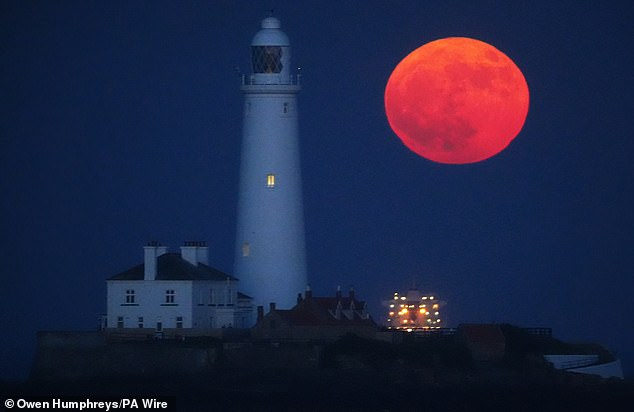
Stargazers enjoying the warm weather this evening will be in for a treat as the full Flower Moon blooms in the night sky. Pictured: A Flower Moon rises over Whitley Bay, England, in May 2025
What is a micromoon?
A ‘micromoon’, as the name suggests, is a full moon that is significantly smaller than normal.
This happens because the moon does not orbit the Earth in a perfect circle, but rather follows a slightly squashed oval.
That means there are points in its orbit when it is closer or further away from our planet, making it seem slightly smaller or larger.
A micromoon occurs when the moon is at apogee, the furthest point away, at a distance of 252,000 miles (406,000 km).
In contrast, when the moon is full at its perigee, the closest point to Earth, it is called a supermoon.
The distance between apogee and perigee, the closest point to Earth, is about 26,000 miles (43,000 km).
That might sound like a massive distance, but it is a tiny difference in astronomical terms and won’t make a massive difference to the full moon you see.
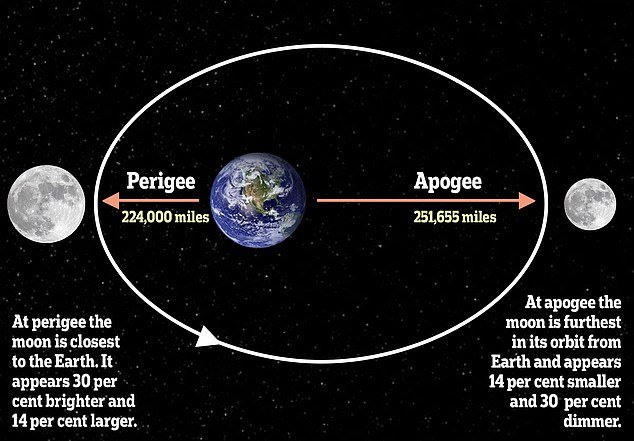
Tonight’s Flower Moon will also be a ‘micromoon’, which occurs when the moon is at its farthest distance from Earth, making it seem slightly smaller and less bright
If you compare photos of a micromoon and supermoon side–by–side, you would see that the former is smaller, but you probably won’t be able to tell the difference otherwise.
When to see the Flower Moon tonight
The moon will technically be at its fullest at 18:23 BST this evening.
However, it will still be behind the horizon at this point.
Instead, the first glimpse we will get in the UK will be at moonrise.
This will start at 20:46 BST for viewers in London and a few minutes later as you travel further north.
Due to a phenomenon called the ‘moon illusion’, the full moon actually appears larger when it is closer to the horizon.
It won’t actually take up any more of the sky, but our brains trick us into thinking that objects closer to the horizon are larger than they really are.
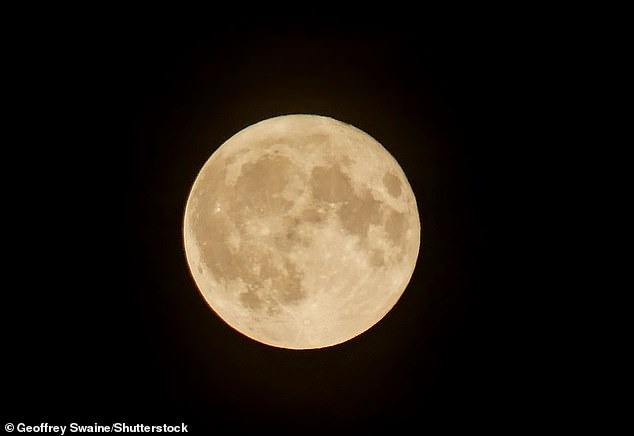
The best time to see the Flower Moon will be shortly after it rises at 20:46 BST. Due to the ‘moon illusion’ the moon will appear larger while close to the horizon. Pictured: The full Flower Moon seen over Oxfordshire in May 2025
Scientists still aren’t quite sure why this illusion works, but some suggest it could be related to the fact that we see the ‘dome’ of the sky as a flat canvas, warping our perceptions of size.
This is also a great time to see the Flower Moon because it might take on a reddish or orange hue while low to the horizon.
When the moon is low on the horizon, the light reflecting from its surface needs to pass through more of the atmosphere before reaching our eyes.
As the light travels, the shorter blue and violet wavelengths are scattered, leaving only the longer–wavelength light from the red end of the spectrum.
Despite its name, the Flower Moon won’t look any different once it has risen, but you can still enjoy a glorious, colourful moon if you catch it early enough.
To get the best view, all you need to do is find a location with a wide, open view of the horizon to the southwest.
Although the full moon will be the brightest thing in the sky, some of the details can be faint, so try to avoid areas with lots of light pollution from streetlights or nearby houses.
You can also improve your view by giving your eyes plenty of time to adjust to the darkness, spending at least 20 minutes without using a torch or checking your phone.
The good news for budding astronomers is that you won’t need any special equipment or preparation to make the most of tonight’s lunar display.
Although a telescope or pair of binoculars will help reveal small details like craters, most of the moon’s most impressive features will be visible to the naked eye.
Dr Bloomer says: ‘Observers will, even with the naked eye, make out the difference between lighter highland regions, and the darker lunar maria or ‘seas’; old cooled lava plains.
‘You can try and spot patterns in the Moon like ‘the man in the Moon’ or ‘the rabbit in the Moon’ if you like.’
However, despite conditions being warm, the weather may not be ideal for stargazing this evening.
The Met Office predicts some fairly heavy cloud cover moving in over the UK as the day goes on, with a few patches of clear sky in the south and southwest of England.
If you do miss tonight’s full moon, there is no reason to worry because May will actually have two full moons.
The second full moon of the month, colloquially known as a blue moon, will rise on the 31st of May.
The phases of the moon
Like Earth, the Moon has a day side and a night side, which change as the Moon rotates.
The Sun always illuminates half of the Moon while the other half remains dark, but how much we are able to see of that illuminated half changes as the Moon travels through its orbit.
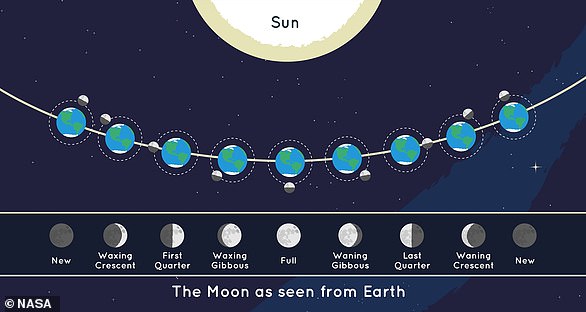
In the Northern Hemisphere, the phases of the moon are:
1. New Moon
This is the invisible phase of the Moon, with the illuminated side of the Moon facing the Sun and the night side facing Earth.
2. Waxing crescent
This silver sliver of a Moon occurs when the illuminated half of the Moon faces mostly away from Earth, with only a tiny portion visible to us from our planet.
3. First Quarter
The Moon is now a quarter of the way through its monthly journey and you see half of its illuminated side.
4. Waxing Gibbous
Now most of the Moon’s dayside has come into view, and the Moon appears brighter in the sky.
5. Full Moon
This is as close as we come to seeing the Sun’s illumination of the entire day side of the Moon.
6. Waning Gibbous
As the Moon begins its journey back toward the Sun, the opposite side of the Moon now reflects the Moon’s light.
7. Last Quarter
The Moon looks like it’s half illuminated from the perspective of Earth, but really you’re seeing half of the half of the Moon that’s illuminated by the Sun ― or a quarter.
8. Waning Crescent
The Moon is nearly back to the point in its orbit where its dayside directly faces the Sun, and all that we see from our perspective is a thin curve.