A different kind of climate change has hit the Caribbean coastline of Colombia over the past few days – triggered not just by oil or gas, but also by missiles and attack drones.
It’s a change in the political climate around recently flagging international efforts to limit the effects of global warming and agree on a “roadmap” away from carbon-based fuels toward cleaner, greener energy.
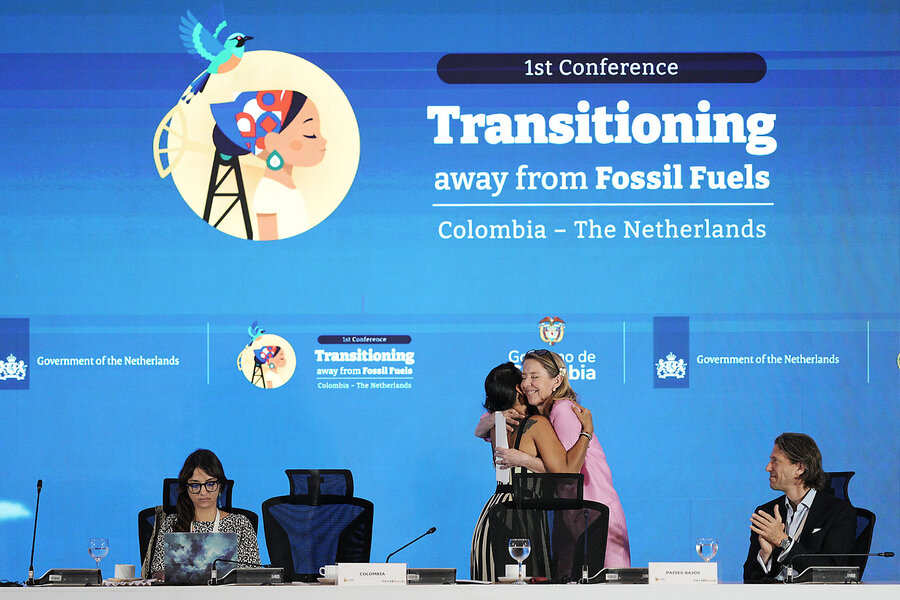
The war in Iran wasn’t on the original agenda for this week’s First Conference on Transitioning Away from Fossil Fuels, held in the Colombian city of Santa Marta. But it was clearly on the minds of delegates from the more than 50 countries represented in what the co-organizers – Colombia and the Netherlands – called an effort by a “coalition of the willing” to explore practical steps away from fossil fuels.
Why We Wrote This
The Iran war has brought change to the climate-policy debate. In many countries, a revived interest in greener energy might well be here to stay.
The conflict has choked off about one-fifth of the world’s supply of oil and gas.
“We already had a very good reason to move on,” said Wopke Hoekstra, the climate envoy from the European Union. But with the war costing EU countries nearly $600 million a day, he said, “we now also have it for commercial reasons, for reasons of independence.”
Britain’s representative, Rachel Kyte, emphasized “energy security,” saying more and more countries were concluding that “fossil fuels are a source of instability.”
The “transition” envisaged by the conference is unlikely to be quick or easy.
Key oil- and gas-producing states rely on their energy exports. And, critically, countries worldwide are still a long way from being able to do without fossil fuels.
That explains why the war’s effective closure of the Strait of Hormuz, vital to oil and gas exports from the Persian Gulf, has dramatically raised energy prices and hit economies across the globe.
When one major Arab oil producer, the United Arab Emirates, announced this week it would be leaving the OPEC petroleum cartel, it signaled its intention to increase production, adding that it expected “sustained growth” in demand once the war was over.
Yet the “political climate change” also appears likely to have a sustained effect.

The conference in Colombia was just the latest sign of how the war in the Gulf has prompted countries dependent on imported oil and gas to take a more urgent look at alternatives.
That’s particularly true in Asia, which is deeply dependent on oil and gas passing through the Strait of Hormuz.
In Japan, despite the lingering memory of the 2011 nuclear accident in Fukushima, an opposition party leader backed government moves to restart reactors in response to the spike in energy costs from the war.
In South Korea, which is also restarting several reactors, President Lee Jae-myung said the conflict had made it clear that “depending on fossil fuels is dangerous.”
India, Pakistan, and Thailand have also announced new green energy projects in response to the war.
The EU’s top official, Ursula von der Leyen, urged a rethink of the decision by Germany and some other states to move away from nuclear power after the Fukushima disaster. The Iran war, she said, made that seem like a “strategic mistake.”
Britain and Germany both announced an expansion of wind-power projects. And consumers, too, have been part of the wartime shift: Purchases of electric vehicles in Britain, Germany, France, and Spain have risen.
Many more motorists, of course, still fill their vehicles with gas or diesel. A wholesale move from fossil fuels will require time, economic adjustments, and a significant investment in the technology and infrastructure required for a reliable green energy supply.
But delegates at this week’s conference believed the war would shift the terms of international debate and drive home the need for such an energy transition.

A few months ago, the mere idea of accepting that transition as a direction of travel faced stiff headwinds at the latest of the annual United Nations-led conferences to implement the 2015 Paris agreement.
The 2023 climate change conference, or COP, did recognize that aim for the first time.
But President Donald Trump has since pulled the United States out of the Paris process. At November’s COP, though 80 of the nearly 195 delegations wanted a transition road map, Saudi Arabia and other oil states prevented its mention in the final communiqué.
Brazil, the host nation, came up with a compromise: Interested countries could draw up proposals for a “voluntary road map” to be considered by this year’s COP, scheduled for November in Turkey.
That was the reason for the conference in Colombia.
The UAE’s expectation of rebounding oil and gas demand after the war could well be borne out.
Still, the war appears to have brought home the longer-term benefits of moving away from fossil fuels.
That’s certainly the view of the head of the International Energy Agency.
Governments worldwide, Fatih Birol said last week, would “review their energy strategies.”
Predicting a “significant boost” for green energy sources, Mr. Birol said the “risk and reliability” equation of fossil fuel imports had changed.
And he used a vivid metaphor to emphasize how fragile that “reliance” was now.
“The vase is broken,” he said. “The damage is done.”