At Le Nouvelliste’s office in the hills of Pétion-Ville, far from its abandoned newsroom in downtown Port-au-Prince, a single newspaper is hidden amid a stack of important documents on Editor-in-Chief Frantz Duval’s desk.
Dated March 26, 2024, it is the last print edition of the 128-year-old paper, Haiti’s oldest. When it went to press two years ago, no one knew it would be the last physical publication.
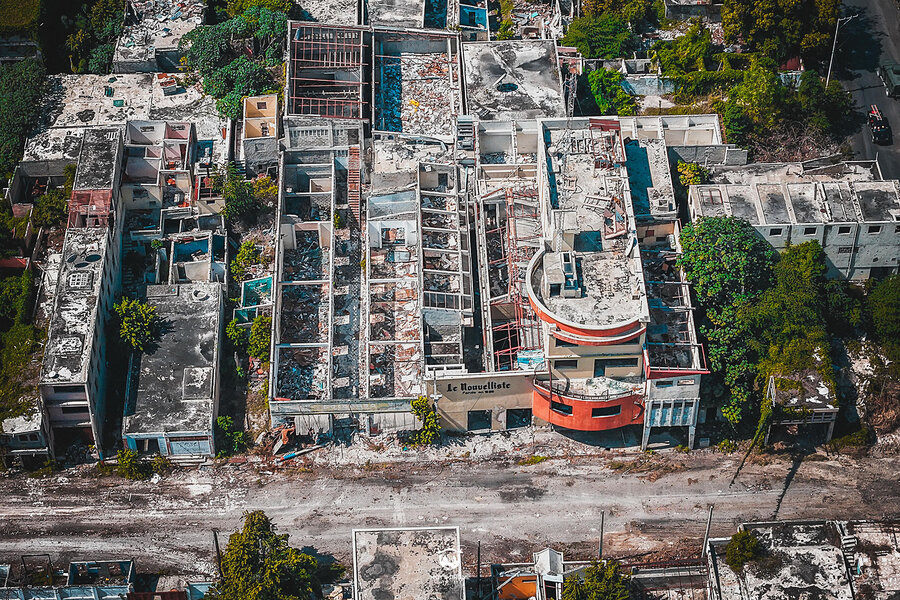
Armed gang members – reinforced by prisoners who had escaped from a nearby jail – took over Le Nouvelliste’s and surrounding offices. On April 18, they began to loot and vandalize the building. They dismantled and carried off the newspaper’s 130-foot printing press.
Why We Wrote This
From foreign occupations to coups to natural disasters, Haiti’s longest-running newspaper has covered it all. But, with gang violence on the rise, Le Nouvelliste may be facing its biggest challenge yet.
It took eight months before Mr. Duval managed to send someone to the ransacked streets near the office to see what remained. It took even longer for him to accept his paper’s new reality, he says. Through it all, he’s kept publishing the paper online.
Le Nouvelliste is one of the oldest continuously published French-language newspapers in the Caribbean, and one of just a handful of institutions in Haiti to surpass a century of existence. It has served as a platform for free expression during dictatorships, coups, the 2010 earthquake, and more recent unrest. Other than the three-month pause when it underwent an ownership change at the turn of the 20th century, only once has the paper ceased publication: for 11 days in 1921, during the United States’ occupation of Haiti. It was in response to martial law prohibiting articles “detrimental to” American rule.
Today, publishing the news in Haiti is getting harder, and more urgent than ever, journalists say. Haitian reporters across outlets and mediums are facing unprecedented threats. They’re dodging bullets and navigating roadblocks as they document the collapse of Port-au-Prince – a city reshaped by gangs and lawlessness since the 2021 assassination of president Jovenel Moïse – as they try to identify a path ahead for their profession.

“The majority get by as best they can: with a pen, a microphone,” says Mr. Duval.
Writing “between the lines”
In his office, Mr. Duval sits beneath the portraits of his nine editorial predecessors. Together, they’ve led the paper since 1898, when for the first year it was known as “Le Matin.” This temporary office building, located in one of the final sections of the capital still free from gang control, is too small to accommodate his full staff of 60. Many reporters work from home, an added challenge in a nation where displacement due to violence is growing daily. More than 1.4 million Haitians are estimated to be displaced, an increase of roughly 50% compared with a year earlier.
Editor-in-chief since 2010, Mr. Duval grew up with the paper. He remembers his parents reading it each morning. In an article last year marking his four decades working in various roles at the paper, he’s quoted recalling how his grandmother used to read Le Nouvelliste aloud to him.
“Each article felt like an adventure,” he said. “Through the pages of Le Nouvelliste and the voice of my grandmother, I explored the world.”
His words first appeared in the paper in 1985, during the dictatorship of Jean-Claude Duvalier. Still a student, Mr. Duval sent an open letter in response to a Le Nouvelliste column that mocked a young writer’s spelling. The problem, he argued, was not the student but the education system.
To his surprise, it was published.
“That caused problems at home,” he recalls. “My parents didn’t know [that he had sent the letter], and didn’t appreciate it. And at that time, it was risky.”
Two years later, he joined the paper as a reporter.

“We spoke in signs back then,” he says of the dictatorship years. “We wrote between the lines. And the readers knew how to decipher” our messages.
In 1995 the paper launched Livres en Folie, the country’s largest literary festival, bringing together hundreds of writers and publishers. Over time, the newspaper expanded – adding cultural supplements on entertainment, youth education, and sports. The most prominent product, Ticket Magazine, was a weekly publication covering pop culture and lifestyle trends.
“Back then, Port-au-Prince was full of life,” Mr. Duval says.
In 2004 it launched its online edition, which continues to serve as a lifeline for Haitians abroad.
“Reading it is a living connection to my late mother’s memory and her love for Haiti,” says Leonie Hermantin, who grew up in Haiti until she was 12 years old, when her family moved to the U.S. “I admire the journalists and editors for their courage,” she says of reporting in Haiti today.
Not everyone is pleased with Le Nouvelliste’s online-only offerings. The paper has lost subscribers, and regularly gets complaints from older readers who prefer the physical paper. But, amid Haiti’s security challenges and government-leadership vacuum – not to mention the multimillion-dollar price tag on a modern printing press – Mr. Duval says he is unsure “if we will ever return to print.”

“The block is everywhere”
Several key media institutions, including one of the country’s oldest radio stations founded in 1949, Radio Caraïbes, face a similar fate: offices looted and burned by organized criminals, and staff evacuated.
Across Haiti’s media landscape, outlets are operating with minimal resources. The private sector has retreated, and there is no state support.
The Inter American Press Association’s index on press freedom last year ranked Haiti in the “high restriction” category. The report says amid a “severe political, economic, and security crisis,” authorities have failed to protect the press.
Nine journalists were killed in 2022, marking the deadliest year for Haitian journalism since 1992, when the Committee to Protect Journalists began recording. Kidnappings are a constant threat, with the most recent occurring in March, when two reporters were abducted in downtown Port-au-Prince.
Only blocks away from the scene of that crime, one of Radio Caraïbes’ most famous journalists, Mackenson Rémy, drives slowly through the city center at 4:30 a.m. His windows are rolled down and the signature melody of his radio program spills into the dark streets. Known by his Creole nickname, “Kat pa Kat” – “four by four,” like a vehicle that can go anywhere – he is the only journalist still reporting regularly from the streets of Port-au-Prince at this hour.
Thousands of listeners tune into his program each day to hear if it’s safe to leave home, if the banks have cash, and whether fuel has arrived.

“Ten years ago, politicians would ask gangs to block a street,” he says, referring to how political leaders have historically used armed groups to exert influence over the population, especially around elections and during crises, as documented by international organizations. “Now, the block is everywhere. It is mental. You see it in people’s eyes,” Mr. Rémy says.
This “block,” or fear, has caused self-censorship among journalists and driven many out of the country, he says.
“I receive threats from gang leaders whenever they don’t like what I report,” says radio and print freelancer Hadiany Oximable Saint-Fleur. “Often, they are threats of sexual violence.”
In a city the United Nations has described as “one of the most dangerous places in the world for women,” Ms. Saint-Fleur is one of only two female journalists doing field reporting for Radio Caraïbes. One in six of Le Nouvelliste’s reporters are women.
A paper that “belongs” to Haiti
Vania André, assistant professor of journalism at Hofstra University in New York, describes Le Nouvelliste as unique within Haiti’s media landscape. While many news organizations rely on broadcast news commentary, she says, Le Nouvelliste is still producing original, shoe-leather reporting that adheres to “journalistic principles.”
“It’s not easy to run a media business anywhere, let alone in Haiti,” says Ms. André, who is also editor-in-chief of the U.S.-based outlet The Haitian Times.
Le Nouvelliste’s longevity is valued beyond fellow journalists and the diaspora: Microfilm copies of Le Nouvelliste are preserved in the U.S. Library of Congress, safeguarding Haiti’s press heritage for the future.
The paper’s biggest task today is finding a business model that will fund its reporting, the fourth-generation owner, Max Chauvet, says. Le Nouvelliste has 120,000 registered users who could potentially be turned into paying subscribers, but models from abroad only go so far in a country where purchasing power is low, intellectual property protections are weak, and articles are routinely copied and republished elsewhere, says Mr. Chauvet.
Possibly, that will mean reshaping the newspaper into something entirely new.
“My father used to repeat: ‘It is not the Chauvet family’s newspaper. It belongs to the country,’” he says.
That idea, that the paper is about something larger than a paycheck or a legacy, is perhaps why, he says, “from crisis to crisis, we’ve managed to survive.”