This article is taken from the March 2026 issue of The Critic. To get the full magazine why not subscribe? Get five issues for just £25.
Every modern university, it seems, needs a “mission statement”. But perusing these hackneyed, vapid, saccharine bromides provides very little instruction or inspiration.
It’s a glib genre where “world changers” in pursuit of a “socially just future” solve “global challenges” through “impactful education” and “knowledge exchange”, whilst upholding their commitment to “collective progress”, “inclusivity” and “wellbeing”.
In simpler times, a university could be content with a brief motto. I don’t mean the new taglines that universities have adopted, which peddle more of the same clichés, be it Cardiff’s “Together in Progress” or Huddersfield’s “Inspiring Tomorrow’s Professionals”.
It’s not a field that fosters originality: the University of Stirling seeks to “Be the difference”, the University of Staffordshire seeks to “Create the Difference”, whilst the University of East Anglia strikes out — even beyond English grammar — to “Do different”.
No, it’s better to find something historical and heraldic. Why not reach far back into the annals of Old English? The University of Winchester lives by King Alfred’s commitment to wisdom and learning (Wisdom ond lar), whilst the University of Essex channels the famous speech of Byrhtwold in the anonymous poem “The Battle of Maldon”: “Thought the harder, heart the keener”.
Better still to turn to a foreign language, not to baffle your audience but to embed the institution in a deeper and enduring tradition. For many universities this very linguistic distance will conveniently disguise how far they have drifted from their noble origins.
The most elegant strategy to take is to deploy a short quotation from antiquity, which combines a historical nod with ambiguous interpretation.
Both the London School of Economics and the University of Sheffield took up the famous phrase from Virgil’s Georgics that celebrates the achievement of the philosopher-poet Lucretius: Rerum cognoscere causas (“Discovering the causes of things”). The University of Bath drew from the same poem the agricultural tip Generatim discite cultus (“Learn each cultivation in accordance with its kind”).
With more epic ambitions, the University of Warwick took from the Aeneid the secret of how souls survive: Mens agitat molem (“Mind moves matter”). By contrast, University College London seems quietly to have abandoned use of its own Virgilian motto, Cuncti adsint meritaeque expectent praemia palmae (“Let all be present and hope for the rewards of the prize they deserve”).
Perhaps meritocracy is not true inclusivity; UCL now uses the tagline “Here it can happen”.
Of course, several universities have panicked about the anachronisms of ancient mottoes
Other ancient sources abound. The University of Bristol opts for Horace’s Vim promovet insitam: “[Learning] advances one’s innate powers”. Liverpool John Moores turns to the comedian Terence: Fortes fortuna adiuvat (“Fortune favours the brave”). More eclectically, the Royal Veterinary College quotes the satirist Persius (Venienti occurrite morbo, “Confront the emerging illness”).
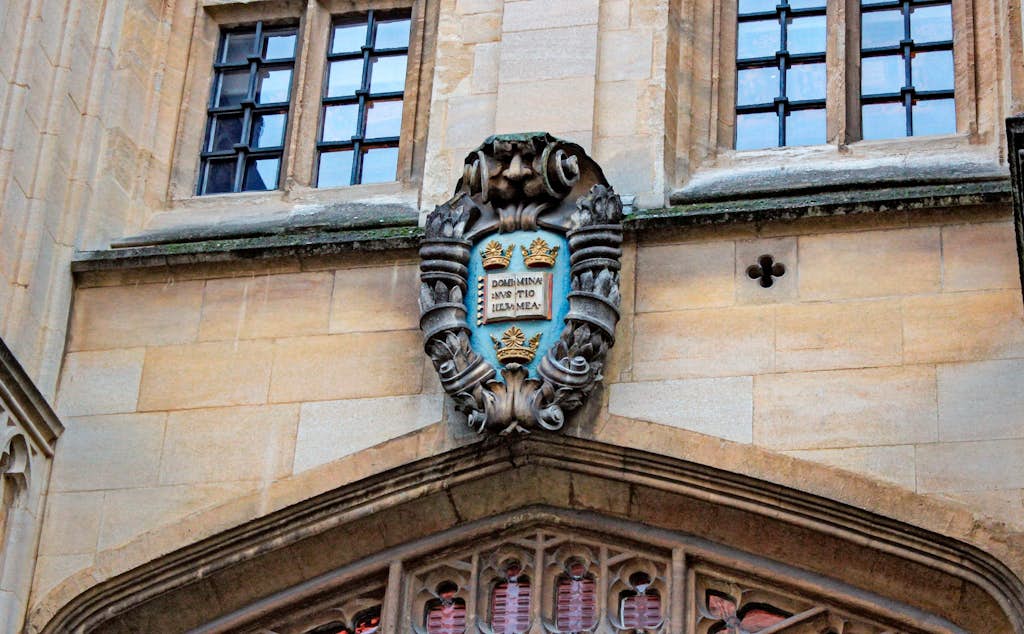
Sacred words call others yet higher. Oxford is guided by Psalm 27 (Dominus illuminatio mea, “The Lord is my light”), whilst Cambridge uses a motto of unknown origin and nuance: Hinc lucem et pocula sacra (“Hence light and sacred draughts”).
No less a figure than Jesus gives instruction to the University of Glasgow (Via, veritas, vita, “The way, the truth, the life”) and Canterbury Christ Church (Veritas liberabit vos, “The truth will set you free”), whilst St Paul inspires the University of Chester (Qui docet in doctrina, “He who teaches, [should be] in teaching”).
But the most majestic of all mottoes is unquestionably that of St Andrews. This is the no-nonsense advice that the Lycian hero Glaucus received from his father in Homer’s Iliad: Αἰὲν ἀριστεύειν (“Always be the best”).
Of course, several universities have panicked about the anachronisms of ancient mottoes. Imperial College abandoned its grandiose expansion of Virgil — Scientia imperii decus et tutamen (“Knowledge is the glory and safeguard of empire”). Half a million pounds of brand strategy delivered its replacement: “Science for humanity”.
As for the University of Northumbria, it quietly removed from its crest the simple Aetas discendi (“the age of learning”) — although since it routinely claimed that this meant “a life of learning”, perhaps that’s no bad thing. Its tagline is now “#TakeOnTomorrow”.
It’s much wiser to let the Latin live. A word of warning, though: if you are to create a new motto in an old language, it’s best to get it checked before printing your crest.
Alcuin College at the University of York has boasted in recent years a novel motto: Panton nos postulo — a curious mixture of Latin and Greek. The website tells us it means “All we need”, which is what an online translation tool would assure you. In fact, it would have to mean something like “I prosecute us for everything”. So at least they’re taking the blame.