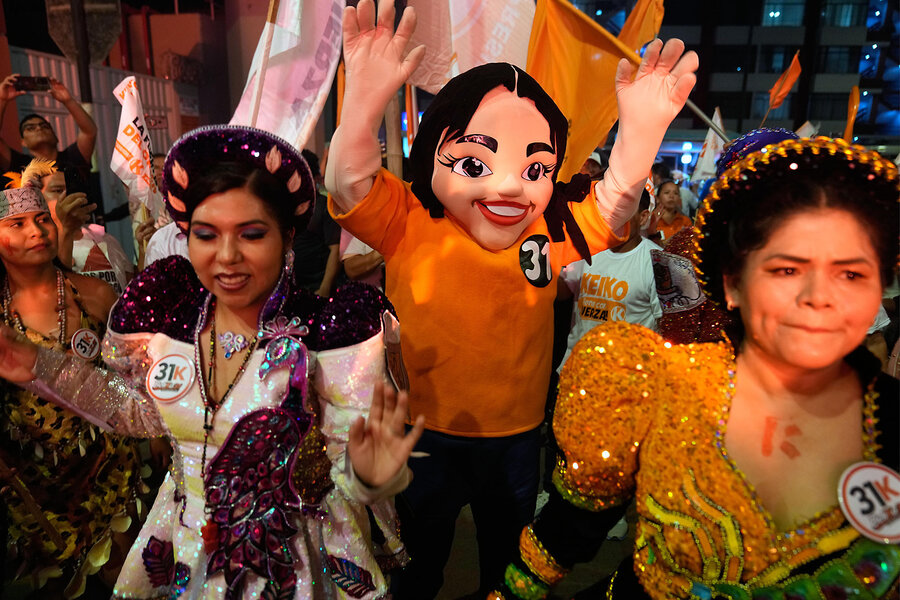
In Peru’s presidential election this weekend, where voters will select the nation’s 10th president in as many years, top candidates are sharing sometimes outrageous ideas for tackling growing crime.
One front-runner says he’ll build a jungle prison with impenetrable perimeters populated by deadly Amazon vipers. Another says she’ll bring back the hooded judges used by former authoritarian President Alberto Fujimori to defeat a violent Marxist insurgency in the 1990s.
And then there’s the candidate proposing to simply load ships with criminals and launch them out to sea.
Why We Wrote This
Peruvians will elect their 10th president in as many years. But the revolving door of top leadership has eroded trust in elected officials. Could the next president change that?
Although violence and gang activity are genuinely on the rise, these candidates are offering solutions that voters say don’t match their realities. Daily life is increasingly shaped by extortion and street-level theft.

For many, the candidates’ proposals are so off base that they’re creating tensions for voters between wanting a leader who can generate real change, and the sense – exacerbated by years of a revolving door of top leadership – that little change can come to Peru via elected officials.
There are 35 people vying to become the next president. And early polling has more citizens saying they’re unsure who they’ll vote for April 12 – nearly one-fifth of the electorate – than there are backing any single candidate.
“We see in the very high indecision among voters and lack of enthusiasm for any candidate a widespread sense that who is president doesn’t matter so much,” says Gino Costa, a political analyst and former interior minister who is also a candidate for Peru’s senate.
Part of that comes down to a sense that candidates are not actually speaking to voters. “My top consideration will be the crime on our streets, which every week seems to be more frequent and violent,” says Joyce Guarníz, a Lima jazz saxophonist. “I want to hear real solutions to the lawlessness,” he says, which extends to other illicit activities – from illegal gold mining to tropical wood logging to drug trafficking – which often have connections to powerful elected officials and foster a sense of impunity.

Howard LaFranchi/The Christian Science Monitor
Crime on the ballot
The emergence of street crime and expanding lawlessness as electoral issues is not unique to Peru. In recent elections across Latin America, from Chile to Ecuador to Bolivia, rising violent crime has played a key role in a regional political shift toward the right.
Sunday’s vote will actually act as a primary. Unless one candidate receives more than 50% of votes – highly unlikely, given the three dozen names on the ballot – the two top vote-getters will proceed to a June runoff.
Polls suggest the most likely scenario is a face-off between two right-wing candidates. Former presidential candidate and congressional leader Keiko Fujimori has risen to the top spot – albeit with support at about 14%, according to polls released in early April. Former Lima mayor Rafael López Aliaga – known across Peru as “Porky” for his resemblance to the cartoon character – has fallen from his onetime lead to second or even third, behind conservative former comedian Carlos Alvarez.

But both Ms. Fujimori and Mr. Aliaga are familiar faces in a ferociously anti-incumbent environment. And with about 17% of voters saying they’re undecided, experts say one of several left-wing candidates could reach the runoff.
Some officials and law enforcement experts point out that statistically Peru is not the crime-ridden danger that newscasts present. There’s been a surge in certain kinds of violent crime, in particular extortion, which is carried out largely in working-class neighborhoods. There were an estimated 30% more cases of extortion reported in the first eight months of 2025 compared to the same period in 2024. But Peru’s crime rates pale in comparison to some regional neighbors.
For Peruvians who are directly affected by crime, the current, sometimes unbelievable, proposals made by presidential candidates are falling flat.
“The candidates come out with proposals that seem designed to make them look tougher than the rest, but I’m not hearing anything I’m confident will change the very bad situation we are living and working in,” says José Quispe, bus depot and route manager for Santa Catalina Transportation, a Lima-based private transit company that runs 220 buses with 300 drivers.
For more than a year, Mr. Quispe’s company has come under relentless extortion pressures from gangs.
“Their message is ‘You pay or you die,’ and we have learned they are not kidding around,” says Mr. Quispe, as he shifts the fingers of one hand from making the sign for money to forming a pistol that he points at his head.
Indeed in March, Mr. Quispe experienced the unthinkable: Armed men on motorbikes shot up one of his buses, killing the driver.
At the bus depot he oversees in a dusty working-class community on Lima’s southern edge, Mr. Quispe chats with a group of drivers on break on a recent afternoon.
“These days we leave the house in the morning not knowing if we will return alive at night,” says one of the drivers, declining to give his name out of fear for his and his family’s security.
Across the dirt street from the depot, Pilar Puma Espinoza pauses a conversation with neighbors to offer her perspective.

Howard LaFranchi/The Christian Science Monitor
“It’s not safe to take the bus,” says Ms. Puma, an employee at a document-printing company. But, “we have to get to work.”
While she has seen the campaign billboards for Mr. Aliaga proclaiming, “Enough with weakness! Now is the time for tough decision-making!” Ms. Puma says she doesn’t trust Lima’s former mayor and is considering a left-wing candidate instead. She believes Jorge Nieto might focus more on sparking the economy.
“Prices keep going up, but our pay does not,” Ms. Puma says.
Turning things around?
The view that politicians – especially powerful members of Congress – are responsible for Peru’s lawlessness and political instability is so prevalent that anti-incumbent rage has become a driving force behind the election, says Mr. Costa, the political analyst.
Over the past two years, Peru’s Congress passed laws that experts say make prosecuting a variety of crimes more difficult, including redefining “organized crime” so narrowly that it effectively excludes many white-collar and corruption-related offenses, including extortion. The laws also weaken investigative powers of both the police and public prosecutors, and lighten sentences for criminals convicted of certain crimes, such as illegal mining.
People associate these laws “with incumbents and powerful politicians with names like Keiko and Aliaga,” Mr. Costa says. And they’ve led to an uptick in illegal activities, he says, like “a boom in coca production, a boom in illegal mining and tropical lumber, a boom in human trafficking, and yes, a boom in the extortion industry that has seized control of many neighborhoods.”
But Peru has shown in the past that it’s possible to reverse lawlessness with strong leadership.
During his 2018-2020 presidency, Martín Alberto Vizcarra, “with a serious deployment of the military, was able to reduce rampant illegal logging in the Madre de Dios region by 90%,” says Will Freeman, Latin America expert with the Council on Foreign Relations in New York. Mr. Vizcarra was impeached over allegations that he took bribes while serving as a regional governor.
While the Vizcarra example “shows it’s possible” to successfully fight corruption, it took place “before the dismantling of anti-corruption institutions by Congress,” Dr. Freeman says.
Now, what he calls Peru’s “parallel powers” – the flourishing illicit business interests and organized crime rings hitting legitimate businesses like Santa Catalina Transportation – are so solidly implanted that any president will face a steep climb to reverse lawlessness, he says.
At the bus depot, Mr. Quispe stares at the iron entrance gates covered with bullet holes, and contemplates videos filling his phone of masked men brandishing weapons and torching buses. He wonders aloud if the criminals can ever be rooted out.
But then he brightens as a carload of police officers arrive to ride along on bus routes today. It’s an innovation to reassure riders and dissuade gangs, which came out of meetings between transportation company representatives and government officials after the bus driver’s murder.
“Maybe with the right president,” he says, “we can start to turn things around.”